IBM Quantum Chip Beats Supercomputer Estimate as Rivals Push Entanglement and Post-Quantum Security
IBM's Nighthawk r2 processor generated a million samples in 19 seconds on 29 September, a task the researchers estimate would take a supercomputer about 110 years.
 Rachel NwosuAI, models and technology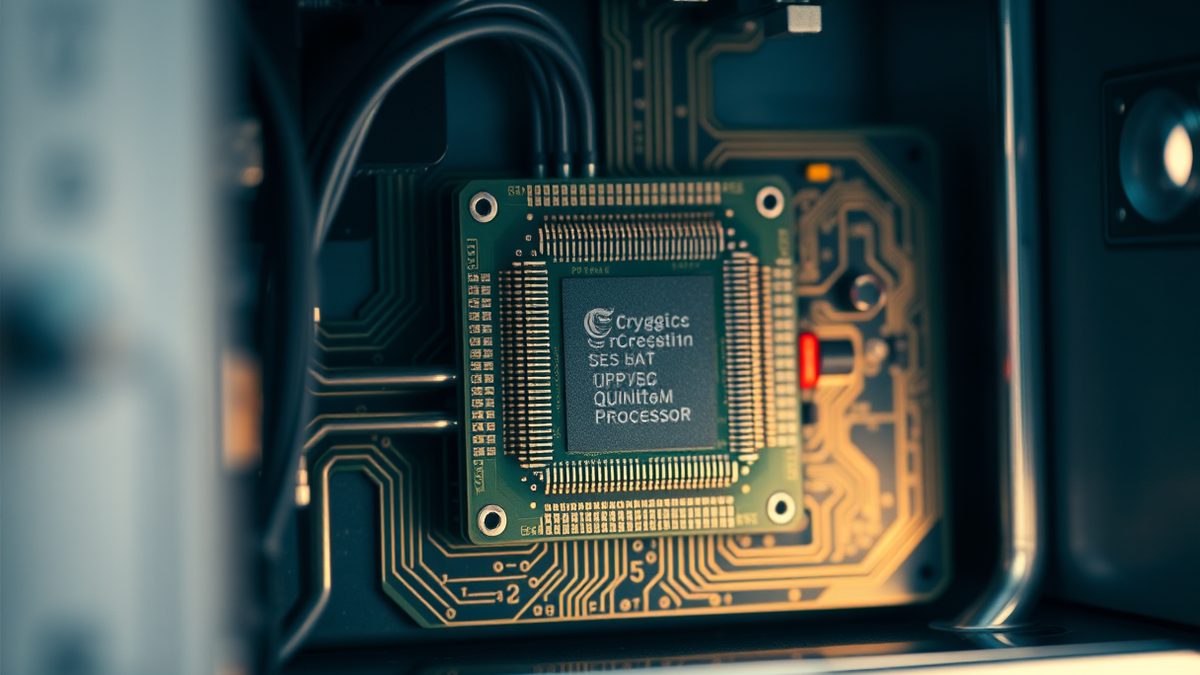
On 29 September, ScienceAlert reported that IBM's Nighthawk r2 quantum processor had generated one million samples in 19 seconds. The paper's authors estimate a classical supercomputer would need around 110 years for the same task.
The result, described in a preprint on arXiv, came from a commercially accessible 120-qubit superconducting chip accessed through IBM's cloud platform, not a bespoke laboratory machine. The claim matters because it is the latest round in a fight that has run since 2018, when researchers at UC Berkeley first argued that random circuit sampling (RCS) was a strong candidate for showing quantum advantage. Google's 53-qubit Sycamore processor made headlines in 2019 by performing an RCS experiment that classical machines could not practically match. Classical researchers then found shortcuts, and quantum teams pushed further. That back-and-forth has defined the field for years. Each demonstration drew a classical rebuttal, and each rebuttal drew a harder quantum test.
What the 29 September result actually shows
According to ScienceAlert, the team led by theoretical condensed matter physicist Tigran Sedrakyan of BlueQubit selected 61 of Nighthawk r2's 120 qubits. They ran random circuits of increasing complexity, up to 40 cycles. They found what the report calls a Goldilocks zone at 36 cycles, involving 918 two-qubit gates. At that setting, the processor produced the million samples in 19 seconds using the platform's standard cloud workflow, with no special calibration.
The paper's own wording is careful. "To our knowledge," the researchers write, "this is the first demonstration of quantum advantage for a vanilla random-circuit sampling on a commercially and broadly accessible quantum processor that most non-expert quantum computer users can easily replicate." That last clause is doing real work. Previous demonstrations often relied on tuned hardware; this one used the same interface any cloud customer would see.
"This is the first demonstration of quantum advantage for a vanilla random-circuit sampling on a commercially and broadly accessible quantum processor."
The 110-year figure is an estimate, not a measurement. No one can actually book time on Frontier, the world's first exascale supercomputer and the fastest until 2024, so the team used tensor-network contraction to estimate the classical cost of reproducing the samples. That calculation put the job at around 1.2 x 10^27 operations, which translates to roughly 110 years on a conservative estimate of Frontier's sustained performance. ScienceAlert notes two caveats. The 110 years is not a fundamental limit for classical hardware, but an estimate tied to one method of reproducing the experiment. And classical computing researchers have a strong record of finding algorithmic shortcuts. The preprint's authors acknowledge that possibility directly; their claim is about what was demonstrated on 29 September, not about a permanent barrier.
Entanglement measurement and the long game
The same week brought a second result that is less flashy but arguably more structural. ScienceDaily reported on 29 September that researchers at Kyoto University and Hiroshima University had developed and experimentally demonstrated a method for identifying W states, a form of multi-photon entanglement that had resisted an efficient one-shot measurement for more than two decades.
The problem is data volume. Standard quantum tomography reconstructs a state from many measurements, and the amount of data needed rises exponentially with photon count. An entangled measurement can identify a state in one shot instead. That had already been done for the Greenberger-Horne-Zeilinger state, but not for W states. The Kyoto and Hiroshima team used a property called cyclic shift symmetry to build a photonic quantum circuit that performs a quantum Fourier transformation, then tested it with three photons.
"More than 25 years after the initial proposal concerning the entangled measurement for GHZ states, we have finally obtained the entangled measurement for the W state as well, with genuine experimental demonstration for 3-photon W states," corresponding author Shigeki Takeuchi said in the ScienceDaily account. The work could feed into quantum teleportation, communication protocols, and measurement-based quantum computing.
Security teams are already preparing for the quantum threat
If the hardware results show progress, the security side shows urgency. Cloudflare published a post on 29 September describing work with the IETF on a downgrade protection mechanism for IPsec, now in beta across its IPsec products. The problem is that a network attacker can strip post-quantum authentication from a handshake, forcing endpoints back to classical cryptography that a future quantum computer could break. Cloudflare says it rediscovered a design flaw in IPsec that allows a more sophisticated attack than the standard downgrade, one that works regardless of the authentication method used. The attack requires a quantum computation to run in real time during the protocol handshake, so it is not a harvest-now-decrypt-later job. Cloudflare states it does not yet know if or when the attack will be feasible, but says falling resource estimates for quantum attacks on public key cryptography led it to move its transition deadline up to 2029.
The mitigation needs both parties to support the extension. Cloudflare has enabled it in beta for Cloudflare WAN and Magic Transit, and customers can request the ipsec_downgrade_protection flag from their account managers. The company says it hopes the wider IPsec ecosystem follows.
Compute is moving off the planet, and energy is the constraint
Two other developments from the past week point in different directions. On 29 September, China-in-Space reported that STAR.VISION Aerospace unveiled its Space.IDC Computing Constellation at the Global Digital Trade Expo on 25 September, with plans for around 1,080 spacecraft by 2035, split between roughly 720 inference units and 360 general compute units. The company cited credit agreements worth 10 billion Yuan (1.49 billion US dollars as of 28 September) with the Industrial and Commercial Bank of China and the Agricultural Bank of China, with at least 1 billion Yuan available for a first phase. Orbits, inter-satellite links, radiator sizes, and mass were not disclosed, and regulatory filings have not yet been made.
On the same day, Efficient Computer announced a 97 million dollar Series B round led by TQ Ventures, taking its total raise to 173 million dollars at a 650 million dollar valuation. In a company blog post, CEO Brandon Lucia argued that fixed-function AI accelerators are a bad trade because the unaccelerated portion of a workload sets the ceiling on system efficiency, citing Amdahl's Law. Efficient claims 10 to 100 times better energy efficiency than traditional CPU architectures for its Electron E1 chip, which it says is launching at volume.
Taken together, the week's news does not describe a single breakthrough. It describes a field working on several fronts at once: proving advantage on accessible hardware, learning to measure entangled states efficiently, hardening the internet against a threat that has not arrived yet, and arguing about where the power for all of it will come from. The 19-second result is the headline, but it is an estimate about a classical machine that was never actually asked to try.
Sources
5- 01IBM's Quantum Computer Completes in 19 Seconds What Could Take a Supercomputer a CenturyEN
- 02Quantum teleportation breakthrough: Scientists crack a 25-year entanglement challengeEN
- 03STAR.VISION Unveils 'Space.IDC' Computing Constellation With PartnersEN
- 04Solving computing's energy problem with Efficient Computer's $97M Series BEN
- 05Preventing quantum downgrade attacks against IPsecEN
All figures and quotations in this text come from the sources listed below.
Content prepared by the editorial team with AI assistance.
Rachel Nwosu
Comments
0- No comments yet — be the first.