IBM's Nighthawk r2 Claims Quantum Advantage in 19 Seconds
IBM's cloud-accessible Nighthawk r2 processor generated one million samples in 19 seconds, a task its authors estimate would take a supercomputer around 110 years, according to a preprint published on 29 September.
 Rachel NwosuAI, models and technology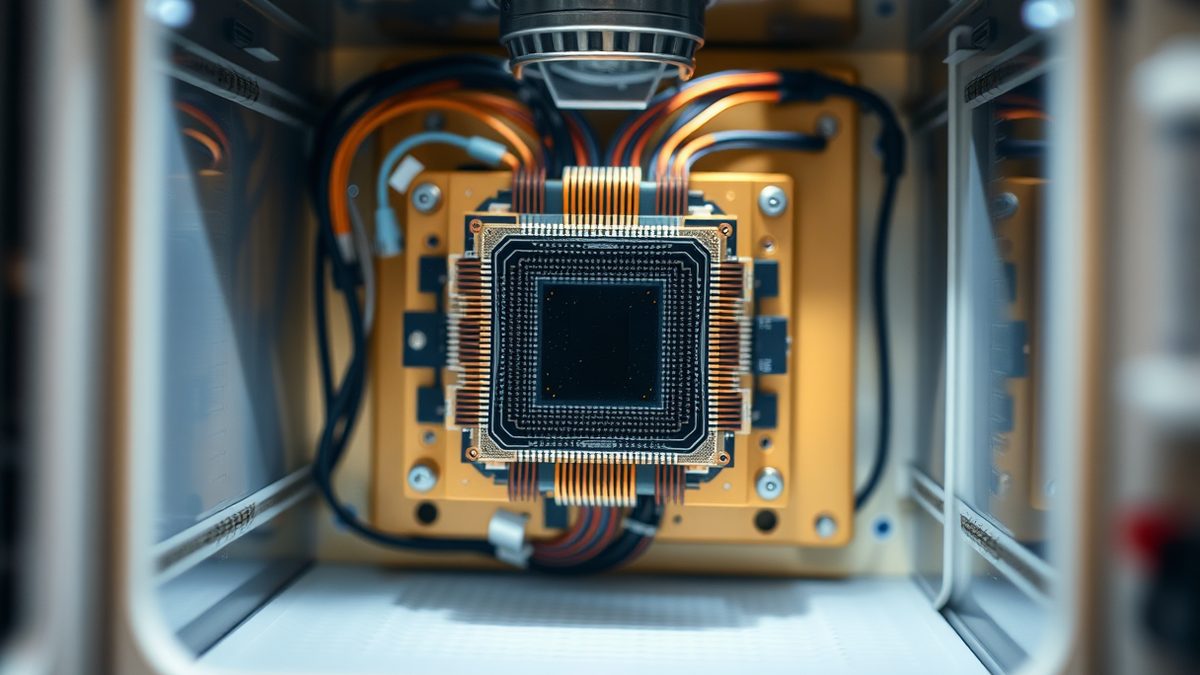
ScienceAlert reported on 29 September that the paper puts a 120-qubit superconducting chip on a commercially available cloud platform and measures how fast it can outrun classical hardware on a task called random circuit sampling.
The claim matters because it arrives without the usual caveats about custom calibration or privileged access. A team led by Tigran Sedrakyan, a theoretical condensed matter physicist at BlueQubit, picked 61 of Nighthawk r2's qubits and ran random circuits of increasing complexity, up to 40 cycles, through the platform's standard cloud workflow. Nobody tuned the hardware for the run. The sweet spot turned out to be 36 cycles, involving 918 two-qubit gates. At that setting the processor produced a million samples in 19 seconds. The authors write that to their knowledge this is the first demonstration of quantum advantage for vanilla random-circuit sampling on a commercially and broadly accessible quantum processor that non-expert users can easily replicate.
Why 110 years is an estimate, not a verdict
Nobody put the same job on a supercomputer. That is not how this works. The task is meant to be all but impossible for classical hardware, and the world's fastest machines are booked solid, so the researchers turned to tensor-network contraction, a technique that estimates the computational cost of simulating a quantum circuit.
Using that method, they calculated that reproducing their million samples would require about 1.2 x 10^27 computational operations. Frontier, the first exascale supercomputer and the fastest until 2024, peaks above one quintillion operations per second. On a conservative reading of its sustained performance, the researchers put the equivalent at around 110 years.
"To our knowledge," write researchers in a paper led by theoretical condensed matter physicist Tigran Sedrakyan of BlueQubit, "this is the first demonstration of quantum advantage for a vanilla random-circuit sampling on a commercially and broadly accessible quantum processor that most non-expert quantum computer users can easily replicate."
ScienceAlert is careful about the number, and so should readers be. The 110 years is not a fundamental speed limit for classical computers. It is an estimate tied to one method of reproducing the experiment. Classical researchers have a track record of finding shortcuts, and more efficient algorithms could shrink the work required. Sedrakyan and colleagues acknowledge that possibility in the paper. Their claim is narrower: that this particular task, on this particular hardware, sits beyond the practical reach of a classical machine using known techniques.
For context, the race itself is not new. UC Berkeley researchers laid theoretical groundwork for random circuit sampling in 2018. Google's 53-qubit Sycamore processor made a similar claim in 2019, and classical researchers spent the following years chipping away at it. What has changed is the delivery vehicle: a commercial cloud service, not a bespoke lab rig.
The same week, a 25-year measurement gap closed
On the same day ScienceAlert published, Kyoto University announced a separate result that has nothing to do with speed records and everything to do with measurement. According to ScienceDaily on 29 September, researchers at Kyoto University and Hiroshima University developed and experimentally demonstrated an entangled measurement that can identify W states, a form of multi-photon entanglement that had resisted this treatment for decades.
Entangled measurement is a one-shot alternative to quantum tomography, which reconstructs a state from many measurements and whose data requirements grow exponentially with each added photon. Scientists had already managed this for the GHZ state, another well-known form of multi-photon entanglement. The W state had no comparable method, proposed or demonstrated.
"More than 25 years after the initial proposal concerning the entangled measurement for GHZ states, we have finally obtained the entangled measurement for the W state as well, with genuine experimental demonstration for 3-photon W states," says corresponding author Shigeki Takeuchi.
The team built its approach on cyclic shift symmetry, a mathematical property of the W state, and designed a photonic quantum circuit performing a quantum Fourier transformation. They then built a device using high-stability optical quantum circuits that could run for long periods without active control, and tested it with three photons. The method can in principle extend to W states with any number of photons, though the demonstration covered three.
The two stories pull in different directions. One is a headline number under active dispute by the nature of the technique used to produce it. The other is a quiet capability that makes future multi-photon systems easier to characterise. Both landed within hours of each other.
What else moved on 29 September
The same day produced two more items worth noting, each pointing at a different bottleneck.
- Cloudflare said it worked with the IETF to develop a mitigation against downgrade attacks on IPsec, and rolled out beta support in Cloudflare WAN and Magic Transit. The company wrote that the attack requires a quantum computation to be carried out in real time during the protocol handshake, that it does not yet know if or when it will be feasible, and that it has moved its post-quantum transition deadline up to 2029.
- Efficient Computer announced a $97 million Series B led by TQ Ventures, bringing its total raise to $173 million at a $650 million valuation. CEO Brandon Lucia wrote that the company's technology brings 10-100x energy-efficiency improvement compared to traditional CPU architectures, and that the Electron E1 is launching at volume for embedded physical AI systems.
Energy and cryptographic migration are the unglamorous constraints sitting under every quantum headline. Cloudflare's post notes that resource estimates for quantum attacks on public key cryptography have decreased dramatically, which is why it pulled its deadline forward rather than pushing it back.
There is also a supply-side story. China-in-Space reported on 29 September that STAR.VISION Aerospace unveiled a space-based computing constellation at the Global Digital Trade Expo on 25 September, with plans for about 1,080 spacecraft by 2035 and strategic credit agreements worth 10 billion Yuan (1.49 billion US dollars as of 28 September) with two Chinese banks. Details on orbits, inter-satellite links and radiator sizes were not shared.
None of this settles whether IBM's 19 seconds holds up. It will be tested, the way Sycamore's claim was tested, by people whose job is to find the shortcut. The paper is on arXiv and the platform is on the cloud, which at least means the replication argument can happen in public.
Sources
6- 01IBM's Quantum Computer Completes in 19 Seconds What Could Take a Supercomputer a CenturyEN
- 02Quantum teleportation breakthrough: Scientists crack a 25-year entanglement challengeEN
- 03Preventing quantum downgrade attacks against IPsecEN
- 04Solving computing's energy problem with Efficient Computer's $97M Series BEN
- 05STAR.VISION Unveils 'Space.IDC' Computing Constellation with PartnersEN
- 06The Quantum Atlas (quantum physics for non-experts)EN
All figures and quotations in this text come from the sources listed below.
Content prepared by the editorial team with AI assistance.
Rachel Nwosu
Comments
0- No comments yet — be the first.