IBM links two 120-qubit chips with four 80cm cables at about 99% fidelity
IBM said on 27 October 2026 that it linked two 120-qubit Nighthawk chips with four 80cm aluminium cables and sent quantum information between them at about 99% average fidelity, a step toward scaling by connecting chips.
 Rachel NwosuAI, models and technology
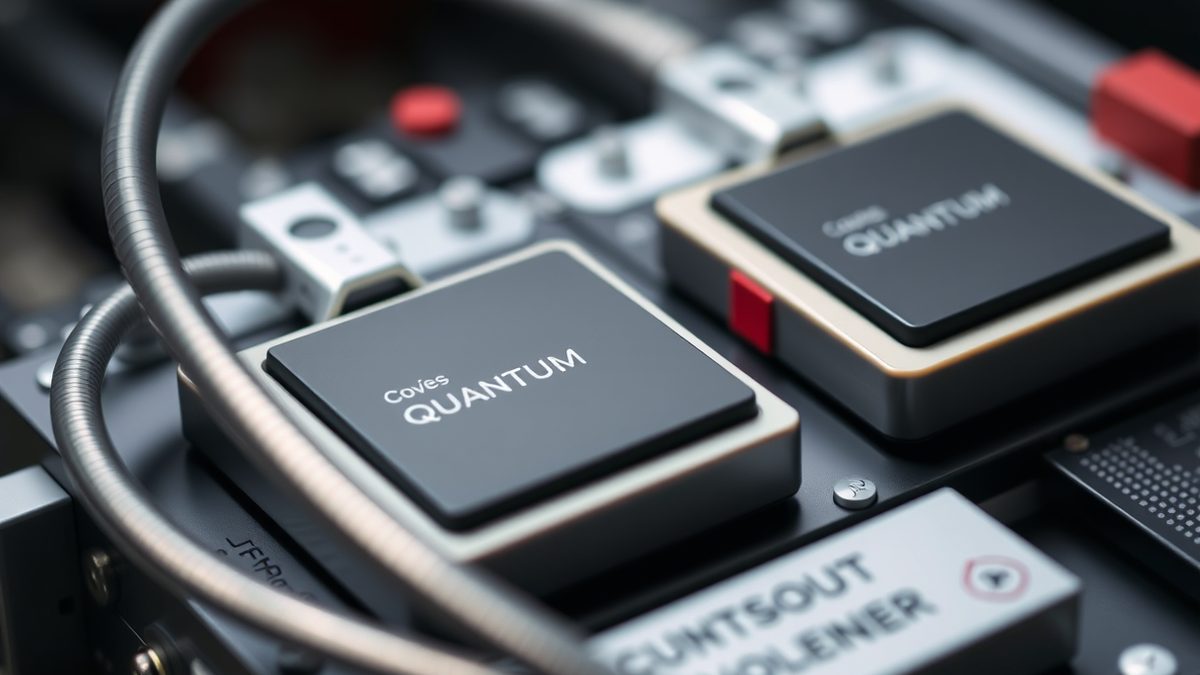
IBM said in a blog post dated 27 October 2026 that it linked two 120-qubit Nighthawk chips with four 80cm aluminium cables inside one fridge and sent quantum information from one chip to the other. The average fidelity was about 99%, and the best cable pair reached 99.3%. The cables have small components at each end to send and receive information, and they can be attached after the chips are mounted.
The same experiment tested a two-qubit gate spanning the two chips. It succeeded 94.75% of the time, averaged across four cables. IBM also entangled qubits across the chips using two cables at once. Quantinuum says its Helios, a single trapped-ion device, reaches 99.921% for a two-qubit gate inside one device, not across chips. That is a higher number, but it measures a different thing: a gate within one chip rather than a link between two.
A lower cross-chip gate score
IBM has tried this before. Its November 2024 Flamingo prototype reported 96.5% for a cross-chip operation, but that number came from test hardware rather than two real chips. The new 94.75% is lower and comes from two actual Nighthawk processors wired inside the fridge. IBM connected only part of the 240 qubits across the two chips for the experiment. Getting all 240 wired remains open work. Keeping quality uniform across many chips also remains open. IBM says every one of these numbers has room to improve.
Why IBM is linking chips
The link is part of IBM's plan to scale by connecting chips rather than building one giant chip. IBM built a 1,121-qubit Condor chip in 2023, but the company says packing more qubits onto one chip makes manufacturing and wiring harder. IBM thinks multiple chips must cooperate for billions of operations.
Roadmap to Starling
Its 2029 Starling system is meant to run 100 million gates on 200 error-corrected logical qubits in a single computation. A logical qubit is built from many physical qubits. IBM's shift to quantum LDPC codes cuts physical qubit overhead by up to 90%, but Starling is still expected to use roughly 10,000 physical qubits for its 200 logical qubits, GCN reported.
IBM's roadmap lists a 2026 target for a quantum-advantage demonstration and at least 1,000 programmable qubits by 2027 using L-couplers. A note.com explainer on the experiment described a 2028 step of up to 1,080 qubits, nine 120-qubit chips' worth, before Starling in 2029.
What happens next
IBM will install Nighthawk processors into new cryogenic modules later this year for performance testing, it said in August. By the time Starling is delivered, IBM expects each module to house thousands of qubits. IBM also says its roadmap targets may change or be withdrawn.
IBM said on 19 August 2026 that it had joined and cooled two cryogenic modules into one environment. Each module's vacuum enclosure offers up to 12 times more wiring space than its most widely used quantum systems, the company said. Jay Gambetta, director of IBM Research and IBM Fellow, said: "Bringing fault-tolerant quantum computers to industries depends on several fundamental advances. The successful connection and operation of these cryogenic modules signals a leap forward in that direction and will accelerate our progress alongside continued innovation in quantum hardware, software, and algorithms."
Sources
20- 01[News Commentary] IBM connected quantum chips with cables. What is so impressive about this?JA
- 02A quantum computer sold on impressive qubit counts just had its real-world price tag exposed by a 2029 roadmapEN
- 03IBM Connects Its First Modular Cryogenic Systems in Milestone Toward Fault-Tolerant Quantum ComputingEN
- 04IBM Connects Its First Modular Cryogenic Systems in Milestone Toward Fault-Tolerant Quantum ComputingEN
- 05IBM Connects First Modular Cryogenic Systems in Quantum Computing PushEN
- 06IBM links cryogenic modules to scale quantum computers toward 2029EN
- 07Utility To Fault-Tolerant Systems, IBM Unveils Quantum Roadmap At Supercomputing India 2025EN
- 08Quantum Roadmaps Are Finally Meeting RealityEN
- 09IBM stock steadies as quantum cryogenic milestone reinforces long-term AI and cloud roadmapEN
- 10What Makes a Quantum Company Valuable?EN
- 11Matched but Not Better: An Equivalence-Tested Benchmark of Quantum Machine Learning on Six Clinical Datasets and the QML-Health-READY Reporting FrameworkEN
- 12Brazil publishes first global 'roadmap' for phasing out fossil fuelsEN
- 13Qualcomm Dragonwing Nabs a Big SpaceX Starlink Mobile Nationwide US 5G Network WinEN
- 14Universal Quantum Launches iQPU Integrated Trapped-Ion ProcessorEN
- 15IonQ Partners with QuantumCT to Expand Quantum Computing AccessEN
- 16STMicroelectronics Expands STM32 Roadmap for Cloud AI and Physical AIEN
- 17D-Wave Updates Stride Solver and Launches Quantum Optimization CoursesEN
- 18 Happy Halloween! SpaceX launches 27 Starlink satellites to orbit from California (video) EN
- 19Lumen redefining networking for AI and quantum eras with three new initiativesEN
- 20Starting Over – Twenty AgainEN
All figures and quotations in this text come from the sources listed below.
Content prepared by the editorial team with AI assistance.
Rachel Nwosu
Comments
0- No comments yet — be the first.