Innodata opens motion-capture lab as robot data race heats up
Innodata said on 30 September that it has opened a motion-capture laboratory in New Jersey to generate training data for humanoid and industrial robots, betting that direct 3D capture beats inferring motion from 2D video.
 Rachel NwosuAI, models and technology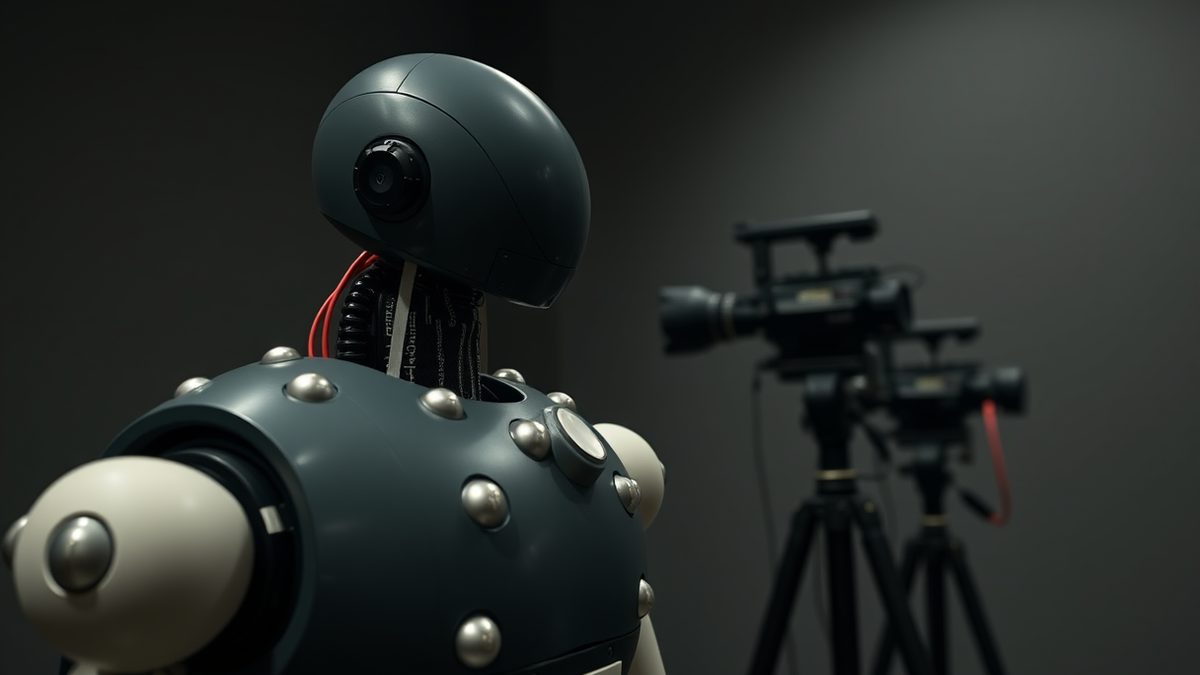
The lab, announced by the Ridgefield Park, N.J., data engineering company on Wednesday, is equipped with infrared optical tracking cameras from Vicon that Innodata says measure movement down to the sub-millimeter level. The company frames the facility as a response to a bottleneck it says every robotics team hits: not enough real-world interaction data, and what exists is expensive and slow to produce.
"Physical AI is growing faster than any other segment in AI, but every robotics team hits the same wall," Rahul Singhal, Innodata's CEO, said in a statement carried by The Robot Report. "This facility removes that wall."
The announcement lands in a week thick with robotics data news. On the same day, TechCrunch reported that Destro AI, a logistics robotics startup, came out of stealth with an $8 million seed round built around an intelligence layer that also tells human workers what to do. Also on 30 September, MindOn published details of Mind-1, a physical AI model it says cuts robot inference latency from 82ms to 32ms. And Fig Inc. released a technical report showing frontier models including Astra and Opus 5.5 perform unevenly across robotics and web tasks.
Why direct capture
Innodata's argument is technical. Most data providers, the company says, infer 3D motion by analyzing 2D video. Innodata captures 3D data directly from bodies, whether human or mechanical.
"There's just no substitute for direct 3D motion capture," Franklin Tanner, Innodata's vice president of robotics and physical AI, told The Robot Report. "When a computer vision model tries to make sense of a 2D grid of pixels, mistakes inevitably creep in."
Tanner gave the example of a robot picking up a mug. Most people grab the handle, but the base works too. If the mug holds hot liquid, the difference matters. "The context matters, and that's not always encoded in even the data sets that are out there right now," he said.
Innodata says the lab will capture data across humanoids, teleoperated hardware, wearable systems, sensor rigs, Universal Manipulator Interface grippers and other multimodal setups. The data can then feed digital twins to generate edge cases. The company also says the facility will independently validate performance data that robots generate internally, a service it pitches as end-to-end: collection through model evaluation.
The scale problem is real. Tanner noted that a humanoid weighing almost 200 lb needs readings that are precise, not "in the ballpark." He also flagged a gap: "We don't have training data right now where humans and robots are interacting. It's one area we're working on in the lab."
The competition is building data layers too
Destro AI, which emerged from stealth on Tuesday, takes a different angle. Rather than building robots, it built an intelligence layer that coordinates robots and humans in logistics settings. Its founder, Manthan Pawar, told TechCrunch that the company is winning against robotics companies "because we are not a robotics company."
Destro started with a pilot at one Yusen Logistics facility in the Pacific Northwest, using three cart-moving robots built by Miva Robotics and operated by Destro's Vision operating system, which is based on open-weight vision-language-action models. Human workers unload goods from one truck into carts; the robots find the full loads and move them. Richard Brunelle, Yusen's director of automation for the American logistics group, told TechCrunch that two other big-name robot startups could not fit the workflow. One offered point-to-point cart movement but no loading or unloading. The other required a person to handle orchestration.
Destro is now expanding that pilot to 26 robots and launching another with 17 robots at a Yusen facility in Southern California. Base10 Partners and Bonfire Ventures led the seed round, with CoFound Partners participating.
MindOn's Mind-1 attacks a related constraint: speed. In a blog post published on 30 September, the company said its model enables robots to reach human-level cycle times on some tasks and even complete work faster than humans. It identifies four obstacles to high-speed manipulation: training data captured by teleoperation is slower than natural human motion; inference latency compounds at speed; consecutive inference steps can produce inconsistent trajectory intents; and control and sensor synchronization demands rise.
"At an end-effector speed of 3 m/s, just 10 ms of latency corresponds to approximately 3 cm of movement," the company wrote, enough to affect precise grasping or insertion. MindOn says Mind-1 is trained on human-centric manipulation data captured directly from people performing tasks at natural speed, and that it cut inference latency from 82ms to 32ms.
Benchmarks hide the jaggedness
Fig Inc., a research group, published a technical report on 30 September arguing that headline benchmark scores obscure how unevenly frontier models perform. The team evaluated seven models on VisualWebArena, a closed-loop web task benchmark with 177 tasks, and three models across four offline physical domains: VLABench, Assembly101, IndEgo and Bench2Drive.
Their finding: for every model pair, the weaker model solves at least one task the stronger one misses. A model update can leave the average almost unchanged while many individual tasks flip. The same jaggedness shows up in physical domains. Models that beat Gemini 3.5-Flash on every domain average still do worse on some task categories. The authors released RIDGE, a dataset of item-level results and model traces.
That matters for anyone buying robot data or models. A single benchmark number tells a deployment team little about whether a model will work on their specific task mix.
The data business meets the hype cycle
Innodata's lab opening is a bet that data, not hardware, is the binding constraint. The company was founded in 1988 and describes itself as providing data, evaluation frameworks and human expertise for AI systems. Its robotics push follows a broader pattern: as humanoid and logistics robot companies raise large rounds, the vendors selling them training data, simulation and evaluation tools are positioning themselves as picks-and-shovels plays.
Whether that market grows as fast as the robot makers hope is untested. Tanner pointed to simulation as one lever. "Simulators are getting pretty good with taking real-world data, doing the real-to-sim translation, and then permuting the environment," he said, naming Nvidia's Cosmos environment as "actually becoming really good at that." But he added that real-world data remains the gold standard, and it is expensive.
There is also a talent and attention question. Rongzhong Li, the maker behind OpenCat, Nybble and Bittle, wrote on Hackster.io on 30 September that his company has shipped more than 30,000 quadrupeds since 2018. His concern is not data volume but product delivery. "People have started complaining that robots only dance or run fast and aren't doing their jobs," he wrote. He argued that high degree-of-freedom robots create emotional connection but also raise the bar for the next maker, lowering the odds that anything ships as a reliable product.
His proposed signal for commercial robots is quieter: compare the second-hand price of an impressive robot with its bill-of-materials cost a few months after delivery. Neither number captures full value, but the relationship between them, he wrote, can reveal how much practical value the market still sees after the novelty wears off. Quaddle, his third product, is on Kickstarter from $99.
For Innodata, the immediate test is whether robot makers will pay for externally captured and validated motion data rather than building capture in-house. The company says its sensors register the tiniest motion of every joint, which makes training more accurate and efficient. Tanner's mug example is the pitch in miniature: a robot that grabs the base instead of the handle may complete the task, but it may also burn the hand holding the cup. Encoding that kind of context is what the lab is selling.
Arrowfly, the parent company of The Robot Report, also used 30 September to launch AI for Engineers, a platform with a news desk, an annual conference scheduled for 20 to 22 September 2027 in Henderson, Nev., original research and an advisory board. Arrowfly says its engineering brands reach 2.1 million verified industry readers. The launch is another sign that the AI-for-robotics information market is expanding alongside the hardware.
The week's announcements share a premise: robots are improving fast enough that the constraint has moved to data, orchestration and speed. Innodata is betting on capture. Destro is betting on coordination. MindOn is betting on latency. Fig is betting that buyers should look past the average. None of them has published independent verification of its claims, and the robot deployments that would prove the market are still counted in dozens of units, not thousands.
Sources
6- 01Innodata opens motion-capture lab to help humanoids move more like peopleEN
- 02Destro AI's secret sauce is getting robots and humans on the same pageEN
- 03Mind-1: Cutting robot inference latency from 82ms to 32msEN
- 04Astra, Opus 5.5, and other Frontier Models Demonstrate Jagged Performance Across SoTA Agentic Tasks from Web Browsing to RoboticsEN
- 05What 30,000 robot dogs taught me about degrees of freedom and shipping a real robot productEN
- 06The Robot Report parent Arrowfly launches AI for Engineers platform, events for engineers navigating AIEN
All figures and quotations in this text come from the sources listed below.
Content prepared by the editorial team with AI assistance.
Rachel Nwosu
Comments
0- No comments yet — be the first.