Trapped-ion quantum computer goes live in Jülich
Forschungszentrum Jülich has switched on JION, a gate-based quantum computer that holds ytterbium ions in electromagnetic traps. A few qubits work today; ten should be ready by mid-2027.
 Sofia MarchettiScience and health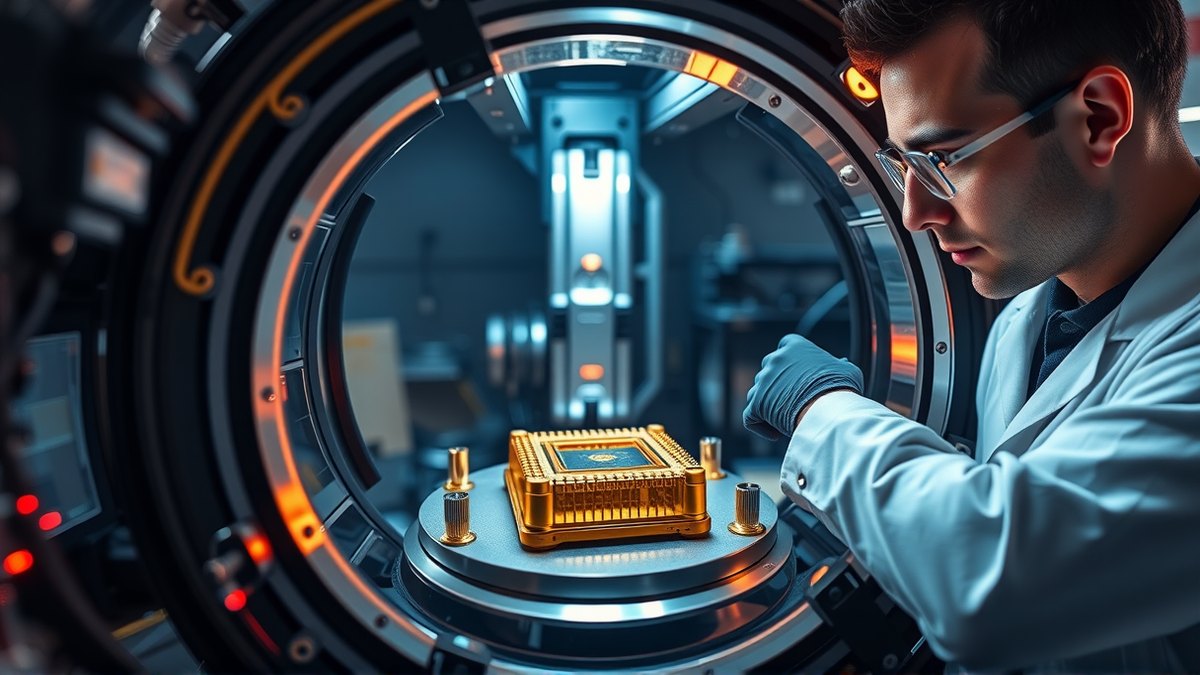
Forschungszentrum Jülich has officially launched the JION quantum computer, short for "Jülich trapped-ION quantum computer". It is a digital, gate-based machine built on trapped-ion technology. Hendrik Wüst, premier of North Rhine-Westphalia, called the launch a technical milestone.
How ion traps work
Several approaches compete in quantum computing, and ion traps are one of them. The information carriers are electrically charged atoms held inside electromagnetic traps. JION's qubits are ionized ytterbium atoms, kept in a vacuum by electromagnetic fields and controlled in a way that allows them to compute. The approach differs from superconducting digital systems in scale and operating conditions.
Where it stands and what comes next
The installation is ready to run, but it is also still being expanded. Only a few qubits are available at the start, and ten are planned by mid-2027. The supplier is Eleqtron of Siegen, founded in 2020 as a spin-off of the University of Siegen. In 2024 the company and its partners built the QSea demonstrator for the German Aerospace Center in Hamburg.
To control the JION qubits, the system uses a technique developed in Siegen called MAGIC, short for magnetic gradient-induced coupling. Microwaves and deliberately created differences in the magnetic field steer individual qubits and couple them directly. The method is meant to be used in larger, more powerful quantum systems in the future.
JION was built within the North Rhine-Westphalia development partnership for ion traps (EPIQ). It is to serve industrial and scientific applications: optimization tasks in logistics, transport and process engineering, as well as in physics, chemistry, biology, medicine, materials research and machine learning. The system will be connected to the JUNIQ user infrastructure, which bundles access to various quantum systems and links them to the centre's supercomputers. Selected computing operations can then be delegated from classical supercomputers to quantum systems.
Money and the next step
Alongside the launch, Wüst handed Eleqtron the funding decision for the SQALING project, short for scalable quantum computing from North Rhine-Westphalia. The start-up's standalone development project is to receive up to around 25 million euro from the state, drawn from European Union funds under the EFRE/JTF programme. The goal is to move trapped-ion technology onto scalable, chip-based quantum computing platforms. A further 35 million euro will go to the new Q-STAR.NRW project, whose task is to buy and integrate a scalable semiconductor quantum computer at JUNIQ. The planned system is to have up to 200 qubits.
Sources
2- 01heise online: „Meilenstein der Technik” — Neuer Quantencomputer mit Ionenfallen in JülichDE
- 02heise online (EN): New trapped-ion quantum computer in JülichEN
All figures and quotations in this text come from the sources listed below.
Content prepared by the editorial team with AI assistance.
Sofia Marchetti
Comments
0- No comments yet — be the first.