Maven Robotics says wheeled robots run 16 hours a day as automation funding accelerates
Maven Robotics says its mobile manipulators are now running 16 hours a day, five days a week, with up to 99% uptime, after raising $100 million since its 2024 founding and closing a Series A round last month. The Santa Clara company's account, published by The Robot Report on 1 October, lands in the same week as a €11 million European round for robot vision firm Inbolt and a forecast that physical AI will define 2027.
 Helen MarshCulture, food and lifestyle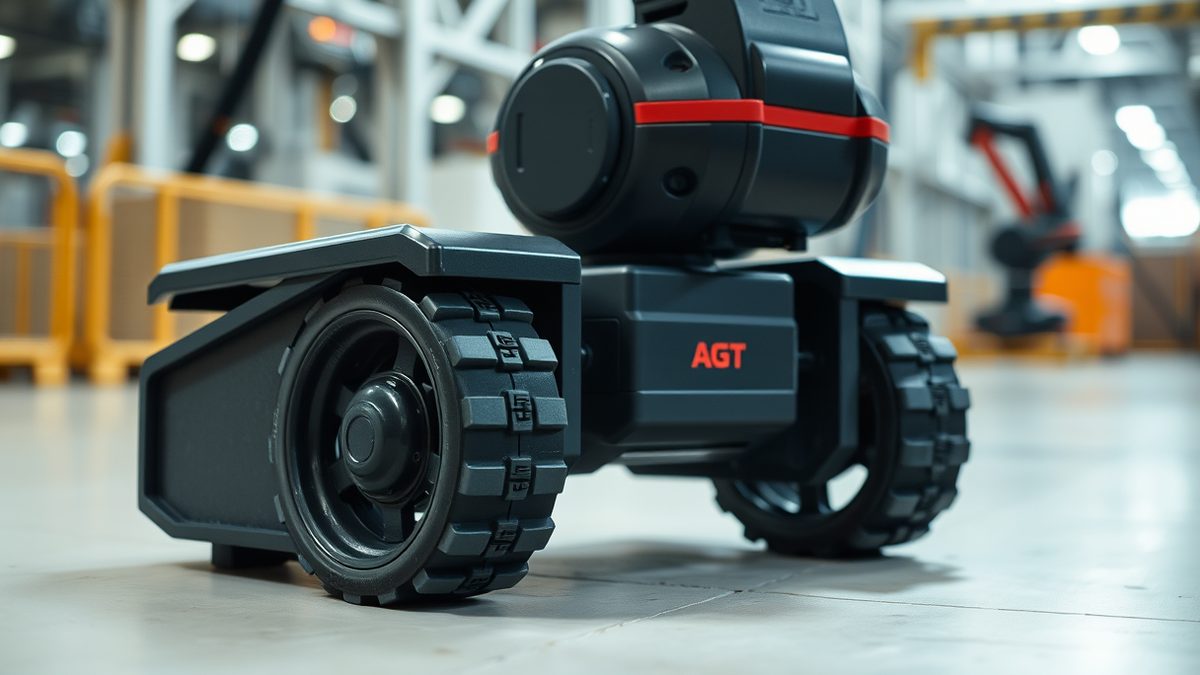
The Robot Report published the Maven Robotics interview on 1 October, the newest dated item in this dossier. Co-founder and CEO Hamza Derbas told the outlet that the company's robots are running 16 hours a day, five days a week, with up to 99% uptime. He also said Maven has shipped four iterations of its mobile manipulator since 2024, while raising $100 million and moving from early pilots to a production contract with its first customer.
Those production numbers are the company's own. There is no independent verification of the uptime figure in the dossier. The financials are also the company's account: Maven raised Series A funding last month but did not disclose the amount or the investors.
Wheels, reach and payload
Derbas frames the company's design choice as a direct argument against the humanoid form factor that dominates robotics coverage. "The humanoid robotics companies, the ones with legs, were starting with the human form factor and trying to work backwards into a problem to be solved," he told The Robot Report. Maven started from jobs instead, he said, down to "the dust, the dirt, and the grease on the factory floor." The resulting machine rolls on a small footprint that fits through doors while carrying a 30 kg (66.1 lb) payload and reaching into the back of a 48-in. (121.9 cm) pallet or 3 m (9.8 ft.) into a storage shelf.
Derbas also described a shared learning layer called the Maven Network. If a robot makes a mistake in California, he said, a robot in Japan can learn how to handle it the next day. That is a claim about infrastructure, not a measured result. No third party has tested it.
"The world needs more and more industrial output every day, but the workforce available to do this work is dwindling." Hamza Derbas, co-founder and CEO of Maven Robotics, speaking to The Robot Report.
Derbas cited more than half a million unfilled U.S. manufacturing jobs and said market analysts expect that figure to grow to millions over the next few years. The dossier does not name those analysts, so the projection should be treated as the CEO's characterisation rather than a sourced forecast.
The money follows the vision layer
The week before Maven's interview, the money moved in a different part of the same stack. Paris-based Inbolt raised €11 million on 30 September, led by new investor Shift4Good with participation from Bridges Climate Transition Partners and existing backers BNP Paribas Développement and Ora Global, according to Tech.eu. That brings Inbolt's total funding to €30 million. The company, founded in 2019 by Rudy Cohen, Albane Dersy and Louis Dumas, sells 3D vision plus a hardware-agnostic AI layer that lets industrial robots adjust their control loops in real time, and says its system is deployed on more than 200 robots in over 100 factories across three continents, with customers including Bosch, Beko, Flex, Ford, Stellantis and Toyota.
Inbolt's pitch is that robots have been running blind for fifty years, and that fixing this is a software problem rather than a hardware replacement cycle. That argument matters for Maven's addressable market too: if perception can be retrofitted onto installed equipment, the case for buying entirely new robot platforms weakens at the margin. Inbolt says it will use the round to enter data centre and electronics manufacturing and to expand internationally.
The analyst view: physical AI escapes the screen
Omdia, the research firm, put a number on the broader shift on 30 September. In its 2027 outlook, it identified "Physical AI: Intelligence Escapes the Screen" as one of four forces reshaping technology, and said global humanoid robot shipments alone are expected to exceed 700,000 units by 2030. The same document notes that 59% of organisations expect their AI budgets to increase by 10% or more in 2027, and that hardware delays are already affecting 60% of PC channel partners, a reminder that the supply chain feeding any robotics buildout is not frictionless.
Omdia's framing is not a forecast of Maven specifically. It is a market-level projection, and the 700,000-unit figure covers humanoids rather than the wheeled manipulators Maven builds, so it should not be read as a direct demand estimate for the company's product.
Where the picture gets more concrete is on the infrastructure side. NVIDIA's blog reported on 30 September that CoreWeave has brought Vera Rubin NVL72 systems into production with Spectrum-X 102.4T Ethernet networking, and that Cognition, the lab behind the Devin software engineer, is the first customer running production workloads on them. Cognition benchmarked Vera Rubin against a GB200 NVL72 baseline and saw up to a 4.8x increase in total token throughput for SWE-2 inference workloads, according to NVIDIA's write-up. CoreWeave also announced it will offer NVIDIA Vera, described as the first CPU built for AI agents, and launched CoreWeave Forge for training and evaluating models and agents.
The reason this belongs in a robotics story is that the same agentic stack is being sold into industrial operations. A panel published by InfoQ on 1 October, featuring Michael Hausenblas of Genesys, Sujana Sooreddy of Netflix and Noam Levi of Groundcover, discussed how production operations are changing as AI reshapes the deterministic behaviour of applications. Hausenblas, an AWS veteran of seven years, and Sooreddy, who works on media systems and observability at Netflix, both described teams reworking operational data into incident response rather than dashboards. That is the software side of the same argument Maven and Inbolt are making on the factory floor.
Security and skills, the parts the demos skip
Industrial deployments carry a security ledger that vendor announcements tend to leave out. Heise is running a two-day workshop on IEC 62443, the international standard for industrial IT and OT security, on 20 and 21 October, covering parts 4-1 and 4-2 on the security development lifecycle and technical requirements. The session is aimed at OT users, automation developers and security officers, and its existence reflects how much normative work now sits between a robot demo and a production line.
At the silicon level, SemiEngineering published a sponsored piece on 1 October arguing that open roots of trust such as Caliptra are only the start, and that data centre architectures mixing CPUs, accelerators, SmartNICs and DPUs make consistent trust establishment harder. Chip suppliers are increasingly expected to deliver Caliptra trademark-compliant implementations, which requires completing a conformance process against the project's integration checklist. None of that is specific to robots, but all of it applies to any fleet that talks to customer infrastructure, which is exactly what Maven says its system does.
The labour side is less settled. A paid post by Lenovo in the South China Morning Post on 30 September described "Industry 5.0" as placing human-centricity at the core of industrial progress, with AI handling repetitive or hazardous work while people focus on higher-value decisions. It cited a Singapore logistics deployment achieving up to 40 per cent faster order processing and a 30 per cent reduction in energy consumption. The piece is advertising content, and the numbers come from the advertiser, not from an independent audit.
For Maven, the practical question is whether a production contract with one customer scales into many. The dossier does not name that customer, the size of the contract, or the Series A amount. Derbas told The Robot Report that Maven's early partners opened their factory floors to the company rather than hosting lab visits, which is a plausible account of how industrial sales cycles work, but it is an account from the seller.
What the dossier does support is a pattern. On 30 September, Inbolt raised for vision. On 1 October, Maven described uptime and payload. Omdia expects the category to expand through 2030. The money and the messaging are moving together, and the independent numbers are still thin.
Sources
8- 01How Maven Robotics plans to automate industrial work, one task at a timeEN
- 02Inbolt raises €11M to bring real-time vision and intelligence to industrial robotsEN
- 03Four forces set to reshape technology in 2027 – OmdiaEN
- 04From Training to Production, NVIDIA and CoreWeave Close the Loop on Agentic AIEN
- 05Beyond Observability: Evolving Production Operations in the Age of AIEN
- 06iX-Workshop: Industrial Security nach IEC 62443 – Ein PraxisleitfadenEN
- 07Open Security Foundations Are Only The Beginning: Deploying Caliptra Hardware in ProductionEN
- 08How 'Industry 5.0' integrates human expertise with artificial intelligenceEN
All figures and quotations in this text come from the sources listed below.
Content prepared by the editorial team with AI assistance.
Helen Marsh
Comments
0- No comments yet — be the first.