Quantum computing's week: a universal gate set, a DOE roadmap and a 100x quieter qubit
On 1 October, Q/C Technologies said it will work with Sandia National Laboratories on optical chips for AI inference, the newest move in a week that also brought a universal gate set for non-Abelian anyons and a DOE quantum roadmap.
 Grace OkonkwoAI, models and technology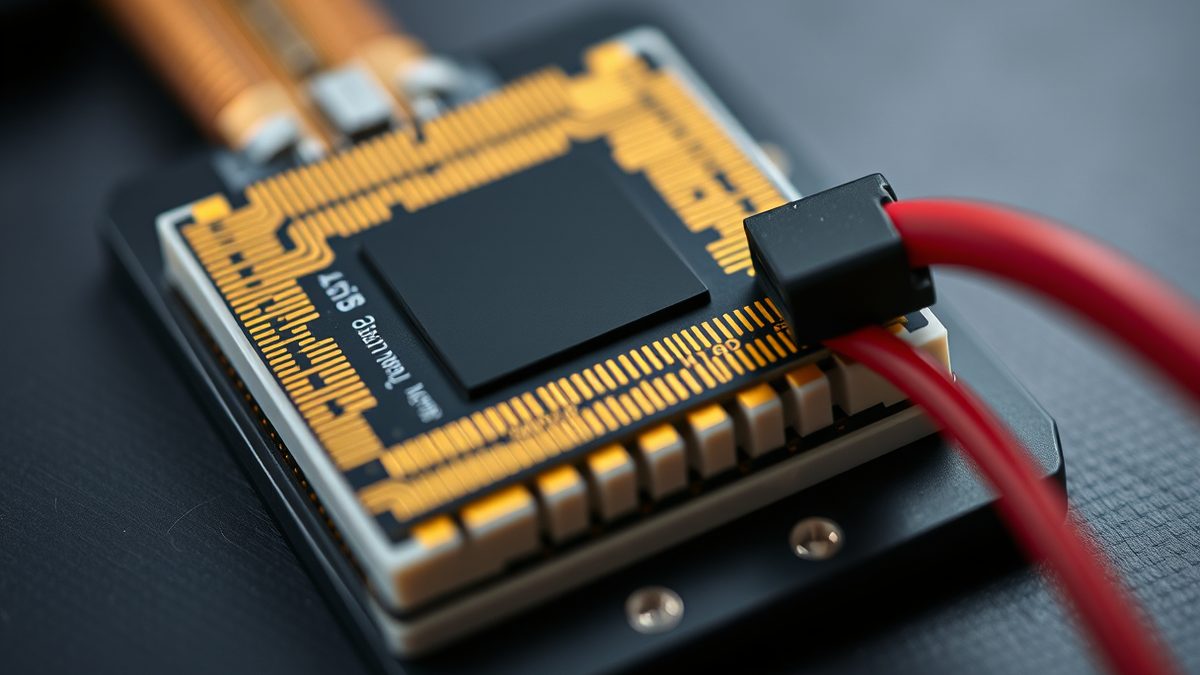
The announcement, dated 1 October and published by HPCwire, is a collaboration with the Center for Integrated Nanotechnologies at Sandia National Laboratories, operated for the US Department of Energy's National Nuclear Security Administration. Q/C Technologies is developing an optical processing unit for AI inference. The joint work will focus on nanophotonic components and the physical building blocks required for scalable optical AI processing, the company says.
Q/C says the project is meant to establish a roadmap for optical AI hardware beyond incremental GPU scaling, and to address nonlinear operations, memory, precision, optical loss and integration with electronic systems. Sandia has roughly 17,000 employees and an annual budget of about $5 billion, according to the same announcement. Joshua Silverman, Q/C's executive chairman, is quoted saying access to CINT's expertise in photonics and nanoscale technologies is an important step for the company's platform.
Non-Abelian anyons reach a universal gate set
Days earlier, on 27 September, ScienceDaily reported on a Nature paper in which researchers from the University of Chicago Pritzker School of Molecular Engineering, Harvard, Stony Brook University and Quantinuum created and tested a full set of operations based on non-Abelian anyons. The work used 54 qubits on Quantinuum's H2 processor and combined braiding and fusion, according to ScienceDaily.
The claim matters because error correction usually preserves data without providing every operation needed for universal quantum computation. Engineers often fill the gap with magic states, which require an intensive purification process known as distillation and can consume a large fraction of a machine's qubits.
"Non-Abelian codes are a dark horse in the race to quantum error correction," said Henrik Dreyer, managing director and scientific lead at Quantinuum's Munich office and a co-author of the study. "In this work we show the first universal gate set in a non-Abelian code, which demonstrates that fault-tolerant computations can in principle be done without resorting to magic state distillation or cultivation, which are the most expensive operations in standard quantum error correction codes."
Ruben Verresen, assistant professor of molecular engineering at UChicago PME and a co-author, described the result as a universal gate set, meaning that if information is stored in these emergent versions of quarks and moved around, any quantum computation can in principle be performed. The study was published in Nature, according to ScienceDaily.
Washington sets a 2028 target
On the same day, Fermilab republished a Department of Energy Office of Science article on the release of a national quantum computing roadmap, produced by the SCAC Quantum Subcommittee. The report calls for a milestone-driven path toward demonstrating a scientifically relevant, error-corrected quantum computer by 2028, and sets out a long-term vision for a dedicated Quantum Computing User Facility.
The document argues that success should be measured by scientific utility rather than hardware-centric metrics, and names drug discovery, catalysts, fusion-relevant materials and early-universe physics as target problems. Fermilab's Anna Grassellino chaired the subcommittee, with Supratik Guha of the University of Chicago's Pritzker School of Molecular Engineering as vice chair. Fermilab says the process drew input from national laboratories, academia, industry and federal agencies, and from hundreds of contributors across the US quantum ecosystem.
A proposed qubit that hides from noise
Also on 1 October, ScienceDaily covered a University of Surrey proposal for a qubit built from superfluid helium-3. The design, called the Superfluid Helium Oscillator Quantum device, would use charge-neutral superfluid helium and could be naturally protected from some electromagnetic noise, the researchers say. Their calculations suggest error rates about 100 times lower than conventional superconducting qubits.
The study appears in npj Quantum Information. Lead author Priya Sharma, a Daphne Jackson Fellow at Surrey's School of Mathematics and Physics, is quoted saying the team is not the first to think about the individual components, but has brought them together in a microfluidic device and worked out the details that could enable it to function as a qubit. She added that the next step is to build a prototype.
The proposed device is not a replacement for existing hardware. The researchers say it could be integrated with superconducting quantum technology, with different qubit types doing different jobs, and could eventually serve as quantum memory.
Two other results in the dossier underline how broad the week was. A Caltech-led team reported in Nature that it had measured energy levels predicted by the Ising and tricritical Ising conformal field theories, using laser-trapped atoms as a quantum simulator, according to ScienceDaily on 30 September. And a Duke Quantum Center-led collaboration used a 13-ion quantum simulator to reproduce string-breaking dynamics tied to particle-antiparticle formation, published on 23 September in Nature Physics, ScienceDaily reported on 26 September.
The outputs are uneven. The anyon result is an experiment on a commercial processor; the Surrey qubit is a design with a stated 100-fold error-rate estimate and no prototype; the DOE roadmap is a policy document with a 2028 milestone and no hardware attached. Taken together, they show a field advancing on several fronts at once, with the hard part, turning proposals and targets into machines that stay coherent at scale, still ahead.
Sources
13- 01Q/C Technologies Collaborates with Sandia on Optical Computing for AI InferenceEN
- 02Quantum computing's "dark horse" just proved it can go universalEN
- 03DOE releases national quantum computing roadmap following field-wide effort led by SCAC subcommitteeEN
- 04This new qubit could be 100 times less error-prone in superfluid quantum computer breakthroughEN
- 05Caltech physicists finally measure a quantum energy ladder predicted 40 years agoEN
- 06Quantum computer simulates matter "popping into existence"EN
- 07Quantum teleportation breakthrough: Scientists crack a 25-year entanglement challengeEN
- 08The Decision Value of Perception ComputeEN
- 09Biology Might Not Be Quantum, but Its Math Is QuantumlikeEN
- 10Advancing Private AI Compute with secure, server-side memoryEN
- 11Quantum Space Executes Launch Processing Agreement with All Points Logistics for Prime MissionEN
- 12AI-Defined Vehicles Push Compute, Memory, And Validation LimitsEN
- 13Edge Computing and Security for Access Control Applications: Getting the Best of the Two WorldsEN
All figures and quotations in this text come from the sources listed below.
Content prepared by the editorial team with AI assistance.
Grace Okonkwo
Comments
0- No comments yet — be the first.