Robot makers chase factory data: Innodata opens motion lab as Tesla solar feud widens
Innodata opened a motion-capture laboratory for humanoid and industrial robot training data on 30 September, the same day Tesla's planned Texas solar factory was pulled into a patent fight between two Chinese equipment makers.
 Grace OkonkwoAI, models and technology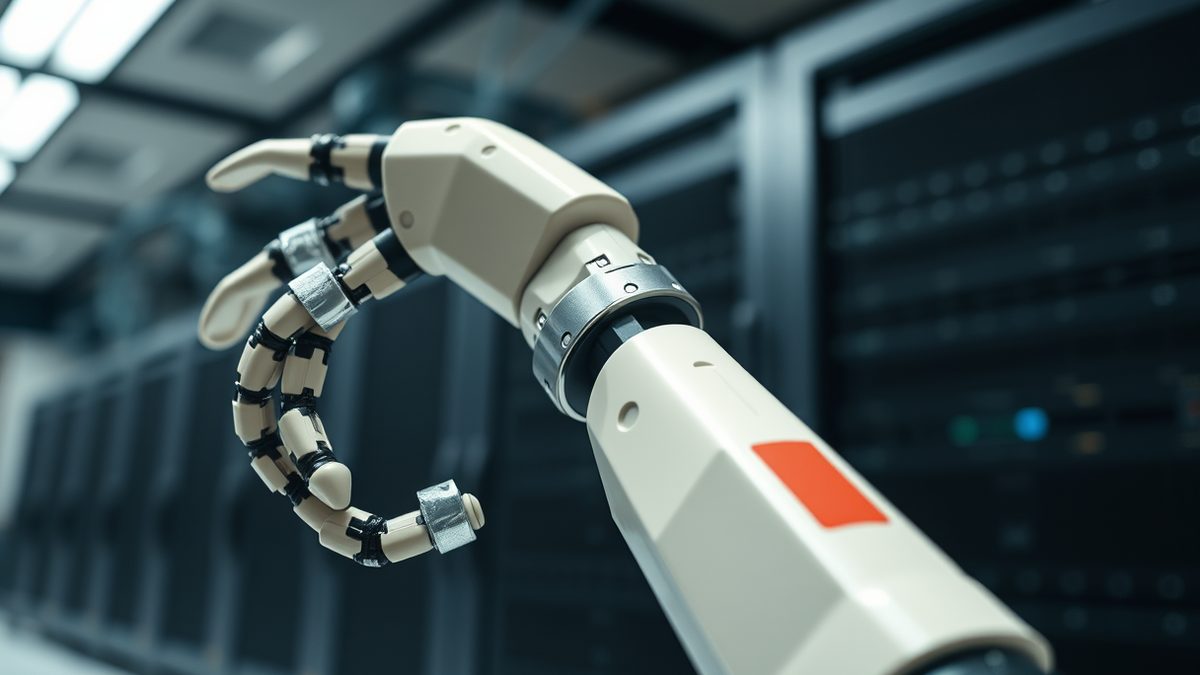
Innodata said on 30 September that it has opened a laboratory to capture 3D motion data for training humanoid robots, industrial robots and other physical AI systems. The Ridgefield Park, New Jersey, data engineering company said the facility will also validate performance data that robots generate internally, according to The Robot Report.
That is the newest development in a week that mixed data infrastructure, supply chain litigation and a growing pile of small robotics funding rounds.
The pitch is straightforward. Large language models could scrape the internet; robots cannot. Franklin Tanner, Innodata's vice president of robotics and physical AI, told The Robot Report that "physical AI has to earn its tokens one interaction at a time, and they have to be deliberate." Innodata says it captures 3D data directly from human or mechanical bodies, rather than inferring motion from 2D video, and that its sensors register the movement of every joint. Tanner said training a humanoid weighing almost 200 lb (90.7 kg) requires readings that are precise, not approximate. The company says the data supports digital twins for edge cases and spans teleoperated hardware, wearable systems, sensor rigs and Universal Manipulator Interface grippers.
Innodata's move lands as humanoid factories are being built in China and Japan, while most deployed industrial robots remain non-humanoid. The company is not alone in selling training data or evaluation. It is trying to own the layer between a robot's body and its model, and it is charging for the part that is hardest to scrape.
Tesla's solar factory caught in a patent fight
Also on 30 September, Electrek reported that Tesla's planned solar factory in Texas has been dragged into a US patent lawsuit between two Chinese solar equipment makers. Linton Crystal Technologies, a Rochester, New York, company wholly owned by China's Dalian Linton, sued Zhejiang Jingsheng in the US District Court for the Eastern District of Texas, Marshall Division, on 22 September. The complaint asserts two US patents, No. 11,255,024 and No. 11,814,746, both titled "Seed Lifting and Rotating System for Use in Crystal Growth."
Those patents cover part of a Czochralski puller, the furnace that draws a monocrystalline silicon ingot out of molten silicon. Linton is asking for damages, treble damages for willful infringement and a permanent injunction. Jingsheng disclosed the suit to investors on 24 September, saying its products use "technical solutions entirely different" from the patents, that it has not been formally served and that it expects no material impact. The first patent was granted in February 2022 and runs to 2040, according to the report.
Tesla is not a party to the case, and neither Tesla nor Jingsheng has confirmed the order that sits behind it. Chinese trade press, as summarised by Electrek, describes a Tesla tender for 210mm monocrystalline pullers, wafer cutting equipment and quartz crucibles that closed in February, contracts signed in March and shipments starting in April, with full delivery planned for the third quarter. Jingsheng reportedly took the puller portion. In August, Tesla filed for a $10.1 billion "Project Crystal Sun" factory in Fort Bend County covering ingot growth through finished modules, with production planned for early 2029. Ingot pulling is the first step in that chain: no pullers, no wafers, no cells. Both suppliers are under pressure. Jingsheng's revenue fell about 40% year over year in the first half of 2026, and Dalian Linton posted a small loss over the same period.
Linton's executive board member Todd Barnum framed the case as a defence of American innovation, saying the company's engineers "invested decades of effort to develop industry-leading crystal growth technology right here in Rochester, New York." Linton traces its Rochester roots to 1952, but its parent is listed on the Beijing Stock Exchange. This is a fight between two Chinese companies, held in a Texas courtroom through American affiliates.
The robots already working, and the ones being pitched
Destro, a startup that came out of stealth on 30 September with an $8 million seed round, is selling the opposite of a humanoid. According to TechCrunch, Destro has built an AI intelligence layer that coordinates robots and human workers in logistics settings, starting with a pilot at one Yusen Logistics facility in the Pacific Northwest. Three cart-moving robots built by Miva Robotics run on Destro's Vision operating system, which is based on open-weight vision-language-action models.
Richard Brunelle, director of automation for the American logistics group at Yusen Logistics, told TechCrunch that he asked Destro to adapt its picking and packing tool to cross-docking, where goods are unloaded from one truck and sorted into mixed loads for other trucks. "I don't think anyone was doing that," he said. Destro founder Manthan Pawar told TechCrunch the company is "not a robotics company" and is on a path to be cash-flow positive at the end of this year. That is a founder's claim, not an audited number.
In Europe, Paris-based Inbolt raised €11 million to bring real-time vision and control to industrial robots, Tech.eu reported on 30 September. The round was led by Shift4Good, with Bridges Climate Transition Partners and existing investors BNP Paribas Développement and Ora Global participating, bringing total funding to €30 million. Inbolt says its hardware-agnostic software layer is deployed on more than 200 robots in over 100 factories across three continents, with customers including Bosch, Beko, Flex, Ford, Stellantis and Toyota. The company is targeting data centre and electronics manufacturing next.
The funding is small next to the claims made for humanoid robots, but it points at where automation budgets are actually going: retrofits of installed equipment, not replacements.
Speed, benchmarks and the gap between demos and shifts
MindOn used 30 September to introduce Mind-1, a physical AI model it says cuts robot inference latency from 82ms to 32ms and brings task execution to human-level cycle times, and in some tasks faster. The company's blog post argues that many embodied systems can complete complex tasks but at a fraction of human speed, and that slow teleoperation data teaches models slow motion. It also notes that at an end-effector speed of 3 m/s, 10 ms of latency corresponds to roughly 3 cm of movement. Those are the company's own figures, published on its own blog, and have not been independently verified.
A separate technical report from Fig. Inc, published on 30 September, evaluated frontier models including Astra and Opus 5.5 across web automation and four physical domains: Bench2Drive, VLABench, IndEgo and Assembly101. The authors found no clear performance leader. In every model pair they tested, the lower-scoring model solved at least one task the higher-scoring one failed. They also found that a model update can leave the average almost unchanged while many individual tasks flip, and they released a dataset called RIDGE with item-level results. The practical point for factory deployments is that a benchmark mean hides which tasks a model will fail on the line.
On the hobbyist end, Petoi founder Rongzhong Li wrote on Hackster.io on 30 September that the company has shipped more than 30,000 quadrupeds since its 2018 Nybble campaign, and its third product, Quaddle, is on Kickstarter from $99. Li's account is a reminder that the robot supply chain has a consumer tier that predates the humanoid boom, and that shipping units, not demos, is what generates support costs.
KIDZ AI, formerly an online coding school called Classover Holdings, said on 30 September that it sent Tesla a procurement inquiry for 500 Robotaxis and plans an "Autonomous Fleet Operations Strategy." Electrek noted the company's own release says the inquiry "does not constitute a binding order" and that the plan is in a preliminary phase. KIDZ AI reported $8.88 million in cash and restricted cash at the end of June and a market value of about $2.4 million; its stock is down about 99.97% over the last year, and it did a 1-for-10 reverse split in June and a 1-for-15 split in August to stay listed on Nasdaq. At Tesla's own "under $30,000" target, 500 Cybercabs would cost about $15 million, roughly six times the company's market value. Tesla has not published a Cybercab price.
What the week adds up to
Two things are happening at once. Humanoid factories are being announced, and factories that already run robots are being asked to do more with the machines they have. The data problem Innodata is selling into is real: robots do not have an internet to learn from, and the models that drive them behave unevenly task by task, as the Fig. Inc report shows.
The litigation around Tesla's solar plans shows the other side of the boom. Supply chains for physical AI and clean manufacturing are entangled, and a patent complaint filed in East Texas on 22 September can reach a $10.1 billion factory filing made in August. Whether the injunction Linton is seeking ever lands is a question for the court, not for a press release.
For now, the most recent dated facts are these: Innodata's lab opened on 30 September, Inbolt closed €11 million the same day, Destro left stealth with $8 million, and Tesla's solar supply chain is being argued over in Marshall, Texas.
Sources
9- 01Innodata opens motion-capture lab to help humanoids move more like peopleEN
- 02Tesla's solar factory dragged into patent war between Chinese suppliersEN
- 03Destro AI's secret sauce is getting robots and humans on the same pageEN
- 04Inbolt raises €11M to bring real-time vision and intelligence to industrial robotsEN
- 05Mind-1: Cutting robot inference latency from 82ms to 32msEN
- 06How Do Astra and Opus 5.5 Perform on Robotics and Web TasksEN
- 07What 30k robot dogs taught me about degrees of freedom, shipping a real productEN
- 08Tesla Robotaxi fleets are the new crypto treasury for zombie companiesEN
- 09The Robot Report parent Arrowfly launches AI for Engineers platformEN
All figures and quotations in this text come from the sources listed below.
Content prepared by the editorial team with AI assistance.
Grace Okonkwo
Comments
0- No comments yet — be the first.