Sumitomo Metal Mining's Ehime facility is Japan's first EV battery recycling plant
Worldwide recycling capacity for EV batteries remains underused because the expected switch to electric vehicles has been slower than anticipated, Nikkei Asia reported on 19 October 2026 [2]. Sumitomo Metal Mining commissioned Japan's first commercial-scale EV battery recycling plant in Ehime prefecture, Argus Media reported on 14 September 2026 [5].
 Peter LindqvistSport, cars and travel
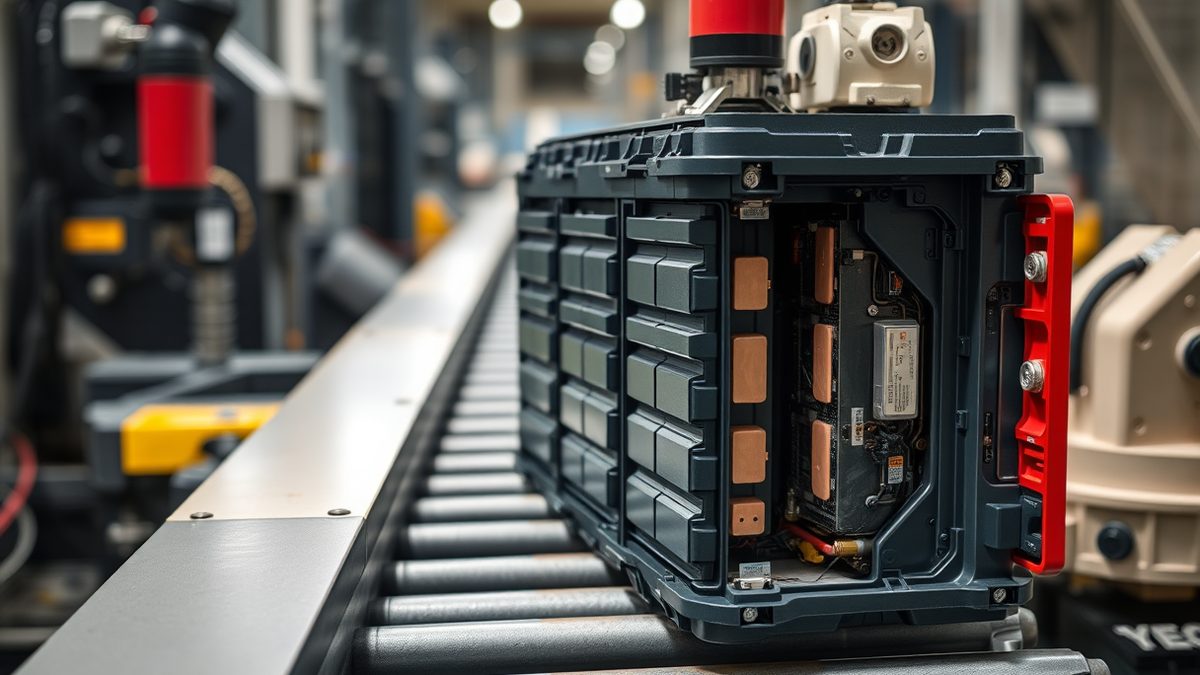
What Sumitomo has switched on
The plant's capacity is equivalent to about 10,000 tonnes of battery cells a year, according to the company [5]. That is roughly 60,000 EVs with 40 kWh packs [5].
It recovers nickel, cobalt, lithium and copper from spent lithium-ion batteries used in electric vehicles and other applications, Sumitomo Metal Mining told Argus Media [5]. The work is split across two sites in Ehime prefecture: the Toyo smelter in Saijo city and the nickel refinery in Niihama [5]. Full-scale operations are expected to begin in fiscal 2028 [5]. Sumitomo did not disclose the investment figure, recovery volumes or recovery rates for individual metals [5]. The facility gives Japanese automakers a domestic route for four metals Japan imports almost entirely [1].
Nikkei Asia reported on 11 September 2026 that the facility is Japan's first recycling plant for EV batteries [4]. It is designed to stem the outflow of rare metals [4].
Why a smelter, not a startup, built it
Recovered nickel and cobalt will be processed into a high-purity nickel-cobalt mixed solution and supplied to Sumitomo's Isoura plant as feedstock for battery cathode materials [5]. The company is working with Kanto Denka Kogyo to pair its smelting and refining technology with Kanto Denka's high-purity lithium recovery process [5]. The stated aim is a battery-to-battery system, in which recovered metals are reused in new battery materials [5]. Feedstock will come from domestic and overseas markets, including black mass and battery manufacturing scrap [5]. Black mass is a concentrated material. It is made by crushing, neutralising and processing spent batteries [5].
Sumitomo is not the only Japanese company building this capacity. JX Advanced Metals already has facilities that can extract lithium, nickel and cobalt from used EV batteries, Nikkei Asia reported [2].
The policy backdrop
Government and industry set a battery industry strategy in 2022 [5]. It targets 150 GWh a year of manufacturing capacity in Japan and 600 GWh globally by 2030 [5]. Meti estimates that 600 GWh of global capacity would require 380,000 tonnes a year of lithium, 310,000 tonnes of nickel and 60,000 tonnes of cobalt [5]. The same estimate puts graphite demand at 600,000 tonnes a year and manganese at 50,000 tonnes [5]. Japan imports virtually all of its lithium, cobalt, nickel and rare earth elements, and much of the refining has historically been routed through China [1].
Public-private targets aim for 70% lithium recovery and 95% for nickel and cobalt from storage batteries by fiscal 2030 [1]. A 2026 law covers smaller batteries. It will require manufacturers and importers to collect and recycle small portable batteries from mobile phones, vapes and power tools [1].
The collection problem nobody has solved
Collection is the constraint. Official channels in Japan gather just 14% of end-of-life lithium-ion batteries [1].
Many Japanese EVs are exported at the end of their lives, which sends the metals abroad [1]. Battery chemistries vary widely, from NMC to LFP, and that makes automated sorting difficult [1]. Most retired batteries never reach recyclers, and fire risk complicates the logistics, Glitchwire reported in April [1]. China still handles an estimated 78% of global pre-treatment capacity [1].
Redwood Materials is a US recycler. It processes the equivalent of 250,000 EVs a year and reports recovery rates above 95% for lithium, nickel, cobalt and copper, according to an April report by Glitchwire [1].
The market was projected to grow from roughly $13 billion in 2025 to $70 billion by 2035, Glitchwire reported in April [1]. Compound annual growth was put at between 18% and 30% [1].
What happens next
Full-scale operations at the Ehime plant are scheduled for fiscal 2028 [5]. The plant will take feedstock from both domestic and overseas markets, Sumitomo told Argus Media [5]. The 2026 collection law and the fiscal 2030 recovery targets are the deadlines the plant will be measured against [1]. Sumitomo has not published recovery rates for individual metals [5].
Sources
33- 01SMM commissions Japan's 1st EV battery recycling plantEN
- 02Sumitomo Metal launches Japan's first EV battery recycling plantEN
- 03As EV adoption slows, battery recyclers beyond China struggle to stay in the gameEN
- 04Japanese Recyclers Hit 90% Lithium Recovery, Turning Dead Batteries Into Strategic AssetsEN
- 05Sumitomo aims to expand battery energy storage in Japan with UK experience - Nikkei AsiaEN
- 06Revolta installs first 10 kWh sodium-ion home battery in GermanyEN
- 07Why batteries, not gas plants, should be data centers' first choiceEN
- 08Google’s first Wyoming data centre will run on gas with carbon captureEN
- 09Janus Electric secures battery supply deal for its battery-swap semi truckEN
- 10Child dies of measles in Wisconsin’s first such death since 1990EN
- 11Who Controls the Battery in Your Driveway?EN
- 12First: Volvo CE Electric equipment does the work, without disturbing the wildlifeEN
- 13Anthropic reverses course and pays for news content for the first timeEN
- 14Virtual power plants can help avoid overbuilt grid if AI boom goes bustEN
- 15Zeekr starts pre-sales for updated 7X in China at $34,220 with battery and comfort upgradesEN
- 16China Has An Iron Grip On EV Batteries. Here's America’s Plan To Break ItEN
- 17Puerto Rico tapped Sunrun’s home batteries for 18 straight daysEN
- 18Bose Recalls 600,000 Batteries After Reports of Melting and Catching FireEN
- 19Kazakhstan Eyes Ambitious 2035 Goal for 2 Nuclear Power PlantsEN
- 20This Startup Is Turning Used E-Bike Batteries Into Affordable Energy StorageEN
- 21Mercedes Wants To Rethink EV Batteries With This Clever New TechnologyEN
- 22A Michigan utility’s iffy plan to trap CO2 from its new gas plantsEN
- 23 China deploys 'world's first' 800-volt DC power system for massive AI data center EN
- 24Nio adds 10 million battery swaps in 88 days, taking total past 130 millionEN
- 25Swarm Of Electric Trucks Coming To US (Battery Swapping Included?)EN
- 26How Europe’s battery passport could have a big impact on US e-bikesEN
- 27Batteries Beat Norway’s Hydrogen Bulk Carriers on Cost in Two Modeled RoutesEN
- 28What Bangladeshi Prime Minister Tarique Rahman Brought Home From JapanEN
- 29Toyota’s Corolla Cross EV spotted for the first time [Images]EN
- 30 Rocket Lab launches Japanese Earth-observing satellite on 99th mission to date (video) EN
- 31Global EV battery market share in January-September 2026: CATL 39.1%, BYD 15.2%EN
- 32Westward Ho! First Trip Cross Country with Our New 2026 Tesla Model Y & Full Self Driving V14EN
- 33Scientists discover metals that defy the deep freeze at -424°FEN
All figures and quotations in this text come from the sources listed below.
Content prepared by the editorial team with AI assistance.
Peter Lindqvist
Comments
0- No comments yet — be the first.