Waymo's Flood Pauses, Recalls and Investigations Show Robotaxi Edge Cases Piling Up
Waymo paused service in four cities after robotaxis drove into flooded roads. It is the latest in a run of recalls and investigations that show how far the industry still is from solving rare edge cases.
 Peter LindqvistSport, cars and travel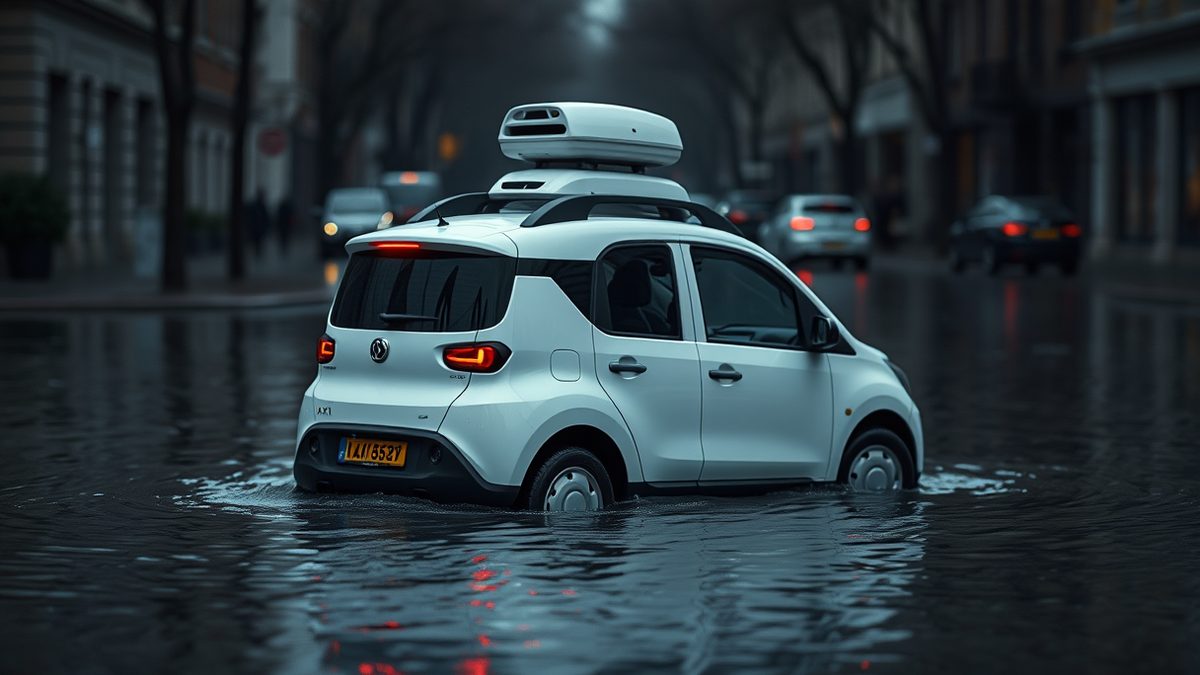
Waymo paused service in Atlanta, San Antonio, Dallas and Houston in May after one of its robotaxis drove through a flooded street in Atlanta and got stuck for about an hour, according to TechCrunch. Crews recovered the vehicle and removed it. The halt came only days after the company issued a software recall for the same class of problem.
The sequence matters more than the incident itself. Waymo knew the weakness existed, shipped a partial fix, and still watched a vehicle enter a flooded intersection.
Regulators and operators across the sector now face the same pattern, and it is not limited to one company or one failure mode. It shows up in recall filings, in second requests for documents, in open investigations and in the way operators describe their own data collection. Each item on its own looks like a narrow bug. Stacked together, they describe a system that performs well in ordinary conditions and stumbles on the unusual ones.
What the recall actually covered
When Waymo filed the flood-related recall, it admitted it had not finished a "final remedy" for avoiding flooded areas, according to documents released by the National Highway Traffic Safety Administration (NHTSA). Instead it pushed an update that placed "restrictions at times and in locations where there is an elevated risk of encountering a flooded, higher-speed roadway."
The Atlanta vehicle got stuck anyway. Waymo told TechCrunch the storm dropped so much rain that flooding was underway before the National Weather Service had issued a flash flood warning, watch or advisory. Those alerts are among the signals Waymo relies on to prepare vehicles for bad weather, the company said. NHTSA said it knew about the incident and was in communication with Waymo.
The company framed the pause in safety terms. "Safety is Waymo's top priority, both for our riders and everyone we share the road with. During a period of intense rain yesterday in Atlanta, an unoccupied Waymo vehicle encountered a flooded road and stopped," Waymo said in a statement.
Not the first partial fix
Waymo has been here before. When people noticed its robotaxis illegally passing stopped school buses last year, the company shipped a fix that was supposed to address the issue. The fleet kept making illegal maneuvers around school buses anyway, TechCrunch reported. Both NHTSA and the National Transportation Safety Board (NTSB) are investigating that behavior. Waymo produced a batch of documents for NHTSA, all redacted to the public, and on May 15 the regulator sent a second request because the initial response "necessitates that [NHTSA] receive further data and information."
A second set of investigations covers a January 23 incident in Santa Monica, California, where a Waymo robotaxi struck a child. Waymo has said the vehicle braked to around six miles per hour before impact and that the child suffered minor injuries.
The flood pause was not the last recall either. In June, Waymo recalled nearly 4,000 robotaxis to stop them driving on highways while it works out how they should behave around construction zones, per TechCrunch. The trigger: at least 13 instances of robotaxis entering highway sections closed for construction, six in Phoenix in April and seven in San Francisco in May. Waymo pulled its vehicles from all highways on May 19 and decided on June 8 to file the recall. It was the sixth recall the company had issued for its robotaxis.
Video of one San Francisco incident spread on social media. X user @Elliot_slade claimed a Waymo "blasted through cones" and said police chased it. "There were construction signs," Slade told CBS News. "There were lights going on. Police in the distance and it sped up." Waymo offered Slade three free rides worth up to $40 each, according to CBS.
Scale is the counterargument, and also the problem
Waymo says its vehicles have driven more than 170 million miles autonomously and claims a 13x reduction in serious-injury-or-worse crashes compared with human drivers. It is planning launches in more than 20 cities this year, including London and Tokyo, and began offering highway rides in November 2025.
The expansion is exactly what surfaces the odd cases its software has not learned: flooded intersections, construction zones, stopped school buses. More miles mean more chances to meet the situations that sit outside the training set, and each one is harder to reproduce on a test track than a routine lane change. That is the trade operators accept when they scale, and it is why the same companies keep filing recalls for narrow conditions rather than broad failures.
The rest of the industry is watching the same problem from a different angle. Uber launched a division called AV Labs in January to gather driving data for robotaxi partners. It had concluded that fleet size creates a physical ceiling on how much real-world data any single operator can collect, TechCrunch reported. Uber has one car so far, a Hyundai Ioniq 5, and its engineering team was still mounting lidars, radars and cameras when it spoke to TechCrunch.
"Our goal, primarily, is to democratize this data, right? I mean, the value of this data and having partners' AV tech advancing is far bigger than the money we can make from this," Uber chief technology officer Praveen Neppalli Naga told TechCrunch.
Uber's vice president of engineering, Danny Guo, described a shadow-mode setup in which a partner's driving software runs alongside Uber's human driver, and any divergence gets flagged back to the partner. The company expects to grow the division to a few hundred people within a year.
Liability is being settled elsewhere
China's Supreme Court set a nationwide standard in February: drivers remain responsible for road safety even after activating driving assistance functions, according to Thairath. The court cited a September 2025 case from Zhejiang province in which a driver surnamed Wang installed a device to simulate holding the steering wheel, set the car to drive itself and fell asleep in the passenger seat. He was jailed and fined. "Driving assistance systems cannot replace the driver as the primary operator," the court stated.
The ruling followed Beijing's tightening of safety rules after a March 2025 accident in Anhui province, where a Xiaomi SU7 struck a concrete barrier at a construction site and caught fire, killing three people.
Tesla's record shows what happens when the gap between marketing and capability widens. An investigation by RTS, based on a leak of internal documents, reported that Tesla concealed thousands of serious incidents involving its Autopilot system up to 2022, including fatal ones. A jury ordered the company to pay more than $243 million in damages to victims, a first in Autopilot-related litigation, and a federal judge upheld the verdict in late February. Tesla can still appeal. The US Department of Justice and NHTSA are examining the company. Tesla and Elon Musk did not respond to interview requests from the investigation.
Taken together, the record points to a practical limit. Robotaxi software is good enough to run at scale in normal conditions, and still brittle enough that a single storm, a construction sign or a stopped school bus can force a city offline. The recalls are not evidence the technology has failed. They are evidence that the remaining problems are the rare ones, and that fixing them takes longer than the launch schedules assume.
Sources
5- 01Waymo expands pause to four cities as robotaxis keep driving into floodsEN
- 02Uber launches an 'AV Labs' division to gather driving data for robotaxi partnersEN
- 03Waymo recalls nearly 4,000 robotaxis to stop them driving into highway construction zonesEN
- 04China's Supreme Court Rules Drivers Remain Liable Despite Autonomous Driving TechnologyEN
- 05Comment Tesla a caché des accidents fatals pour continuer à tester la conduite autonome sur les routesEN
All figures and quotations in this text come from the sources listed below.
Content prepared by the editorial team with AI assistance.
Peter Lindqvist
Comments
0- No comments yet — be the first.