AI chips: Alibaba unveils Zhenwu V900 and opens up its SAIL software stack
At the Yunqi Conference, Alibaba's CEO presented the Zhenwu V900 as China's most powerful AI chip, three times faster than the M890. A day later, subsidiary T-Head widened access to its SAIL software stack.
 Rachel NwosuAI, models and technology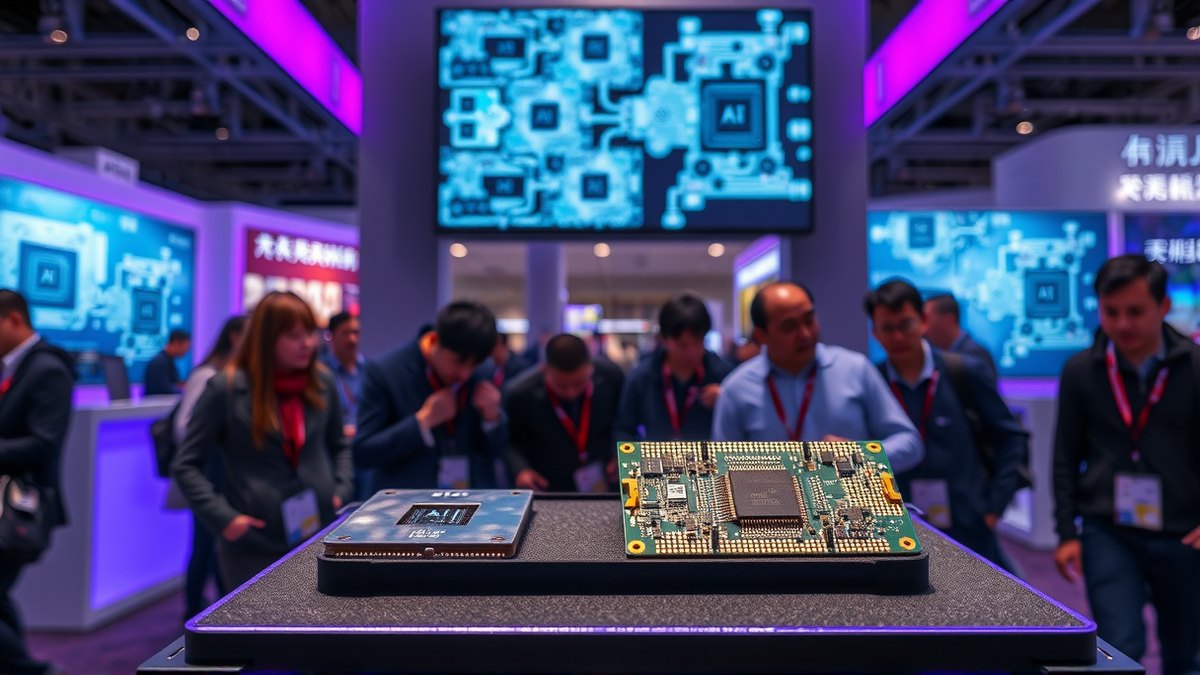
The race for AI chips is now run as much in software as in silicon. That was Alibaba's message at its Yunqi Conference, as reported by the Chinese outlet 量子位 (QbitAI). On 22 September, group CEO Wu Yongming presented the new Zhenwu V900 chip and called it "China's most powerful AI chip." He said it performs three times better than the M890.
Software, the submerged part of the iceberg
But a processor is only worth what you can run on it. The next day, 23 September, semiconductor subsidiary T-Head reported new progress in opening up its T-Head SAIL software stack. It widened framework adaptations, acceleration libraries, the toolchain and communication libraries.
The company's image is telling: the AI chip is the engine, the software stack is the gearbox, the transmission and the driving system. However good the engine, the result depends on how well the software migrates, runs and optimises models.
650 customers and industrial use cases
According to the figures presented, Zhenwu AI chips already serve more than 650 customers across more than twenty sectors. Companies such as Ant Group, Xiaohongshu and the carmaker Xpeng use T-Head SAIL. Xiaohongshu has even built an agent from SAIL's open code that handles model migration and operator optimisation, which speeds up the deployment of its generative recommendation models.
This opening goes back to the WAIC show in July, where T-Head announced that SAIL was moving to open source, with development kits, drivers, performance analysis tools and technical documentation. Two months later, the open projects include adapting the framework to the PyTorch model, the source code migration tool, an operator development tool inspired by Triton and computation acceleration projects.
Cutting the cost of migration
A manager in T-Head's software ecosystem sums up what customers care about most: "the strongest demand, from a business point of view, is the cost of migration." Many companies have been running their software for years, and switching chips means reassessing that legacy without interrupting operations. Migration tools are meant to preserve that asset.
The second issue is performance after migration. If efficiency drops to 30 or 40% of the original, the change becomes hard to accept. Hence the publication of the acceleration projects, which let business teams understand the implementation and optimise it themselves. The third issue is how quickly new models are adapted, with a target of availability on the day of launch.
On resources, T-Head says it offers 39 quantised models on the ModelScope platform, covering in particular the Qwen, DeepSeek and Kimi series, with more than 348 000 cumulative downloads at the end of September 2026. Among the users, Xpeng has migrated the training of its intelligent driving models from a GPU platform to a Zhenwu cloud cluster. Ant Group has adapted inference for its main models on the Zhenwu 810E and M890 chips.
Chip manufacturing by the big groups is shifting from a logic of delivery to a logic of open co-construction.
Sources
2- 01量子位 (QbitAI) : 亮出「中国最强AI芯片」还不够,平头哥又甩出一手开源ZH
- 02ModelScope : plateforme de modèles ouverts (ressources adaptées par T-Head)ZH
All figures and quotations in this text come from the sources listed below.
Content prepared by the editorial team with AI assistance.
Rachel Nwosu
Comments
0- No comments yet — be the first.