Autonomous AI in space: 1,080 satellites, a rover on Claude, and a model that fails at poop
NASA's Jet Propulsion Laboratory used Anthropic's Claude models to plan two Mars drives for the Perseverance rover, IEEE Spectrum reported on 29 September, as Chinese firm STAR.VISION unveiled a 1,080-spacecraft computing constellation on 25 September.
 Sofia MarchettiScience and health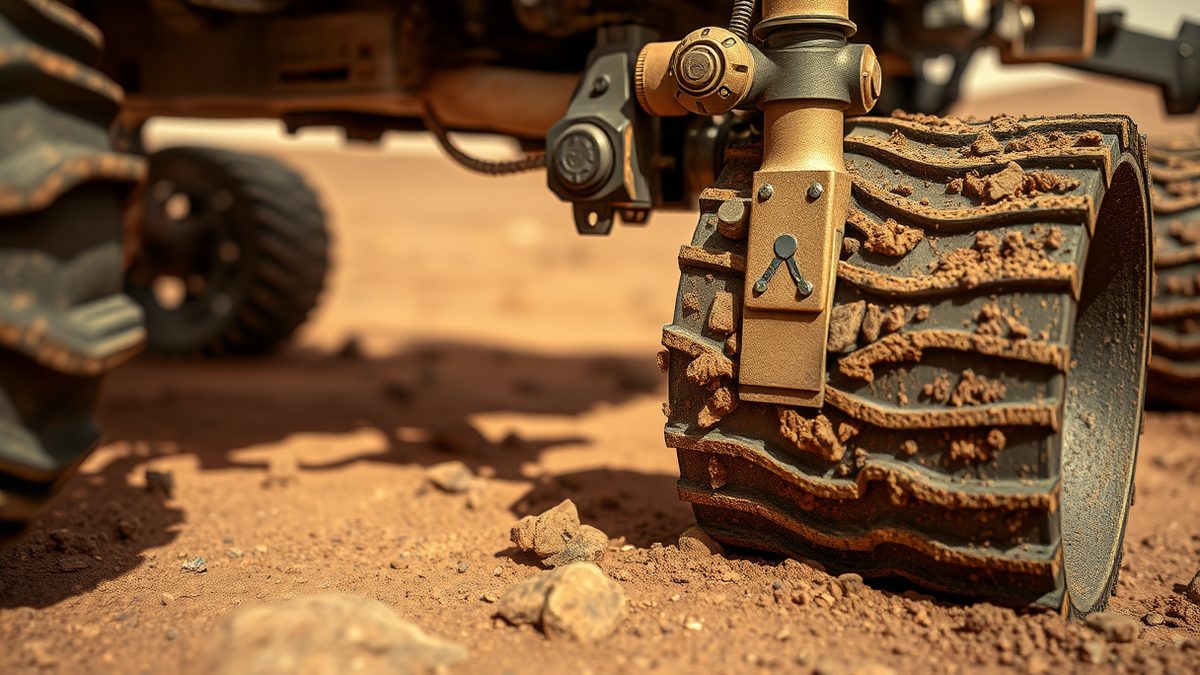
The newest thing in space autonomy is not a rocket. It is a scheduling decision made on Mars by a language model, checked by a person, and uploaded. IEEE Spectrum reported on 29 September that NASA's Jet Propulsion Laboratory had used Anthropic's Claude models to help plan two Mars drives for the Perseverance rover. Human planners reviewed and adjusted the route before it was sent.
That is a modest, bounded use. It is also the clearest example of a shift engineers have argued about for years: whether spacecraft should be allowed to make their own calls.
Two very different bets on the same idea
On 25 September, at the Global Digital Trade Expo, Chinese commercial space firm STAR.VISION Aerospace unveiled the Space.IDC Computing Constellation, according to the space trade outlet china-in-space.com. The numbers are large. About 1,080 spacecraft in the main constellation, fully deployed by 2035, with roughly 720 for inference tasks and 360 for general compute. Three spacecraft designs are on the table: the G1 verification craft at 40 to 60 PetaFLOPs from 11.5 kilowatts of solar power, the G2 standard at 160 to 310 PetaFLOPs from 48 kilowatts, and the G3 flagship at 460 to 1000 PetaFLOPs from 140 kilowatts.
STAR.VISION said it has secured strategic credit agreements with the Industrial and Commercial Bank of China and the Agricultural Bank of China totalling 10 billion Yuan, or 1.49 billion US dollars as of 28 September, with at least 1 billion Yuan available for "Phase One". Launches are booked aboard Orienspace's Gravity-1 and Galactic Energy's Ceres-2 for G1 spacecraft, though no target month or quarter was shared. Orbits, inter-satellite optical links, radiator sizes and mass were not disclosed, and the international regulatory paperwork is not yet filed.
So the project is real, funded, and still largely unspecified. That gap matters when the pitch is compute in orbit.
The old argument about unpredictable machines
Engineers have run spacecraft autonomously for decades, but autonomy has never been the dominant model, IEEE Spectrum notes, largely because the field prizes systems whose behaviour can be predicted. Robert Ambrose, the former chief of NASA's Software, Robotics, and Simulation Division, put the objection plainly to Spectrum: "Autonomy often does not have a deterministic outcome, which means that how you got into a certain situation changes the behavior. So if you come into the same situation but from different paths, the outcome could be different. And so engineers hate that."
"Autonomy often does not have a deterministic outcome... And so engineers hate that."
Ambrose worked on autonomy for the Orion spacecraft and on Robonaut 2, the humanoid that went to space in 2011. His point is a testing point, not a philosophical one: with Orion, engineers had to consider not only what the spacecraft might do but every route by which it could have reached a decision. Spectrum reports that engineers found ways to manage that complexity, which is why the current experiments exist at all.
The experiments are stacking up. In December, JPL used Claude for the two Mars drives. In May, NASA and IBM put a compressed AI model on the International Space Station and a satellite to identify floods and clouds from orbit, described as the first model of its kind demonstrated in space. In July, astronauts on the ISS tested a large language model for maintenance questions. None of these handed control to the model. All of them moved the boundary.
What these models actually score
If you want a reality check on how far the software has to go, the dossier has one, though it has nothing to do with spacecraft. A blog called Labqoat published a benchmark on 29 September that put 2,000 wildlife trace photos, 400 each of droppings, footprints, feathers, eggs and bones, in front of eight models. Each model got one photo and its country, and was asked which species left it.
The best model, Claude Opus 5.5, got the species right 743 times out of 2,000, or 37.15%. Muse Spark 1.3 followed at 33.35% and GPT-6 Astra at 31.70%. Claude Sonnet 5.5 came fourth at 25.15% for an estimated $7.62, returning an answer for every photo with no request errors. Across all eight models, 842 photos, more than 40% of the set, drew no correct species identification at all. Even Opus managed the right family on only 51.75% of photos.
The author is careful about the limits of the result. Sonnet, GLM and DeepSeek scores are described as provisional because a text model interpreted some replies during scoring, and Sonnet has 15 replies awaiting review. Egg photos did best, but the author warns that some species have more photos than others, and that reweighting so every species counts equally drops Opus's egg score from 51.25% to about 37%. And there is no human baseline: no wildlife experts have tried the same set. "I don't yet know what a good score should be," the post says.
That is the honest version of an AI benchmark, and it is worth holding next to the orbital claims. A model that misses six in ten animal traces given the country as a hint is not obviously ready to decide what a satellite does next, though it may still be useful for narrowing options a human then checks.
Where the money and the noise are
Space-based compute is already crowded. China-in-space.com notes that ADA Space and Zhejiang Lab's Three-Body Computing Constellation is ahead of the field with a dozen satellites running in orbit, that Orbital Chenguang has major financial backing, and that Chaozhisuan Beijing Technology has well-linked partners, with both running demonstration satellites. State-owned firms are working on large computing spacecraft with little publicity. STAR.VISION itself has used AI on remote sensing satellites since at least mid-2023 and says two satellites it built for Uzbekistan and Indonesia have verified parts of the coming constellation. The outlet also reports that the Central Government has designated the necessary technologies as a focus area for the 15th Five-Year Plan period, 2026 to 2030.
Meanwhile the public conversation is not always technical. The Daily Mail published a story on 28 September about viewers of a SpaceX Starship livestream who spotted a narrow, slightly curved streak of pale blue light with a brighter white tip about seven minutes and 55 seconds into the test flight, with social media users calling it a possible UFO. The same outlet notes the rocket reached orbit. The dossier does not identify the object.
And there is a small, useful reminder that autonomy in orbit is not the only thing being automated. ABA Games released Wreckfall on itch.io, a fixed-screen 1981-style shooter in which a craft you hit does not vanish but becomes a burning wreck that falls, crushing every craft it passes and eventually landing on the player's position. The page carries an AI disclosure: AI Assisted, Code. Games like this are not science. They are, however, a fair picture of the current state of the art: a machine that produces something useful, with a human still deciding what counts as a win.
Back on the serious side, the contested ground is narrow and practical. STAR.VISION has funding, partners including Baidu AI Cloud, MinoSpace, the Hangzhou Institute for Advanced Study at UCAS and the Hangzhou Research Institute of Xidian University, and letters of support from several Zhejiang zones plus Xichang and Chongzhou. It does not have published orbits, links or cooling plans, and its regulatory filings are pending. IEEE Spectrum, for its part, reports that generative AI in space is still far from trustworthy enough to hand over control of a spacecraft, while engineers are beginning to ask whether they can afford not to try as missions become more complex, distant and numerous.
Those two positions are not contradictory, and that is the story. The hardware is being financed and launched. The software is being tested in small, reversible steps. Nobody has yet published the number that would settle it: how often the model is right, and what it costs when it is wrong.
Sources
6- 01Autonomous AI in Space Exploration Raises New StakesEN
- 02Star.vision Unveils 'Space.IDC' Computing Constellation with PartnersEN
- 03I Made AI Look at Traces. For ScienceEN
- 04Mysterious 'UFO' spotted on SpaceX livestreamEN
- 05Wreckfall: Space Invaders but they crash to earthEN
- 06Space-bunny-alpha a reasoning model from an anonymous providerEN
All figures and quotations in this text come from the sources listed below.
Content prepared by the editorial team with AI assistance.
Sofia Marchetti
Comments
0- No comments yet — be the first.