Caltech and Oratomic say useful quantum computer could need 10,000 to 20,000 qubits
CoinMarketCap reported that Caltech and Oratomic presented findings publicly on Tuesday that a useful, fault-tolerant quantum computer could be built with 10,000 to 20,000 qubits, far fewer than the millions previously assumed, bringing encryption risks closer.
 Sofia MarchettiScience and health
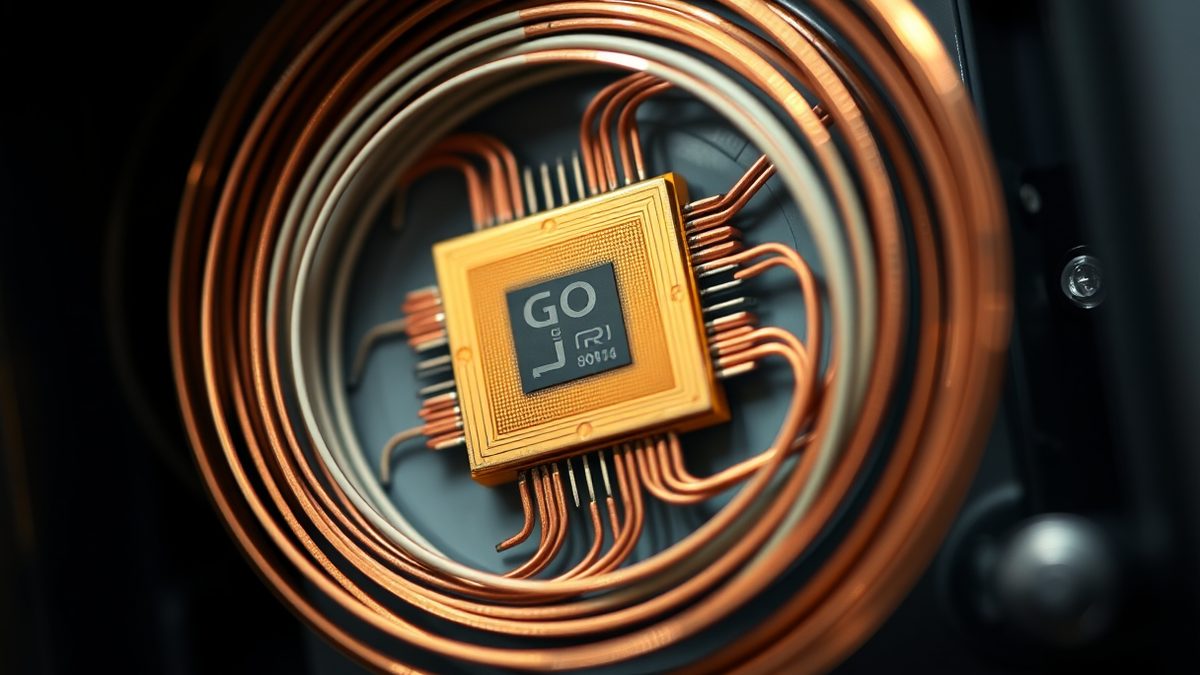
Caltech said the proposed error-correction architecture can encode each logical qubit with as few as five physical qubits, compared with about 1,000 in conventional methods. The university said the approach exploits neutral atoms, which can be moved and entangled across an array with laser beams called optical tweezers.
Caltech tied the lower qubit count to a security risk. It said the accelerated timeline means the security of digital communications, including financial transactions and private messaging, could be vulnerable sooner than expected. Today's RSA and ECC encryption could be broken by a sufficiently large quantum computer using Shor's algorithm, the release said. The authors emphasized the importance of safe and timely migration to new encryption schemes that can resist quantum attacks.
How the estimate falls
Caltech said previous estimates held that millions of qubits would be needed for a reliable quantum computer, while the new results indicate a fully realized machine could be built with as few as 10,000 to 20,000 qubits. The need for fewer qubits means such a machine could, in theory, be operational by the end of the decade, Caltech said. Previously, experts thought such an accurate machine would take another 10 or even 20 years to build.
Madelyn Cain, lead theoretical scientist at Oratomic and a co-first author, said the work reduces qubit counts by up to two orders of magnitude. John Preskill, a Caltech theoretical physicist, said the team is developing neutral-atom architectures that "dramatically reduce the resource estimates for fault-tolerant quantum computing." The report was posted online, Caltech said. Manuel Endres, a Caltech professor of physics, called the result "ultra-efficient error correction," according to CoinMarketCap.
Why neutral atoms matter
Endres and colleagues recently built the largest qubit array ever assembled, with 6,100 trapped neutral atoms, Caltech said. HPCwire reported that the team split a laser into 12,000 tweezers to hold the atoms, that previous arrays of this kind contained only hundreds of qubits, that the array kept qubits in superposition for about 13 seconds, nearly 10 times longer than earlier similar arrays, while manipulating individual qubits with 99.98 percent accuracy, and that the team also moved atoms hundreds of micrometers while maintaining superposition.
Endres said neutral-atom qubits can be connected directly over large distances because a tweezer can shuttle one atom to the far end of an array and entangle it there. That ability to move atoms is central to the error-correction scheme, Caltech said.
The company behind the claim
Oratomic said it raised $300 million in a Series A. ARCH Venture Partners, Spark Capital and Khosla Ventures co-led the round, with Bezos Expeditions, Index Ventures, General Catalyst, Lowercarbon Capital and Bain Capital among the participants. Vinod Khosla wrote on X that the round was his firm's largest initial investment yet.
Dolev Bluvstein, Oratomic's CEO, told TechCrunch that Oratomic should not be compared with PsiQuantum, a startup valued at $7 billion last September that aims to deliver a million-qubit machine by the end of next year. He said Oratomic needs roughly 10,000 to 20,000 qubits and has already demonstrated all the core components at a slightly smaller scale. Oratomic is skipping the noisy intermediate-scale quantum stage, Bluvstein said, and has no plans to build or sell those prototypes, which most rivals offer.
What remains unproven
The result is theoretical, Caltech said. Oratomic has shown its components only at a smaller scale, Bluvstein told TechCrunch. Caltech's release says the findings mean fault-tolerant quantum computers could be on the horizon, but gives no date for a full-scale demonstration. Oratomic said it will work closely with Caltech's Advanced Quantum Computing Mission on quantum information processing, with the goal of building the first utility-scale fault-tolerant quantum computer.
What happens next
Oratomic said it raised the Series A to build a viable quantum computer and aims for a utility-scale machine by the end of the decade. Venture funding for quantum startups reached a record $3.9 billion across 127 deals in 2025, according to PitchBook. Dimitri Zabelin, the author of the research, wrote that the sector has "moved from debating feasibility to competing on execution."
Sources
18- 01Caltech Team Finds Useful Quantum Computers Could Be Built with as Few as 10,000 QubitsEN
- 02Researchers say quantum computers could, in theory, be ready by 2030EN
- 03Oratomic raises $300M to build a viable quantum computer that needs only 20K qubitsEN
- 04Caltech Team Sets Record with 6,100-Qubit ArrayEN
- 05Quantum computing at scale could be here soonEN
- 06Quantum Computer Could Be Ready by 2030, Caltech Researchers SayEN
- 07QpiAI opens ‘Asia’s largest’ quantum chip foundry, targets 10,000-qubit processorsEN
- 08NQCC and STFC Select 13 Projects for UK Quantum Computing GrantsEN
- 09Microsoft is winding down its deal to rent AI computing from OracleEN
- 10Quandoom – A port of DOOM for a quantum computerEN
- 11 SpaceX's plan to build more data center compute than Google's entire lifetime capacity in just 1.5 years is possible, say analysts EN
- 12Turning Conv2D Into A Practical GPU Compute PatternEN
- 13A Strange Quantum Theorem Has Killed Einstein’s RealityEN
- 14Kihan Launches Constitutional Computing to Bring Enforceable Authority to Enterprise AI AgentsEN
- 15IBM, AMD Mix Quantum and AI at U.S. National LabEN
- 16Malicious Browser Extensions Could Use Claude Dispatch to Run Code on Users' ComputersEN
- 17IEEE Computer Society Chapter Offers Webinars With Industry ExpertsEN
- 18OpenAI to acquire Pierre Computer Company, Inc.EN
All figures and quotations in this text come from the sources listed below.
Content prepared by the editorial team with AI assistance.
Sofia Marchetti
Comments
0- No comments yet — be the first.