Gamma iron found intact in Chang'e-6 impact glass
Researchers have identified face-centered cubic gamma iron in natural lunar material for the first time, preserved in impact glass returned by Chang'e-6 from the Moon's far side, a PNAS study reports, offering a possible record of ancient lunar magnetism.
 Sofia MarchettiScience and health
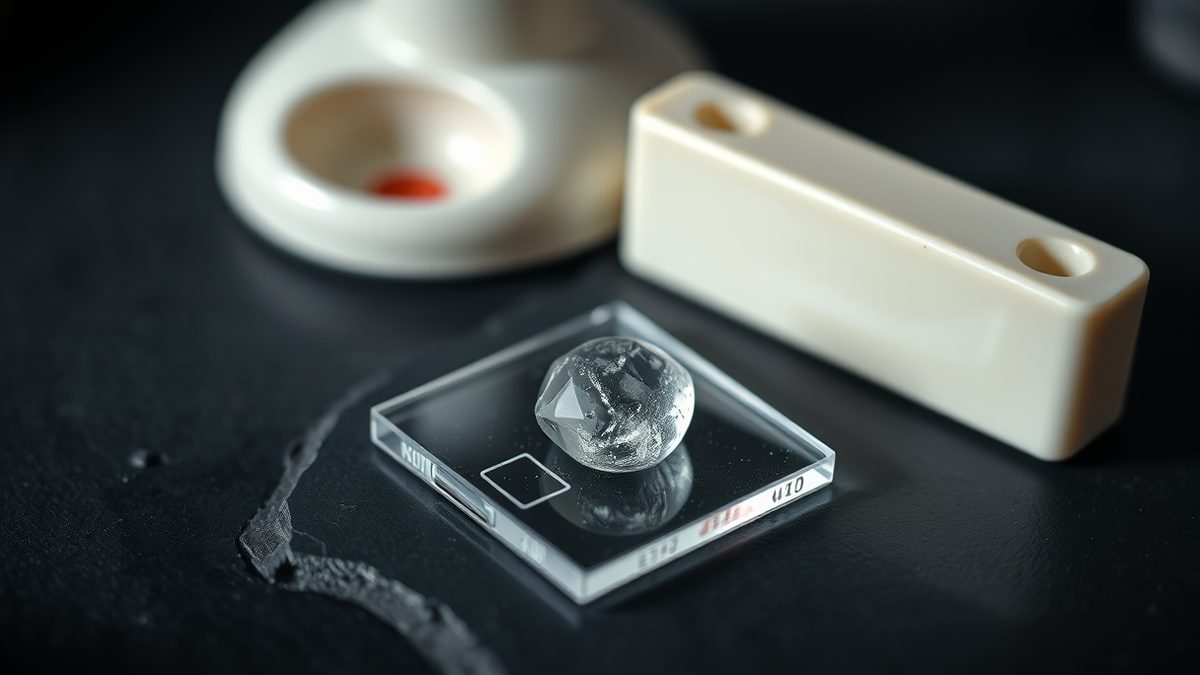
A magnetic fossil in impact glass
The iron particles ranged from less than 10 nanometers to about 140 nanometers across and contained very little nickel, according to the study. The researchers selected three iron-bearing particles from a Chang'e-6 soil sample: two impact-glass fragments and one basalt fragment. Focused ion beam techniques cut thin sections for transmission electron microscopy. Inside the two glass fragments, spherical metallic iron particles were embedded in a silica-rich matrix, and high-resolution imaging and diffraction revealed both alpha iron and gamma iron.
Structure was the surprise. Among 50 particles the team examined at random across the two impact-glass samples, gamma iron dominated, accounting for 64% of those analysed in one sample and 76% in the other. The basalt fragment behaved as expected: its much larger metallic iron grain consisted entirely of alpha iron, consistent with formation during ordinary cooling of magma rather than a violent impact.
Pure gamma iron has a face-centered cubic atomic structure and is normally stable only between roughly 912 and 1,394 degrees Celsius at low pressure. During ordinary cooling it transforms into the body-centered cubic alpha phase. Finding it intact in lunar soil was therefore unexpected. The particles survived inside glass formed by impacts.
How impacts may have frozen the structure
The researchers propose that two conditions worked together. One is the presence of small amounts of elements capable of stabilizing the face-centered cubic phase. Nickel can perform this role, but the particles contained less than 0.8% nickel by weight, far below levels typical of the fcc iron-nickel alloy taenite. Carbon is therefore a leading candidate. Laboratory research has shown that small amounts can stabilize nanoscale gamma iron at room temperature, and carbon-rich impactor material has previously been identified in lunar samples.
The second requirement is extremely rapid cooling. Meteorite impacts generate intense, short-lived heating that can melt lunar soil. On an airless Moon, tiny droplets and fragments can then lose heat extremely quickly. Rapid quenching may prevent atoms from rearranging into the more stable alpha iron structure. The surrounding impact glass may also mechanically trap the particles. Differences in thermal contraction between iron and glass can leave the nanoparticles under tension, potentially helping stabilize both their structure and magnetic behavior.
What the iron can and cannot show
Electron holography showed that larger gamma iron particles can form stable magnetic vortex states, suggesting they may preserve ancient magnetic information alongside better-known lunar iron minerals. "This tiny magnetic fossil may help us better understand the Moon's ancient magnetic history," team member Long Li said.
The Moon has no global magnetic field today, but portions of its crust remain magnetized, preserving evidence of fields that existed billions of years ago. Scientists have traditionally relied on metallic alpha iron and iron-nickel alloys as magnetic recorders in lunar rocks. The researchers say gamma iron could eventually help separate magnetic signals left by the Moon's ancient core dynamo from fields generated during major impacts. They also say that possibility remains unproven.
Chang'e-6 returned the first samples ever collected from the Moon's far side in 2024, from Apollo crater inside the South Pole-Aitken basin, one of the Moon's oldest and deepest impact structures. The mission brought back 1,935 grams of soil. Until then, every returned lunar sample came from the near side. The discovery, published in the Proceedings of the National Academy of Sciences, came from an international team led in part by scientists at the High Magnetic Field Laboratory of the Chinese Academy of Sciences.
Sources
15- 01Chang'e-6 samples reveal a form of magnetic iron never before found on the MoonEN
- 02Chang'e-6 samples reveal how Earth's magnetosphere changed the solar wind reaching the MoonEN
- 03Chinese team finds 'iron rust' in lunar soil, challenging moon surface mythsEN
- 04Chang'e-6 lunar samples reveal first discovery of naturally formed single-walled carbon nanotubes and graphitic carbonEN
- 05Chang'e-6 Lunar Soil Reveals Changing History of Asteroid ImpactsEN
- 06Joint study on 'time capsule' lunar soil from Chang'e-5, -6 missions reveals evolutionary processes of organics in solar systemEN
- 07Chang'e-6 Mission Discovers Iron Oxide Crystals on the MoonEN
- 08Chang'e 6 findings challenge Earth water theoriesEN
- 09Chinese scientists discover rare-earth-rich new lunar minerals in Chang'e-5 mission samples - Global TimesEN
- 10Chang’e-6 samples reveal how Earth's magnetosphere changed the solar wind reaching the MoonEN
- 116 default Pixel 11 settings I changed that made a big difference – and whyEN
- 12‘The ticket is the gateway’: How destination events, sprint races and greater accessibility are changing the modern F1 fanEN
- 13Liquid Cooling Is Changing What Data Centers Need to MeasureEN
- 14mSecure Warns Users to Change Passwords, Reset 2FA and Passkeys After Suspicious ActivityEN
- 15AI Is Changing How Semiconductor Fabs Work — and Engineers Are Moving Faster Because of ItEN
All figures and quotations in this text come from the sources listed below.
Content prepared by the editorial team with AI assistance.
Sofia Marchetti
Comments
0- No comments yet — be the first.