Curtin team reports blood-cell traces in 115-million-year-old dinosaur bone
An international team led by Curtin University says it has the first chemical proof of haemoglobin-derived molecules inside mineralised red blood cell-like structures in a 115-million-year-old dinosaur bone from Brazil. The study was published in the Proceedings of the National Academy of Sciences on 2 November.
 Sofia MarchettiScience and health
What the team reported
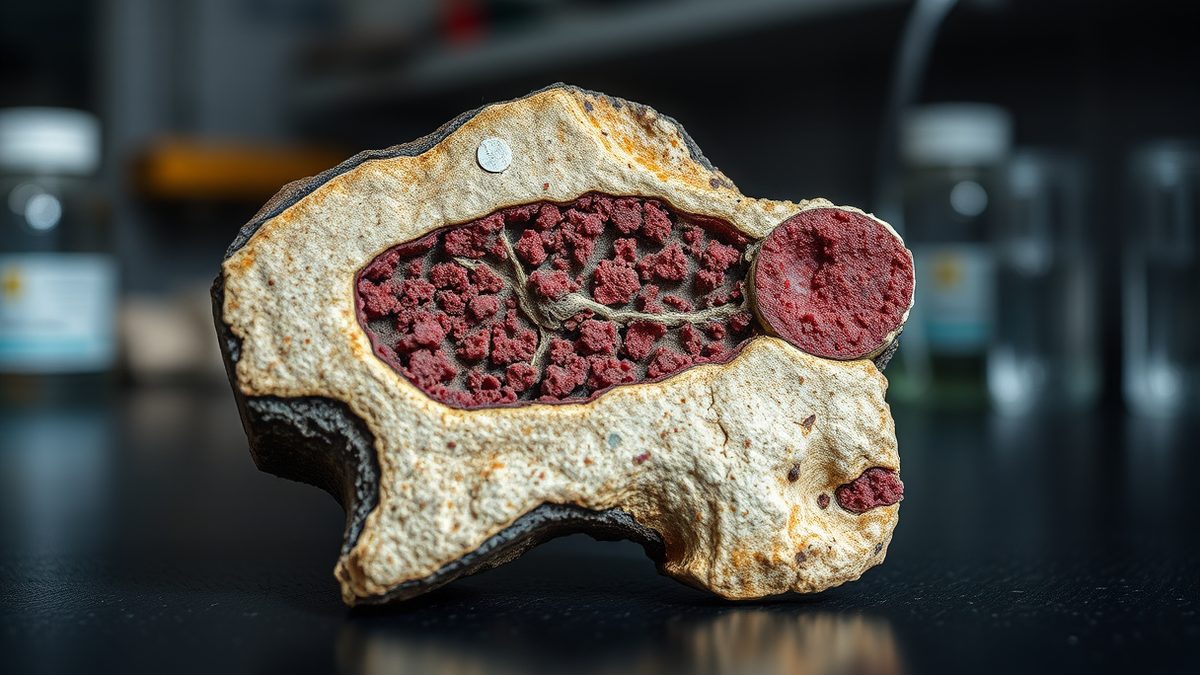
The paper reports mineralised red blood cell-like structures and heme biomolecules in the hind-limb bones of Aratasaurus museunacionali, a small theropod from northeastern Brazil. The animal was a juvenile, estimated at about 3.12 metres long and 34 kilograms, roughly four years old at death and possibly still growing. The fossil is about 115 million years old, from the Romualdo Formation in Ceará state.
The structures average about 23 micrometres long and 20 micrometres wide.
They sit inside vascular canals, the narrow channels that once carried blood vessels through the bone, and that location carries much of the argument: in living vertebrates, red blood cells occupy the same space. Chemical analysis found heme B, the iron-bearing part of haemoglobin, and a derivative called 3,8-diethyl heme B. The team combined microscopy, elemental mapping, spectroscopy and high-performance liquid chromatography-mass spectrometry, and reported iron, carbon and nitrogen associated with the structures. The authors describe the result as the first chemical proof of haemoglobin-derived molecules inside mineralised fossil cells.
The team included researchers from Curtin's School of Earth and Planetary Sciences, the Japan Agency for Marine-Earth Science and Technology, the Brazilian National Museum, the Regional University of Cariri and Johns Hopkins University.
Why it matters
The claim extends the known fossil record of blood to 115 million years.
If it holds, it gives researchers a molecular route into dinosaur physiology, including blood evolution, metabolism and activity levels. It does not deliver a vial of dinosaur blood. The team found no liquid blood, no intact haemoglobin protein and no DNA. The practical effect is narrower: knowing this preservation is possible tells other teams what to look for in unusually well-preserved bone, and how to test whether a cell-shaped blob really carries animal chemistry.
The animal lived during the Early Cretaceous. Curtin also points outward, arguing that if delicate biomolecules can fossilise over millions of years, similar traces of life might persist elsewhere in the universe.
How the traces survived
The team's explanation starts with burial: rapid sediment cover in a low-oxygen, microbially rich setting that would have slowed normal decay.
A manganese oxide mineral, hausmannite, mineralised the cell-like structures. Grice has described it as a natural time capsule that stabilised the structures and their contents before they could break down. The sediment around the bone told a different chemical story, mostly plant and bacterial compounds, which the authors say makes contamination from the rock less likely. The bone also yielded amino acids associated with collagen, the main structural protein in connective tissue.
The specimen has its own history. Workers found it in a gypsum mine in 2008, and it was later held at the National Museum of Brazil in Rio de Janeiro. A fire destroyed much of that museum's collection in September 2018, but the building holding this fossil was not affected.
Its genus name means "lizard born from fire", a reference to the museum fire the fossil survived.
The dispute and what remains open
Not everyone accepts the identification. Mary Schweitzer, a molecular palaeontologist at North Carolina State University, is not convinced the structures are red blood cells.
Her objection is morphological. Birds and reptiles keep the nuclei in their red blood cells, which usually gives the cell a bulge, and Schweitzer says the Aratasaurus structures are concave, show no such bulge and are smaller than most nonmammalian red blood cells. She was more persuaded by the heme and collagen amino acid results, and said there was much to learn from exceptionally well-preserved fossils. Schweitzer has studied soft tissues from the dinosaur age for years and agrees that molecules made inside an animal can persist over geological time.
Grice has said museum collections may hold overlooked chemical evidence that modern techniques can now detect.
What would settle it is replication: the same chemistry, found in situ, in another specimen.
Sources
28- 01115-Million-Year-Old Dinosaur Bones Preserve Chemical Traces of Red Blood CellsEN
- 02Dinosaur blood – oldest discovery rewrites what fossils can revealEN
- 03Fossilised red blood cells found in 115M-year-old dinosaur's boneEN
- 04Geochemist Kliti Grice says the 115-million-year-old leg bones of a small Brazilian dinosaur hold what look like fossilized red blood cellsEN
- 05Evidence of red blood cells found in 115-million-year-old dinosaur's bonesEN
- 06Oldest Dinosaur Blood Cell Evidence Found in 115M-Year-Old Brazilian FossilEN
- 07Echoes of Jurassic Park: Scientists Found Traces of Blood Inside a 115-Million-Year-Old Dinosaur BoneEN
- 08Possible red blood cells found in 115-million-year-old dinosaur boneEN
- 09Curtin University study discovers 115-million-year-old dinosaur red blood cells and heme biomoleculesEN
- 10Scientists Discover Traces of Dinosaur Blood Cells in 115-Million-Year-Old FossilEN
- 11Scientists find traces of red blood cells in dinosaur boneEN
- 12115 million years ago, a small dinosaur died and was buried quickly in BrazilEN
- 13Scientists Find Dinosaur Blood and Cells For First Time in Fossil - NerdistEN
- 14Dinosaur Red Blood Cells Detected: Heme Found in 115-Million-Year BoneEN
- 15Traces of ancient blood found in 115 million-year-old dinosaur fossil, new study claims - Live ScienceEN
- 16Dinosaur blood found in fossils for the first timeEN
- 17Cyberattack disrupts blood storage refrigeration systems in FranceEN
- 18From Ankara To Ankara: 34 Years of Turkic CooperationEN
- 19Google Disrupts 1.3 Million-Device Android Botnet, Says TV Box Maker Sold Criminal AccessEN
- 20Chipfertigung: EU investiert Hunderte Millionen in Chipdesign-PlattformEN
- 21French blood storage impacted by freezer hacks as theories swirl about culpritsEN
- 22Titan OS raises $46 million to expand its smart TV OS internationallyEN
- 23Blood banks targeted in latest European fridge cyberattacksEN
- 24French blood banks hacked in latest cyber-attack on EuropeEN
- 25 PHP vulnerability post-mortem reveals bug was known two years ago — Small team of maintainers knew of the issue before it was made public, as new PHP2Shell chaEN
- 26 Certified Android TV manufacturer put unauthorized backdoor in 1.3 million set-top boxes, Google reveals EN
- 27China clean-tech exports in 2026 to avoid as much CO2 as Brazil emits in 1 yearEN
- 28Hackers Steal About $2.7 Million From Polymarket Traders via Hijacked DebugBear ScriptEN
All figures and quotations in this text come from the sources listed below.
Content prepared by the editorial team with AI assistance.
Sofia Marchetti
Comments
0- No comments yet — be the first.