Euclid's first comet turned up in frames taken to map distant galaxies
The European Space Agency said on 19 October that its Euclid space telescope had found its first previously unknown comet. C/2026 S1 (Euclid) sits about 810 million miles from Earth [5][6].
 Sofia MarchettiScience and health
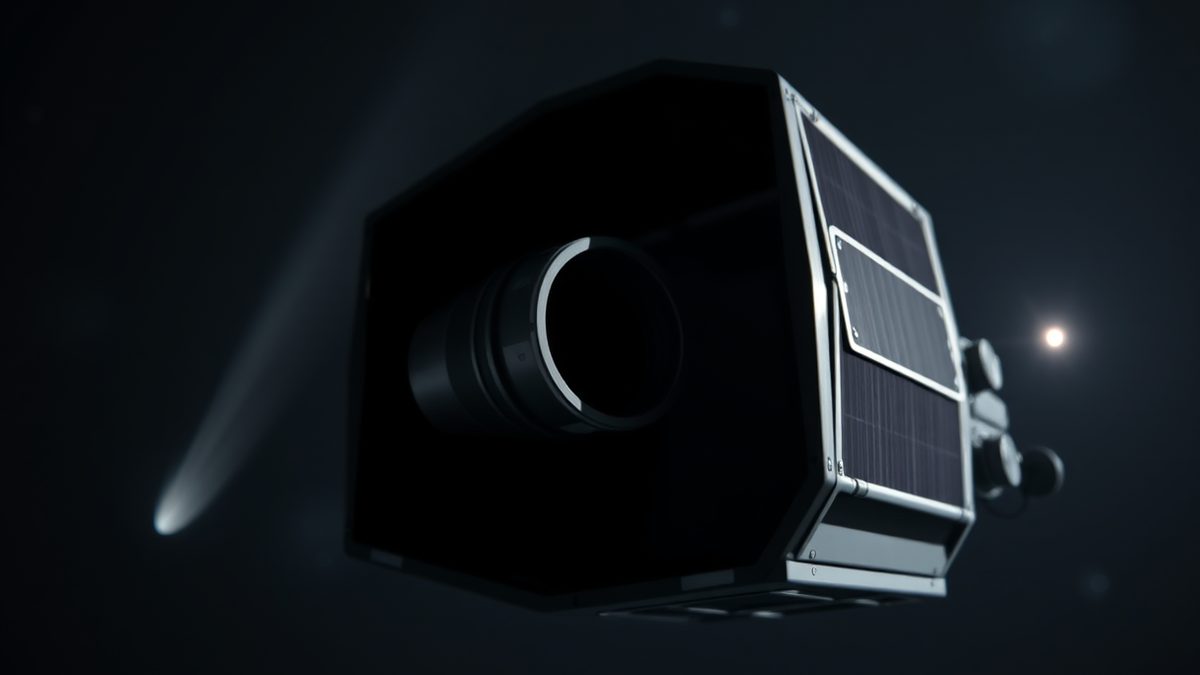
Euclid Deep Field North is one of the few patches the telescope returns to [4]. The comet appears as a streak in 16 exposures taken between 16 and 24 September 2026, across five fields of view [5].
Euclid's design avoids the dusty plane where comets live, so almost nobody expected it to find one [4]. Catching a comet while it is still far from the Sun gives astronomers time to watch it activate and measure what it releases [3].
Mikko Pöntinen, a PhD student at the University of Helsinki, wrote the moving-object software that flagged the streak [2][5]. He predicted where it would appear in later frames, turning one flag into 16 exposures [5]. "I was excited to see my software flag a 'streak' smeared across several images," he said in an ESA release. Closer inspection showed "a fuzzy cloud around it, indicative of an active object like a comet that is shedding dust and gas" [2][6]. He reported it on 29 September for the Euclid Consortium's Solar System Objects Science Working Group [5].
The Minor Planet Center confirmed the comet on 8 October and published an orbit from 54 observations in circular 2026-T146 [1][5].
Ground observers had been sending in positions. The Canada-France-Hawaii Telescope recorded a tail about 12 arcseconds long on 7 October, and Pöntinen measured the coma at 10 arcseconds across [5]. That is a sliver beside the full Moon's roughly 1,800 [5]. Eight shorter exposures, aligned on the comet's motion, left the core and its dust cloud [5].
An orbit almost upright on the planets
The orbit is inclined about 85 degrees to the plane where the planets travel [5]. The European Space Agency (ESA) describes the comet as currently straight up from the Sun's point of view [5][6]. At about 810 million miles (1.3 billion kilometres), it sits roughly in the gap between the orbits of Jupiter and Saturn [1][6].
That geometry made the find unlikely. Euclid points away from the dusty plane where comets and asteroids are common, to keep glare out of its galaxy images [4].
The telescope also steps to a patch of sky, stares for about an hour and moves on, so most of what it records it records once [4]. Comets usually give themselves away by moving, which a single pass cannot show. The deep fields are the exception, revisited a handful of times a year, and that is why this object landed in several frames [4]. One orbit will take thousands of years; astronomers have not published an exact period [4][5].
One of 13 comets found in 2026
Comets are icy leftovers from the solar system's formation about 4.6 billion years ago. Astronomers know more than 4,000 [3]. The Minor Planet Center's confirmation made this one of 13 found so far in 2026 [3]. Astronomers typically find 40 to 70 new comets a year, most through searches built for the job [4].
A rehearsal for Comet Interceptor
ESA says the comet is not a suitable target for its planned Comet Interceptor [1][5][6]. Valeria Pettorino, Euclid's project scientist, said the discovery and alert process "gives us a real test case for how our two mission teams will coordinate in the future" [6].
Euclid launched in 2023 on a six-year plan to map about one-third of the sky and trace dark matter and dark energy [2][4][7]. Its frames target distant galaxies, but they also carry solar-system objects nobody sought [2][5]. The Minor Planet Center has alerted other observers, so follow-up now belongs to ground telescopes [5].
Sources
35- 01PhD student built software to catch streaks in Euclid images, and it flagged the telescope's first comet discoveryEN
- 02Euclid was mapping the universe. Then it found a cometEN
- 03New comet accidentally discovered by space telescopeEN
- 04The ESA's Euclid Telescope Discovered a New Comet Completely by AccidentEN
- 05A telescope's survey got interrupted by a comet nobody knew existedEN
- 06Space telescope discovers a new comet 810 million miles from EarthEN
- 07The Euclid telescope accidentally discovered a new cometEN
- 08 NASA's Swift space telescope crashes back to Earth after failed rescue attempt EN
- 09NASA is racing against time to save the Hubble Space TelescopeEN
- 10 NASA asks industry for ideas about saving Hubble Space Telescope EN
- 11 James Webb Space Telescope uncovers new clues about the origins of 'interstellar invader' comet 3I/ATLAS EN
- 12The New York Times is in talks to buy Letterboxd for around $330 millionEN
- 13Elon Musk's Tesla and SpaceX lose over $420 billion in combined market cap after midtermsEN
- 14 'We got it done!' Spacewalking astronauts finish installing next-gen ISS solar arrays EN
- 15Software squeezes more data out of Webb Telescope for imaging exoplanetsEN
- 16 On this day in space! Nov. 5, 2002: NASA's Galileo spacecraft flies by Jupiter moon Amalthea only to find it's a 'pile of icy rubble less dense than water' EN
- 17Insurer Guardian hands 1 million dental calls a year to Sierra’s AI agentsEN
- 18SpaceX treibt Mobilfunkpläne voranEN
- 19 NASA's Voyager 1 probe bounces back from communications glitch in interstellar space EN
- 20CesiumAstro Secures $730 Million in Janus Henderson-Led Series D at a Valuation Above $4.5 Billion; Unveils Synchronicity Satellite Constellation Following FullEN
- 21 Early Black Friday beginner telescope deal — this portable Celestron is now 25% off at Amazon EN
- 22 SpaceX's plan to build more data center compute than Google's entire lifetime capacity in just 1.5 years is possible, say analysts EN
- 23Scientists solve 30-year-old mystery and discover a hidden defense against inflammationEN
- 24 2 astronauts will finish upgrading ISS solar arrays during spacewalk today: Watch it live EN
- 25Why Integrated Gate Drive Regulation Matters For High Reliability Space GaN DesignsEN
- 26Elon Musk Threw Away $474 Million (Or More) … But May Benefit From FailingEN
- 27AI PACs spent millions trying to shape Congress — here’s how they faredEN
- 28 Trump declares 'American space superiority for all eternity' in election night proclamation EN
- 29SpaceX signs deal with Qualcomm to provide network technology for U.S. mobile serviceEN
- 30 Drone warfare in space: Swarms of autonomous, laser-shooting cubesats could defend Western satellites in orbit EN
- 31 Certified Android TV manufacturer put unauthorized backdoor in 1.3 million set-top boxes, Google reveals EN
- 32 Hubble Telescope sees cosmic 'cat's tail' that could wrap around Earth and the sun 500 times EN
- 33All 5 genetic “letters” of DNA and RNA discovered in a 4.5-billion-year-old asteroidEN
- 34NASA's Hubble and Webb discover ancient worlds that remember their pastEN
- 35 NASA's Swift space telescope is about to crash to Earth. Where will it fall? EN
All figures and quotations in this text come from the sources listed below.
Content prepared by the editorial team with AI assistance.
Sofia Marchetti
Comments
0- No comments yet — be the first.