Data center waste heat is warming nearby neighborhoods
The first measurements around data centers show air temperatures 0.7 to 0.9 degrees Celsius higher within 90 meters to half a kilometer. Simulations point to bigger effects at higher power levels.
 Sofia MarchettiScience and health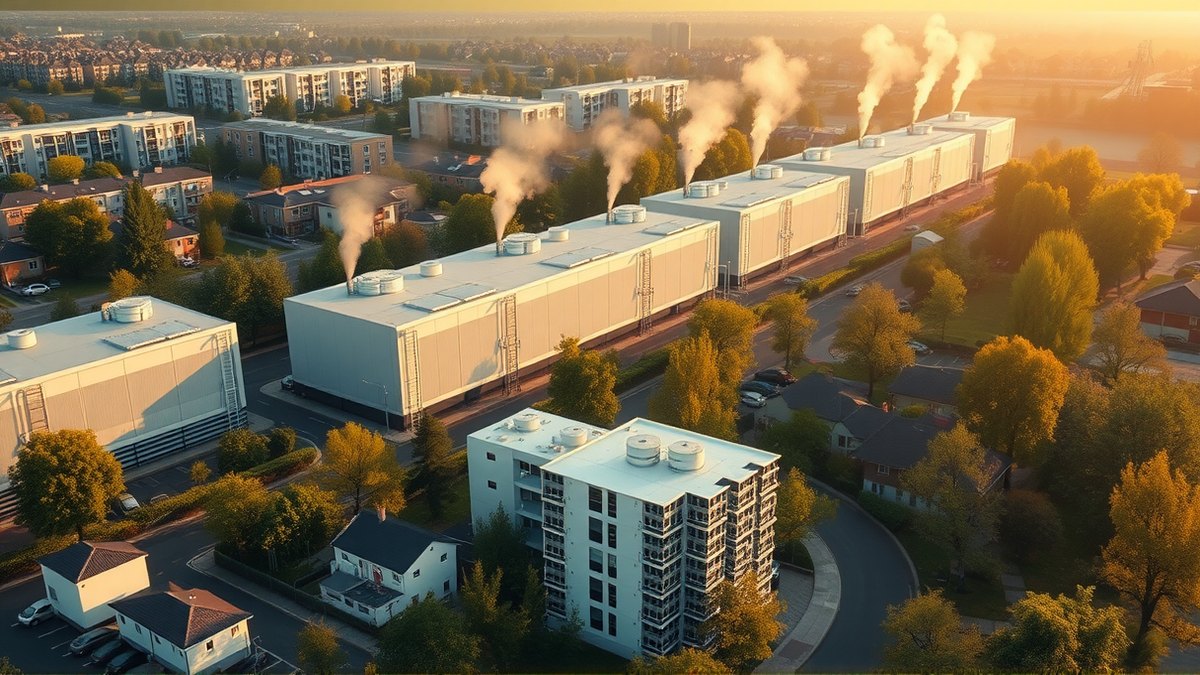
Public debate about data centers usually comes down to land, water and electricity. Early research now suggests that clusters of heavy computing power also warm the air right around them.
Measurements around Phoenix
Bloomberg, citing research and simulations, reports that data centers give off so much heat that temperatures in adjacent neighborhoods rise measurably. Around four installations near Phoenix, among them a large CyrusOne facility, readings averaged 0.7 to 0.9 degrees Celsius above the surrounding area. The effect showed up from roughly 90 meters out to half a kilometer. The authors caution that their sample covered only four locations over three measurement days, so whether the finding holds more broadly is still an open question.
Simulations by EOLIOS, an international consulting firm that Bloomberg says serves mostly European clients, suggest larger effects. Under certain wind conditions, data centers drawing 50 to 100 megawatts could raise temperatures by 2.5 to 5 degrees Celsius at distances of up to 150 meters. Those are modeled values, not measurements like the Phoenix readings, so the two sets of numbers should not be compared directly. At gigawatt scale, the effects could be larger still.
The scale of the problem
Calculations cited by Bloomberg show that a single data center drawing more than 50 megawatts produces as much heat as about 54,000 households consume. Nearly all of the electricity it pulls in ends up as waste heat. According to the market researcher DC Byte, 41 percent of American data centers sit in clusters of at least three facilities within a one-kilometer radius. There are 88 such clusters today, and 23 more are expected by 2040. The combined capacity of every planned facility in the US could top 290 gigawatts, roughly four times the current total.
Germany is heading for a similar boom. An interactive map from the "Heiße Luft" initiative tracks planned and under-construction data centers and shows how many municipalities are struggling to cope. Add the more than 25 billion euros pouring into Germany on the back of the sudden AI data center boom, and questions about heat, water and power will keep coming back.
What operators are doing
Operators are already looking for answers. CyrusOne says it uses light-colored rather than dark roof surfaces at its Phoenix site to cut heat absorption. Amazon says it vents waste heat vertically instead of low over the ground, and leans harder on evaporative cooling during hot spells. Others are reusing the heat. At Amazon's Seattle headquarters, heat from a neighboring data center warms the building. In Finland, a Microsoft data center due to open in 2027 is expected, once fully built out, to cover about 40 percent of the heating demand of 250,000 households and businesses in the region.
Regulation is moving on separate tracks. Germany and France require operators to reuse waste heat. In the United States, the issue remains effectively unregulated. That gap explains why the problem is still described mainly through individual studies and simulations rather than systematic monitoring.
Sources
2- 01heise online: KI-Rechenzentren: Abwärme heizt angrenzende Wohngebiete aufDE
- 02heise online (EN): Data center waste heat warms nearby neighbourhoodsEN
All figures and quotations in this text come from the sources listed below.
Content prepared by the editorial team with AI assistance.
Sofia Marchetti
Comments
0- No comments yet — be the first.