DeepSeek open-sources Huawei chip tools as US export controls squeeze China's AI stack
DeepSeek released open-source programming tools for Huawei's Ascend chips on 30 September, the clearest sign yet that China's AI industry is trying to build a software stack that does not depend on Nvidia's CUDA.
 Dr. Amara PatelEconomy, business and world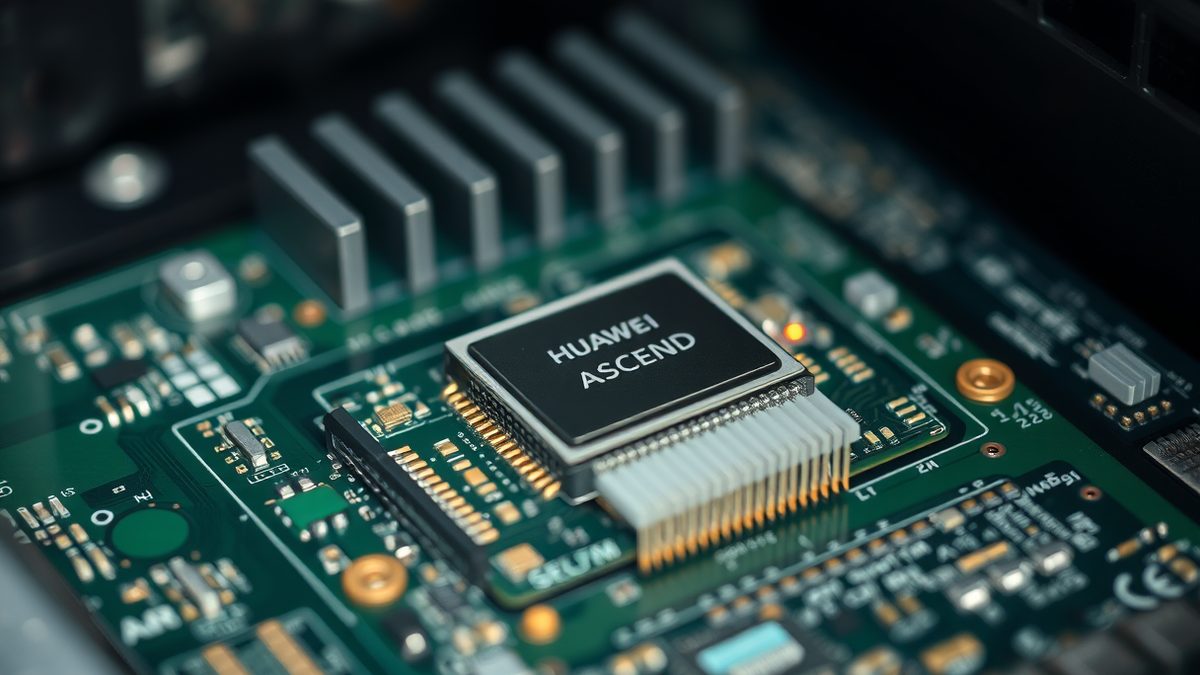
DeepSeek published the release on its official WeChat channel. Reuters covered it, and THE DECODER followed on 30 September. The centrepiece is TileLang, a programming language that DeepSeek argues is easier to work with than CUDA, Nvidia's software platform. The package also includes libraries for computation and for moving data between chips. DeepSeek is publishing all of it as open source.
That is the news peg. The rest is context, and the context is a supply chain being rebuilt under pressure.
DeepSeek says Huawei "fully supported" the work, according to the same account. The two companies also optimized a supernode, a cluster of 128 Ascend 950 chips. TileLang was originally developed by researchers at Peking University, and DeepSeek has been using it for about a year. The company first tested the language on older Nvidia chips. It is now the main tool for its work on artificial general intelligence, according to The New York Times, as cited by THE DECODER.
Why a language matters more than a chip
Nvidia's dominance does not rest on silicon alone. THE DECODER's report puts the CUDA developer base at an estimated four million people worldwide. That ecosystem is the moat rivals like AMD have not crossed, even when their hardware looked competitive on paper. A programming language that gets full performance out of Huawei's Ascend parts, while being simpler to learn than CUDA, attacks that moat directly.
Huawei has been moving on the hardware side too. Two weeks before DeepSeek's announcement, the company unveiled new AI processors and supernode systems. It said they would be widely used for model training next year, THE DECODER reported. Huawei also admits it cannot keep up with demand at home, so it plans to sell fewer chips abroad. Its current rotating chairman, Eric Xu, said the company cannot accept a future that hinges on whether others are willing to sell chips to China, a reference to US export controls.
The software gap is the harder problem. Chinese model makers like Z.ai and Moonshot AI have moved faster than the country's chipmakers, according to the NYT. Huawei wants to close that distance. Whether TileLang does it depends on adoption, not on the announcement.
"If you don't go overseas, all that grinding was for nothing."
That line comes from David Cheng, an investor at DCM. He wrote it on his Earned Intuition Substack on 30 September after a week in Beijing and Shanghai. He renders the Chinese phrase as 如果不出海就白卷了. The shorthand he heard everywhere was 内卷, involution: effort that increases without producing gains. Hundreds of labs undercut each other on price, poach each other's researchers and ship monthly. They run a treadmill that produces genuine engineering excellence and almost no profit.
Cheng's essay is the most useful counterweight to the American framing, because it describes the domestic economy the chips are supposed to serve. Youth unemployment was 17.9% as of July, he writes. July retail sales were up 0.6% year over year against an expected 1.5%. Didi drivers, many of them graduates of the country's best universities, are the visible symptom. In that setting, AI is the one sector the state has decided must work, propped up with subsidized electricity, fast-tracked IPOs and open encouragement of price wars. Export is the only mechanism that converts the grinding into money.
The moat, tested
How much of CUDA's advantage is left is now an empirical question. Research firm SemiAnalysis tested Jalapeño, OpenAI's inference chip, and called the CUDA moat "potentially dead," according to THE DECODER, because OpenAI gets new models running on its own hardware so quickly. Jalapeño beat Nvidia's Blackwell on performance per watt in most of the scenarios tested. OpenAI models also helped design the chip, and those models run on Nvidia GPUs.
The analysts added their own caveats: they only tested scenarios that are relatively easy to optimize, with about 8,000 input tokens and 1,000 output tokens. They have not yet run AgentX, a benchmark for how AI agents handle multistep tasks. That is exactly where SemiAnalysis found Nvidia well ahead back in August. With AMD's current software stack, Nvidia would still come out cheaper per token even if AMD gave its hardware away. The lasting advantage, the authors argue, is not in the silicon but in the software that links many chips into one system.
Huawei's chips were not part of the AgentX comparison. In an earlier analysis of DeepSeek V4, though, SemiAnalysis noted that Huawei's CANN software stack was the only one besides CUDA to support the model on day one. That is a data point in Huawei's favour, and a reminder that the comparison keeps shifting.
On the same day DeepSeek published its tools, OpenAI and Synopsys announced a multi-year partnership to build GPT-Synopsys, a model for chip design that combines OpenAI's AI with Synopsys' electronic design automation tools, THE DECODER reported on 30 September. OpenAI is licensing the EDA tools. The model will run on OpenAI's infrastructure. Customer data will not be used for training and will be stored encrypted, according to both companies. Early tests with semiconductor customers are already underway, and the two firms will market the product together and share revenue.
Synopsys CEO Sassine Ghazi says AI could significantly speed up the design process. OpenAI co-founder Greg Brockman frames the partnership as a path to better chips and better AI. OpenAI is already working with Broadcom on chips built specifically for running AI models. The recently unveiled Jalapeno chip is described as very competitive against similar specialized chips.
Put the two announcements side by side and the shape of the competition is clear. One camp is trying to automate the design of chips with a frontier model. The other is trying to make a domestic chip family programmable without the incumbent's software. Both are responses to the same constraint: the export controls that limit what China can buy, and the strategic worry in Washington that those controls will not be enough.
Politics on both sides of the Pacific
The policy layer moved on 29 September, when President Trump and the leaders of the largest US AI companies signed a set of voluntary safety standards at the White House, CBS News reported. "It's almost like a constitution, in a way," Trump said, flanked by SpaceX's Elon Musk, Meta's Mark Zuckerberg, Anthropic's Dario Amodei, Nvidia's Jensen Huang, OpenAI's Greg Brockman and Google's Sundar Pichai. Asked whether the deal was binding, Trump said: "I think it's morally binding."
The companies committed to "four layers of controls and audits," including internal evaluations, audits by an external firm and reviews by each company's board, according to a one-page accord Trump posted to Truth Social. They also agreed to meet regularly to establish standards and best practices. Trump said he plans to name an "AI czar" within three or four days, and signed an executive order directing the federal government to use the term "Super Intelligence" instead of artificial intelligence.
Democratic Sen. Mark Warner of Virginia was not impressed. "The companies building the most powerful AI systems are warning us that the technology is advancing faster than our safeguards," he said in a statement. "The president's response? To rename it and tell the companies developing it to regulate themselves."
In Europe, the parallel fight is over scanning private messages. The EU Council is pushing for the Chat Control 2.0 regulation to let police order internet companies to scan communications in "parts of a service" for a period of time rather than obtaining a warrant for a specific suspect, according to a leaked presidency note dated 18 September and reported by Reclaim The Net on 30 September. The note was prepared for a sixth trilogue on Tuesday, 29 September. Former MEP Patrick Breyer called it "mass surveillance by another name," and said the proposal would in practice cover every user in the EU. The Council's own legal service has previously said scanning an entire service or parts of it is "highly probable" to be found general and indiscriminate, and therefore unlawful.
None of that settles the chip question. But it sets the terms. The US is betting on voluntary corporate self-policing and export controls. China is betting on state-backed involution and open-source workarounds. DeepSeek's TileLang release is the latest move in the second strategy, and it is the kind of move that is hard to reverse once developers start using it.
Sources
5- 01China's AI industry closes ranks as Deepseek ships open-source software for Huawei's Ascend chipsEN
- 02OpenAI and Synopsys team up to build an AI model that designs chips like a seasoned engineerEN
- 03Involution Without Export Is Wasted EffortEN
- 04Trump and major AI executives sign "morally binding" voluntary controlsEN
- 05EU Council Advances Chat Control 2.0 Scanning ProposalEN
All figures and quotations in this text come from the sources listed below.
Content prepared by the editorial team with AI assistance.
Dr. Amara Patel
Comments
0- No comments yet — be the first.