Electric Trucks Are Selling in Record Numbers. The Chargers Are Not Keeping Up
Global sales of medium- and heavy-duty electric trucks hit a record 158,000 units in the first half of 2026, up 75% year on year, according to BloombergNEF. Megawatt charging is now the bottleneck.
 Peter LindqvistSport, cars and travel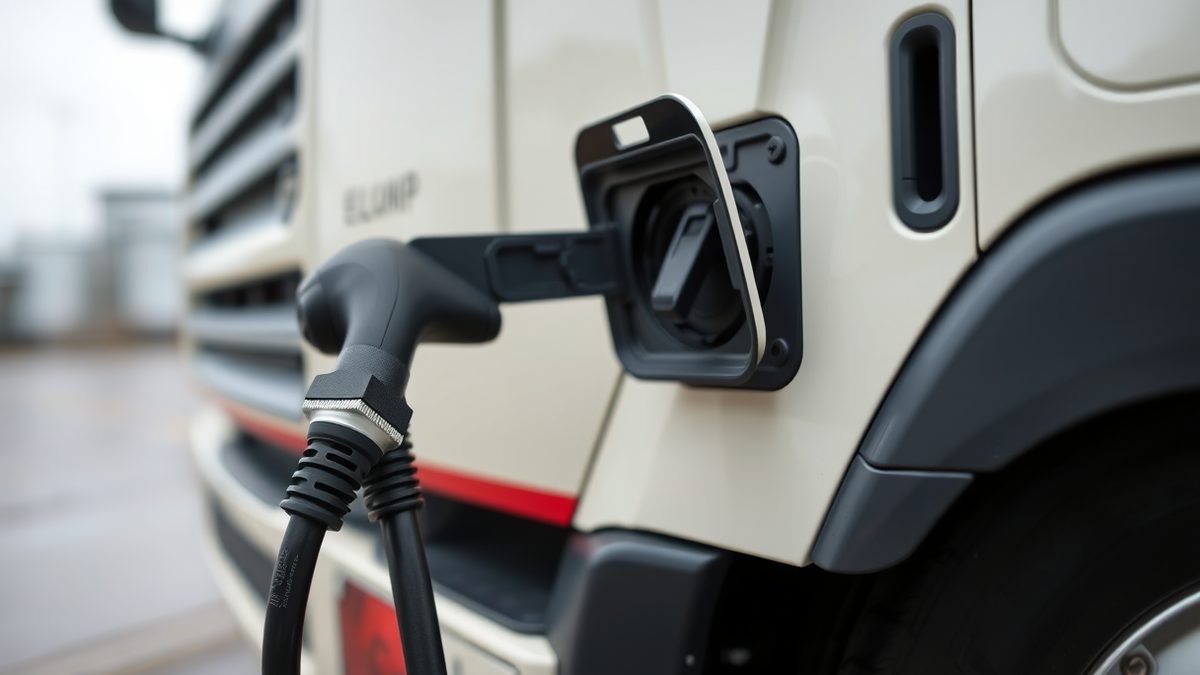
Germany's Bundesnetzagentur approved MiSpeL on 2 October, a set of rules for integrating electricity storage systems and charging points into the power market, pv magazine reported that morning. Under the framework, batteries can take power from the grid and feed it back later without losing support eligibility for the renewable electricity they hold. Bidirectional charging points are generally treated the same way as stationary storage.
That matters for trucks. Depot charging and megawatt charging both strain local grids, and storage is one of the few ways operators can plug in without waiting years for a connection upgrade.
The demand side is not waiting. BloombergNEF put global medium- and heavy-duty electric truck sales at a record 158,000 vehicles in the first half of 2026, up 75% from the same period a year earlier, in a 30 September blog post. More than nine out of ten of those trucks were sold in China. Electric trucks now account for roughly 20% of total truck sales worldwide, BNEF said. In Europe the share was 5.5% in the first half, with Norway and Switzerland running higher.
Order books fill up
Two fleet orders in the past week show the demand is not only Chinese. FedEx ordered 2,000 medium-duty electric trucks from Harbinger, a California startup that builds its Class 5 and Class 6 vehicles in the state, InsideEVs reported on 1 October. The trucks will be deployed in the US and Canada by the end of 2027. Harbinger estimates the order is worth more than $200 million and will save FedEx about $40 million a year in fuel, with total savings of $800 million over a 20-year service life. FedEx previously ordered 53 Harbinger trucks.
The same day, Electrek reported that Gateway Fleets had ordered 200 Workhorse W56 step vans, doubling an earlier purchase of 100. Workhorse chief executive Scott Griffith said in that article that customers are looking for lower operating costs "without sacrificing safety or performance." The W56 carries a 210 kWh battery pack and is rated for up to 150 miles of range.
None of those trucks move without a charger. And BNEF's own numbers show how rough the economics of truck charging still are. On top of electricity costs, station operators need to charge roughly $0.10 to $0.22 per kilowatt-hour to recover their investment, BNEF said, with utilisation varying widely between sites. High-power stations face cost and grid-connection hurdles in Europe, China and the US alike.
The grid is the constraint
Transport & Environment laid out the scale of that connection problem in a 1 October piece carried by CleanTechnica. Some 375 GW of clean energy projects and 455 GW of battery storage projects are sitting in queues waiting for permission to connect to the grid. Demand-side projects, including ports and airports, are stuck in a parallel queue facing the same physical bottleneck.
The EU has already legislated the demand into existence. Under AFIR and FuelEU Maritime, container and passenger ships calling at EU ports must plug into onshore power supply by 2030 instead of running auxiliary engines at berth. AFIR obliges major airports to supply electricity to stationary aircraft at contact stands from 2025 and at remote stands from 2030.
Germany's MiSpeL rules are one answer to that congestion: let storage and bidirectional charging absorb and shift load instead of demanding more capacity. The Bundesnetzagentur had to revise its original proposal after automakers and energy companies warned in September that the flat-rate option could make bidirectional charging harder. The final version simplifies the flat-rate calculations for charging points, pv magazine reported. BSW-Solar managing director Carsten Körnig called MiSpeL a long-awaited regulatory key for using renewable and grid electricity simultaneously with battery storage. The flat-rate option still needs European Commission approval under state-aid rules.
Charging hardware is moving faster than the wires behind it. EVgo previewed a DC fast charging system capable of delivering up to 750 kW, Electrek reported on 29 September. The system shares power across stalls and is being developed at the company's Innovation Lab in El Segundo, California, with support from Delta Electronics. EVgo claims it could charge the fastest-charging EVs on sale in the US in around 10 minutes, though it has not specified the battery percentage range behind that estimate. The final design and deployment are now expected in 2027, later than the second half of 2026 the company projected in 2024.
For heavy trucks, the relevant figure is higher still. BNEF's point is that megawatt-scale charging only pencils out as station utilisation rises, and utilisation depends on how many electric trucks are running regular routes past a given site.
What the economics say
The case for switching keeps strengthening as diesel prices climb. A Transport & Environment total cost of ownership analysis, published on 28 September and carried by CleanTechnica, found electric trucks are already the cheapest financial choice in six of nine major EU markets, which together account for 46% of new heavy truck sales in the bloc. Five-year savings reach about €100,000 in the Netherlands, €85,000 in Germany and €69,000 in Denmark, with payback after two years. With current diesel prices, T&E said those savings could rise to €123,000 and €106,000 in the Netherlands and Germany respectively.
Chinese trucks change the maths further. T&E calculated that buying a Chinese electric truck rather than a European one would mean €34,000 more in five-year savings in Germany, and up to €128,000 in the Netherlands. Stef Cornelis, T&E's director of freight and fleets, said truckmakers should stop asking for delays to EU electrification targets and stick to the 2030 CO2 goals. "Governments can play their part by exempting e-trucks from road tolls while accelerating charging infrastructure and grid connections," he said in that analysis. "Reintroducing fuel rebates is the wrong answer to this crisis."
The US picture is the opposite of Europe's. BNEF described the American battery-electric truck market as having slowed to a near standstill, with policy and cost headwinds limiting uptake. The second Trump administration ended federal EV tax credits, froze grants for electric trucks and chargers, and worked with Congress to nullify California's authority to set its own truck emissions standards, Canary Media reported on 2 October.
US electricity consumption tells the same story from the demand side. Light-duty electric vehicles consumed 8% more electricity in the first half of 2026 than in the previous six months, the Energy Information Administration estimated, down from the 13% to 24% growth seen in earlier six-month periods. New electric vehicle sales fell 19% in the first half of 2026 compared with the second half of 2025, after the New Clean Vehicle Credit and Qualified Commercial Clean Vehicle Credit expired on 30 September 2025.
California is the exception. About 2,000 zero-emission heavy trucks now operate on the state's roads, more than anywhere else in the US, according to Canary Media. Governor Gavin Newsom signed Senate Bill 1213 last week, which from 2027 will require truck manufacturers to share pricing data with state agencies if they want their vehicles to qualify for incentive programmes including CARB's voucher scheme and the California Energy Commission's Clean Transportation Program. A 2024 CARB report found the average zero-emission Class 8 truck in California cost $436,000, about $87,000 more than the average in Europe.
Some of that money is heading into chargers rather than vehicles. IONNA, the charging joint venture owned by eight automakers including BMW, GM, Honda, Hyundai, Kia, Mercedes-Benz, Stellantis and Toyota, now has more than 180 sites open across the US and says it has more than doubled its footprint since the start of 2026, Electrek reported on 30 September. The network says it is the largest 400 kW charging network in the country. Hyundai and Mercedes-Benz joined BMW on 1 October in offering a 10% charging discount through their apps, and Volvo drivers gained Plug & Charge support. IONNA chief executive Seth Cutler told Electrek that keeping quality high during rapid growth was his biggest challenge. The company ranked first for DC fast-charging satisfaction in J.D. Power's 2026 US Electric Vehicle Experience Public Charging Study. It aims for 30,000 ultra-fast charging points by 2030.
Outside the US, the build-out is more advanced. BYD reached 2,000 highway flash charging stations, hitting its target three months early, CnEVPost reported on 24 September. The Philippines, where electrified vehicles made up 24.7% of vehicle sales from January through August, has proposed raising its EV industry development budget from P32.46 million in 2026 to P228.92 million in 2027, with money directed at charging facilities in government offices and a charging-system testing facility, CleanTechnica reported on 29 September. The country had 1,876 registered charging stations as of 31 August, against a 2028 target of at least 7,300.
Back in Europe, the charging build-out faces the same connection queue as everything else. T&E's warning is blunt: rules that force ports and airports to electrify are useless if the cable does not arrive. Germany's MiSpeL is a small, technical fix for one part of that problem. It will not be the last one needed.
Sources
13- 01Germany approves rules for storage, bidirectional chargingEN
- 02The Electric Trucking Market's Record Rise: Three Things to KnowEN
- 03FedEx Just Ordered 2,000 Electric Trucks That Will Save $40 Million Every Year On FuelEN
- 04Commercial EVs take off as Workhorse announces fresh, 200 truck orderEN
- 05Grid Connection at European Ports & Airports: Solutions to Accelerate Transport ElectrificationEN
- 06EVgo's 750 kW charging system is coming in 2027EN
- 07Electric Trucks Cheaper To Operate Than Diesel For Almost Half Of Trucks Sold In EU — New AnalysisEN
- 08Diesel prices are rising worldwide. So are electric truck sales.EN
- 09Electric trucks cost too much. California has a law for that.EN
- 10U.S. Electricity Use For Electric Vehicles Increasing At A Slower Pace In 2026EN
- 11IONNA tops 180 charging sites, with discounts for these EV driversEN
- 12BYD reaches 2,000 highway flash charging stations, hitting target 3 months earlyEN
- 13Philippines Boosts EV Infrastructure Budget as Charging Network Faces Expansion TestEN
All figures and quotations in this text come from the sources listed below.
Content prepared by the editorial team with AI assistance.
Peter Lindqvist
Comments
0- No comments yet — be the first.