FedEx Orders 2,000 Harbinger Electric Trucks As Charging Build-Out Lags
FedEx has ordered 2,000 medium-duty electric trucks from California startup Harbinger, the largest order yet for a company that has delivered only 53 vehicles to the parcel giant, according to InsideEVs.
 Peter LindqvistSport, cars and travel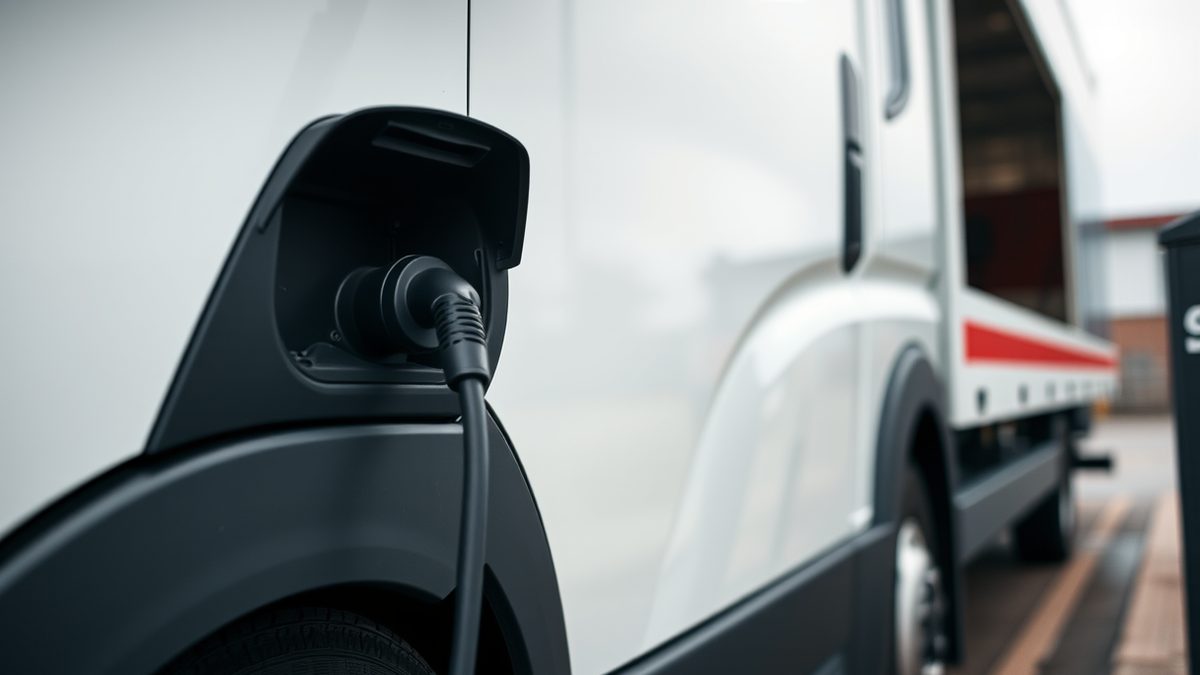
InsideEVs reported the order on 1 October. CleanTechnica carried it the same day. It lands as the electric truck market sets records in China and Europe while the United States stalls.
Harbinger builds its Class 5 and Class 6 trucks in California. InsideEVs says the 2,000 vehicles cost more than $200 million, will be deployed in the US and Canada by the end of 2027, and are engineered for a 20-year service life. The startup estimates they will save FedEx $40 million a year in fuel, or $800 million over that life, and avoid over 1.7 million tons of carbon dioxide.
Those are Harbinger's numbers, not independently audited figures. The same report notes the trucks start at $103,000 before incentives, carry a 35-kilowatt-hour battery pack rated at 800 volts in four-to-six-pack configurations, and deliver 140 to 210 miles of real-world range. A 20-to-80% charge takes under an hour on a DC fast charger.
The order is FedEx's biggest for Harbinger, after an initial 53 Class 5 and Class 6 models last year. It fits a goal of electrifying the entire pickup and delivery fleet by 2040.
Charging is the bottleneck, not the trucks
BloombergNEF reported on 30 September that global sales of medium- and heavy-duty electric trucks hit a record 158,000 units in the first half of 2026, up 75% from a year earlier, with more than nine in ten sold in China. The US battery-electric truck market, by contrast, has slowed to a near standstill, BNEF said, citing policy and cost headwinds.
BNEF also put Tesla's Semi at between $250,000 and $300,000 per vehicle, a price it says could already undercut the total cost of ownership of equivalent diesel trucks in some duty cycles, depending on charging costs. That conditional matters. Long-haul battery-electric trucking depends on adequate high-power charging, and BNEF says operators need roughly $0.10 to $0.22 per kilowatt-hour on top of electricity costs to recover investment in megawatt-scale stations.
Europe is where the charging build-out is most visible. BNEF notes that truck charging stations are being developed along freight routes and increasingly beside existing logistics infrastructure, with European Union deployment targets under the Alternative Fuels Infrastructure Regulation accelerating construction. Coverage remains patchy and concentrated across countries and regions.
Transport & Environment published a total cost of ownership analysis on 28 September finding that electric trucks are already the cheaper financial choice in six of nine major EU markets, which together account for 46% of all new heavy trucks sold in the bloc. It puts five-year savings at up to €100,000 in the Netherlands and €85,000 in Germany, with payback after two years. With current high diesel prices, CleanTechnica's write-up of the same analysis says those figures could rise to €123,000 and €106,000.
"Europe's truckers are on the front line of the diesel crisis. There has never been a better time to switch from diesel to electric, but we need truckmakers and governments to support them in doing so," said Stef Cornelis, director of freight and fleets at T&E, in the CleanTechnica report.
Cornelis also warned against reintroducing fuel rebates, calling that the wrong answer to the crisis.
In the US, the policy picture runs the other way. CleanTechnica noted on 30 September that the $7,500 federal tax credit ended on 30 September 2025 and that EV sales fell sharply afterwards. The US Energy Information Administration, in a 30 September piece carried by CleanTechnica, estimated that light-duty EVs consumed 8% more electricity in the first half of 2026 than in the second half of 2025, down from the 13% to 24% growth seen in recent six-month periods, with new EV sales down 19% in 1H26 versus 2H25.
California tries to bring prices down
Canary Media reported on 30 September that Governor Gavin Newsom signed Senate Bill 1213, which requires truck manufacturers to share pricing data with state agencies starting in 2027 if they want their vehicles eligible for incentive programs including CARB's Hybrid and Zero-Emission Truck and Bus Voucher Incentive Project and the California Energy Commission's Clean Transportation Program.
The bill's backers point to a 2024 California Air Resources Board report showing the average price of a zero-emission Class 8 truck in California was $436,000, about $87,000 more than the average in Europe. Canary Media also cites International Council on Clean Transportation research finding big gaps between US and European pricing, and quotes Ray Minjares, the council's heavy-duty vehicles program director, saying commercial trucks are sold through business-to-business transactions that "do not operate under a high degree of pricing transparency."
About 2,000 zero-emission heavy trucks now run on California roads, far more than in any other state, against roughly 1.8 million commercial trucks in total, almost all diesel.
The US charging side is expanding anyway. On 30 September, IONNA said it had passed 180 open sites, more than double its footprint at the start of 2026, according to Electrek and InsideEVs. IONNA CEO Seth Cutler told InsideEVs the company started the year at 80 sites. The network, backed by BMW, GM, Honda, Hyundai, Kia, Mercedes-Benz, Stellantis and Toyota, aims for 30,000 ultra-fast charging points by 2030 and has more than 40 Circle K partner sites live since announcing that deal in April.
On 1 October, Electrek reported that BMW, Hyundai and Mercedes-Benz drivers can now get 10% charging discounts through their automaker apps and Plug & Charge. CleanTechnica reported the previous day that IONNA had nearly 1,000 charging bays in operation as of March, with another 4,700 under contract.
None of that is truck-specific megawatt charging, which is the harder engineering problem. EVgo said on 29 September that its 750 kW DC fast charging system will begin deployment in 2027, later than the second half of 2026 it projected when it announced work with Delta Electronics in 2024. Electrek notes the company has not specified the battery percentage range behind its claim that the system could charge the fastest-charging EVs sold in the US in around 10 minutes.
Financing is adapting in the meantime. BNEF says transactions are increasingly underwritten against a truck's contracted transport operation rather than its resale value alone, a response to wide variability in electric truck residual values caused by uncertainty over battery degradation.
Elsewhere, the orders keep coming. Electrek reported on 30 September that Gateway Fleets ordered 200 more Workhorse W56 step vans, after 100 earlier this year, with 210 kWh battery packs, up to 150 miles of range and 10,000 pounds of payload capacity in 1,000 cubic foot boxes. Workhorse CEO Scott Griffith said in that report that bundled pricing eliminates the higher upfront vehicle cost and the added capital for charging infrastructure.
The Philippine government, meanwhile, is proposing P228.92 million ($3.71 million) for its Electric Vehicle Industry Development Program in 2027, up from P32.46 million ($526,000) in 2026, CleanTechnica reported on 29 September. The Department of Energy had accredited 422 charging station providers and registered 1,876 stations as of 31 August, against a CREVI target of at least 7,300 stations between 2023 and 2028.
That is the shape of the problem everywhere: trucks are being ordered, and the chargers are still being counted.
Sources
14- 01FedEx Just Ordered 2,000 Electric Trucks That Will Save $40 Million Every Year On FuelEN
- 02US Startup Adds Another 2,000 Electric Trucks To The FedEx FleetEN
- 03The Electric Trucking Market's Record Rise: Three Things to KnowEN
- 04Electric Trucks Cheaper To Operate Than Diesel For Almost Half Of Trucks Sold In EUEN
- 05Are Electric Trucks Cheaper To Operate Than Diesel?EN
- 06Is The US Going To End DEAD LAST In Vehicle Electrification?EN
- 07U.S. Electricity Use For Electric Vehicles Increasing At A Slower Pace In 2026EN
- 08Electric trucks cost too much. California has a law for that.EN
- 09IONNA tops 180 charging sites, with discounts for these EV driversEN
- 10Ionna Has Doubled Its Charging Network This Year. It's Not Slowing DownEN
- 11New EV Charging Checklist: Style, Comfort, And A Cool Place To HangEN
- 12EVgo's 750 kW charging system is coming in 2027EN
- 13Commercial EVs take off as Workhorse announces fresh, 200 truck orderEN
- 14Philippines Boosts EV Infrastructure Budget as Charging Network Faces Expansion TestEN
All figures and quotations in this text come from the sources listed below.
Content prepared by the editorial team with AI assistance.
Peter Lindqvist
Comments
0- No comments yet — be the first.