Free fast lanes at German airports: book a slot from 48 hours to 100 days before departure
The fast security check at German airports is usually free, but when booking opens varies by a factor of two between airports.
 Peter LindqvistSport, cars and travel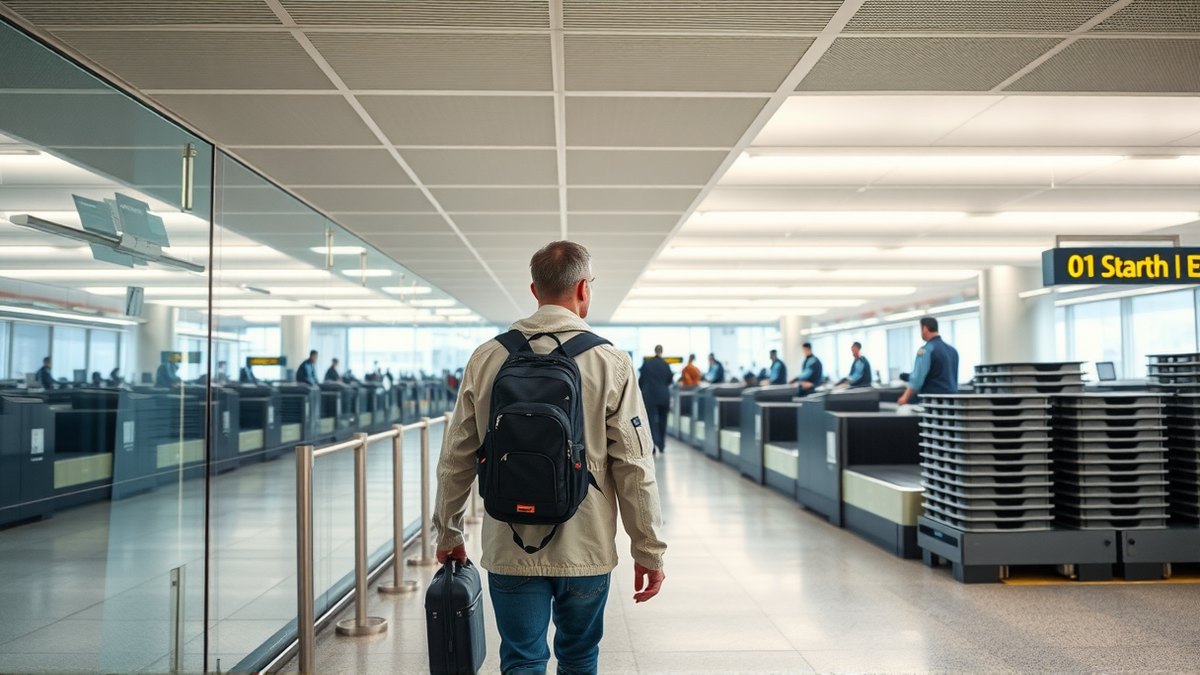
At German airports you can book a faster security check, and against intuition it is almost always free. BER went first, launching BER Runway in August 2022. The service was a response to the chaos after the pandemic: passengers flooded back to airports while security staff had been heavily cut. Queues stretched for hours, crowds spilled out in front of the terminals and passengers missed connections in large numbers.
How it works
The principle is simple: you book a time window, not a place in the queue. At BER, from three days before departure, a passenger could book a 15-minute slot at a dedicated security line for themselves and up to four companions. Anyone who arrived on time got through security in minutes.
Today the most important parameter is when booking opens, and that differs between airports. In Hamburg, Frankfurt and Düsseldorf you can book a slot exactly 72 hours before departure, in Hanover 96 hours, in Stuttgart 48 hours, and in Cologne/Bonn as much as 100 days in advance.
BER withdrew the service
The Berlin airport switched the service off in May 2026. The reason is not a crisis: the airport is better equipped, and every security line now has the latest CT scanners, which do not require taking out laptops or liquids. Liquids can now be carried in double quantity, up to two litres.
That does not mean the service has lost its point. In Germany, unlike for example in the United Kingdom, it is almost always free, which made it popular. Whether it actually works remains an open question: F.A.Z. describes a study assessing the usefulness of these solutions from the passenger's point of view.
The service only makes sense if the airport has unused capacity in security. Booking a slot does not create an extra checkpoint or hire a new employee, it only changes the order of entry. So it works when the bottleneck is queue organisation, not the throughput of security itself.
The differences in deadlines show that German airports have not worked out a common standard. Each sets its own booking window and its own rules for access to the dedicated security line. Many passengers do not even know they can book a slot, because the service is not promoted as widely as paid extras.
The scale of traffic means security throughput will remain a bottleneck. In 2026 airlines are expected to carry 5,085 million passengers, 118 million more than in 2025.
Sources
2- 01F.A.Z. — Fast Lanes am Flughafen: Vorzugsbehandlung auf BestellungDE
- 02IATA — Industry Statistics Fact SheetEN
All figures and quotations in this text come from the sources listed below.
Content prepared by the editorial team with AI assistance.
Peter Lindqvist
Comments
0- No comments yet — be the first.