Google's orbital AI data centre test has 15 minutes of cooling, 1 kW of solar
Google's first orbital data centre satellite, MVP, is set to launch on 1 October with four tensor chips and about one kilowatt of solar power. Its cooling system will only let the chips run for roughly 15 minutes at a time, according to Ars Technica and Tom's Hardware.
 Grace OkonkwoAI, models and technology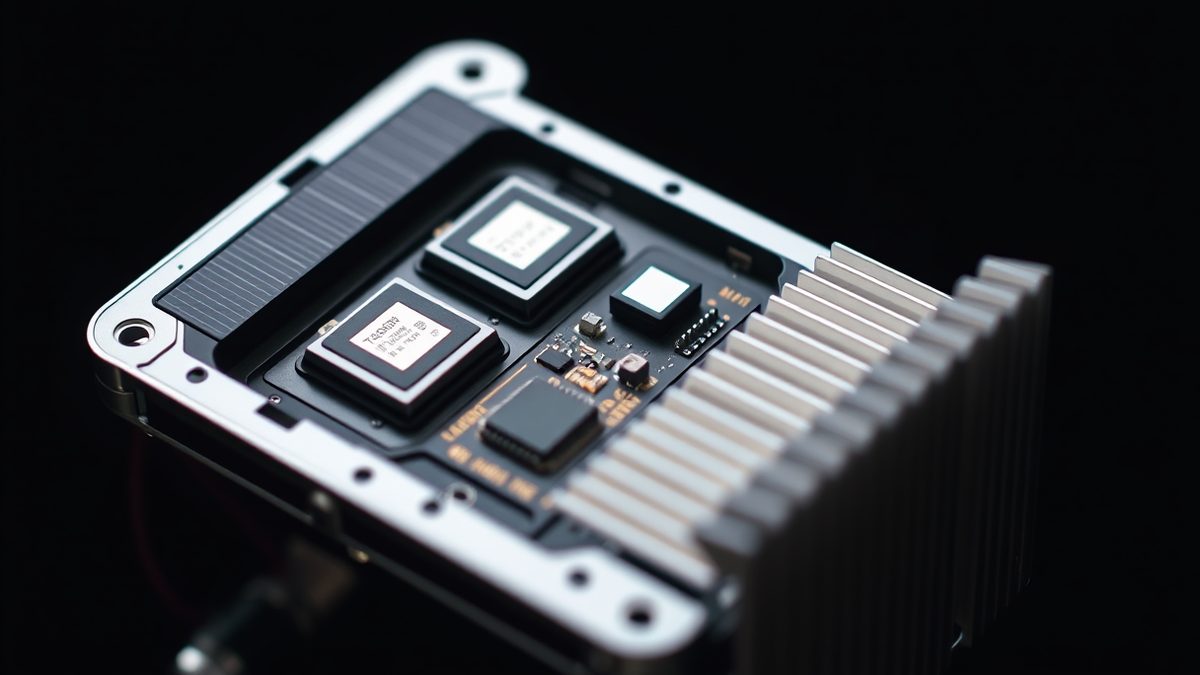
The satellite is called MVP. It is roughly the size of a refrigerator. Inside sit four of Google's custom Tensor Processing Units, the same accelerator silicon the company uses in terrestrial servers to train models and run inference. Ars Technica reported on 24 September that the launch is booked for 1 October as part of the Transporter-18 rideshare aboard a SpaceX Falcon 9. Tom's Hardware puts the launch site at Vandenberg Space Force Base in California.
Google did not build the spacecraft itself. According to Ars Technica, the satellite comes from Planet Labs, an Earth imaging firm. The original plan was to fly two custom satellites in 2027, but Google chose to move faster and bolted its AI hardware into a satellite Planet Labs had already assembled for an earlier test. Tom's Hardware describes the wider effort as Project Suncatcher.
Power is a microwave, cooling is a radiator
The power budget is the clearest signal of how small this test is. Ars Technica reports the solar panels supply around one kilowatt, which the site says is enough to run a microwave or a hair dryer. Tom's Hardware gives the same figure and notes the satellite's capabilities are similar to a single Earth-bound server. On the ground, a data centre runs thousands of these chips and draws megawatts. That is the whole reason orbital compute keeps coming up in AI circles.
Cooling is the harder problem, and both outlets flag it as the biggest open question. Space has radiators, but they are built to shed relatively small amounts of heat, while AI accelerators generate far more. Google's answer, as described by Ars Technica, is a layer of malleable thermal interface material that connects each chip to aluminium and copper heat pipes. Those pipes conduct heat into a radiator that projects it into space. Tom's Hardware points out the obvious gap in that design: there is no air in orbit, so the usual fan-based approach simply does not work.
The result is a duty cycle, not a server. The chips will run in bursts of about 15 minutes, after which they have to shut down and let the radiators catch up, according to Ars Technica. Tom's Hardware frames the same limit as overheating that forces shutdowns. Google plans to run Gemini models on the TPUs during the test.
"We don't expect, to be perfectly frank, that we'll have anything usefully operational in the next few years," Google senior vice president of research James Manyika told The New York Times, according to Tom's Hardware.
Manyika compared the effort to Google's driverless car programme, which he said the company was testing roughly 15 years before anything shipped, according to Tom's Hardware. By that estimate, the gap from a four-chip satellite to a working orbital data centre is about 15 years. Google has said it plans to launch a pair of satellites next. Tom's Hardware reports long-term plans have floated networked fleets of more than 80 satellites, linked by high-speed laser connections that would probably need dedicated launches rather than rideshares.
Radiation, bit flips and a six-year orbit
Radiation is the other physics problem. Tom's Hardware notes that radiation in space can cause bit flips that change how chips process data, and that Google's current answer is to restart the chips periodically to reset them. Ars Technica adds that vibration and high g-forces during launch also pose risks, and that these are the same TPUs Google puts into ground servers rather than radiation-hardened parts.
The satellite will handle AI requests for up to a year, according to Tom's Hardware, though it will stay in orbit for up to six years before gravity brings it down to burn up on re-entry. Ars Technica reports it will operate for just a few months. The two outlets differ on that point, and Google has not published a figure that resolves it.
Google is not alone in looking upward. Tom's Hardware notes that Elon Musk, Jeff Bezos and Sam Altman have all talked up orbital data centres, that China has already put AI compute into orbit, and that Intel holds a patent in the area. The attraction is straightforward: solar power in space is uninterrupted, and the land, water and grid connections that terrestrial AI data centres fight over do not exist up there.
The counterargument is cost. One commenter quoted by Tom's Hardware calculated that launching a single server into space to cut cooling costs makes little sense when one kilowatt will not power a single power supply in a regular server. Another commenter argued the point of the experiment is to learn how compute in space could work, not to be cost-effective on the first flight. Both reactions sit under the same article, and neither is a Google position.
Meanwhile, the grid and the regulators
The orbital test lands in a week when terrestrial data centre power was already in the news. The Register reported on 25 September that the US Department of Energy announced $5.25 billion for grid improvements, made up of $1.9 billion in federal funds and $3.35 billion in cost-share funding. The programme covers 31 projects across 26 states and is expected to free up at least 23 gigawatts of additional capacity, according to the Department of Energy.
The money is not for new generation. The projects aim to reconductor or rebuild more than 1,500 miles of transmission lines and deploy grid-enhancing technologies such as sensors and power flow control devices across 21,000 miles of infrastructure. US Secretary of Energy Chris Wright said in a statement that the investments "will get more out of the infrastructure we already have, move more electricity across the grid, and help deliver affordable, reliable, and secure power that will fuel American prosperity for decades to come."
The Register also cites a warning from Moody's earlier in September that the pace of data centre construction exceeds the speed at which the US grid can add the required capacity. Moody's estimates US data centre electricity consumption will reach 426 TWh by 2030, nearly double the 2025 figure, according to The Register.
Regulators are moving too, and not always in the direction operators would like. Ars Technica reported on 24 September that New Jersey fined DataOne $1.1 million for secretly installing and operating gas generators in violation of the state's Air Pollution Control Act. The case began with thermal drone footage gathered by The Guardian and Floodlight News in August showing 45 of 62 gas generators running.
None of the generators had the permits required for units of 37 kilowatts or higher, Ars Technica reports, despite running at 1,982 kilowatts, more than 50 times the state threshold. New Jersey's Department of Environmental Protection said such generators emit carbon dioxide, nitrogen oxides, carbon monoxide and other combustion pollutants that can worsen asthma, trigger heart attacks and cause early deaths. DEP Commissioner Ed Potosnak called the action the largest ever taken against a data centre in New Jersey and said data centres would not be "constructed or operated with impunity in this state."
DataOne has 45 days to apply for permits or cease operations, but can keep running the engines while it seeks them. A company spokesperson told The New York Times that DataOne will apply for air permits for the temporary generators, that it "disagreed" with the fine, and that the site is transitioning to low-emission fuel cells. Local residents quoted by the Times were unpersuaded. Tiffany Leone-Vespa asked what the neighbourhood had been breathing in since the generators started running without permits. Steve Brown called it a "don't ask for permission, just ask for forgiveness later" arrangement.
The thread connecting the two stories is that power and heat are the constraints, whether the rack sits in Vineland, New Jersey or in low Earth orbit. On the ground, the answers so far are grid upgrades, reconductoring, fuel cells and, in New Jersey's case, a seven-figure fine. In orbit, the answer is a radiator, a 15-minute duty cycle and a lot of questions that a refrigerator-sized satellite is meant to start answering after 1 October.
Sources
5- 01Zelensky says Russia has widened attacks to hit Ukraine's data centresEN
- 02Google's orbital AI data center test packs four TPUs and 1,000W of solar powerEN
- 03Uncle Sam coughs up $1.9B for grid upgrades as datacenters hit a power wallEN
- 04New Jersey fines data center $1.1M after drone pics expose 62 gas generatorsEN
- 05Google's first Suncatcher orbital data center test launches October 1EN
All figures and quotations in this text come from the sources listed below.
Content prepared by the editorial team with AI assistance.
Grace Okonkwo
Comments
0- No comments yet — be the first.