Google's orbital data centre test and three other power and cooling stories that explain the squeeze
Four stories published between 24 and 26 September 2026, from New Jersey and New Mexico to Kyiv and low Earth orbit, all circle the same problem: AI hardware needs power and heat removal that existing infrastructure cannot easily supply.
 Grace OkonkwoAI, models and technology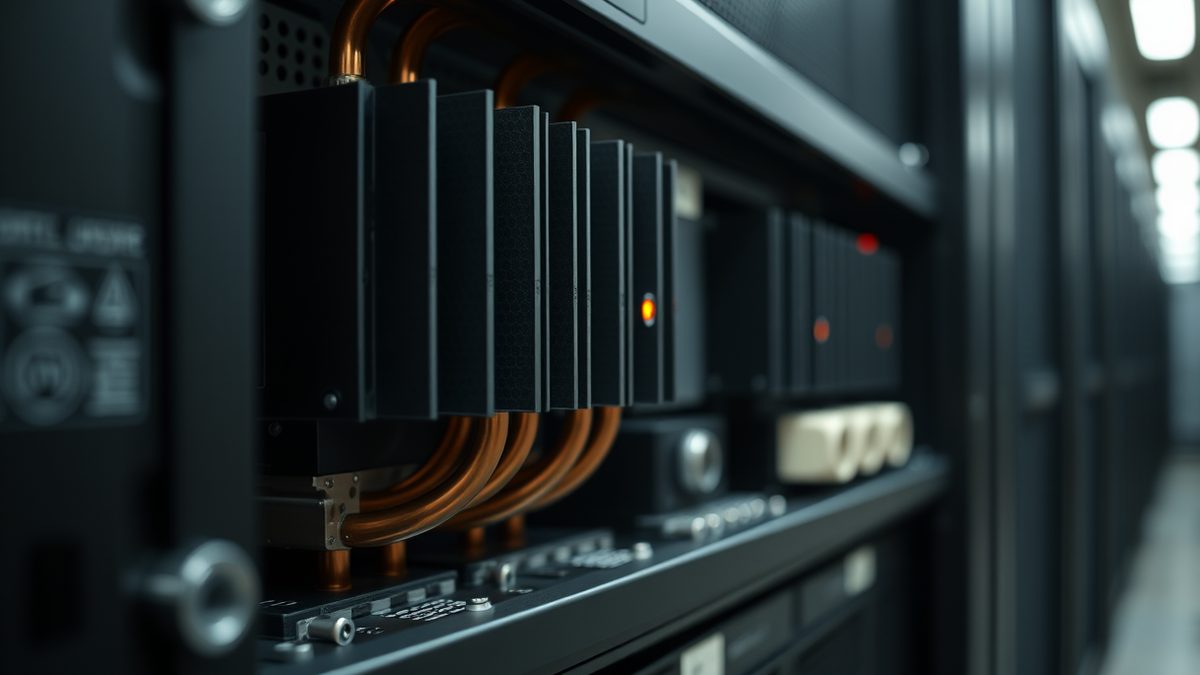
Google will launch an experimental satellite called MVP on October 1, aboard a SpaceX Falcon 9 flying as part of the Transporter-18 rideshare, according to Ars Technica. The satellite is about the size of a refrigerator and carries four of Google's custom TPU AI accelerators. It is the first step in Project Suncatcher, the company's effort to design orbital AI data centres. Tom's Hardware reported the launch window on 26 September; Ars Technica detailed the payload on 24 September.
The numbers are deliberately small. Four chips. Roughly one kilowatt of solar power, which Ars Technica notes is enough to run a microwave or a hair dryer. Google will run Gemini models on the TPUs as a test, but the chips cannot run continuously. The cooling system works in bursts of about 15 minutes, after which the TPUs must shut down so the radiators can catch up.
Why a radiator in space is harder than it sounds
Cooling is the constraint that keeps coming back in every orbital data centre pitch, and Google's design illustrates why. There is no air in space, so fans are useless. Heat has to be conducted away from the chips and radiated into the void. Google's answer, per Ars Technica, is a layer of malleable "thermal interface material" connecting the chips to aluminium and copper heat pipes, which carry heat into a radiator that projects it into space. Tom's Hardware describes the same system as venting heat directly into space.
Radiation is the other problem. Ars Technica notes that radiation can damage chips or interfere with calculations by flipping bits. Google's interim fix is to restart the chips periodically to reset them.
"We don't expect, to be perfectly frank, that we'll have anything usefully operational in the next few years," Google senior vice president of research James Manyika told The New York Times, as quoted by Tom's Hardware.
Manyika compared the effort to Google's driverless cars, saying the company tested those "like 15 years before anything showed up." Google plans to launch a pair of satellites next, with long-term plans for networked fleets of more than 80 satellites, according to Tom's Hardware. The MVP satellite is expected to handle AI requests for up to a year and remain in orbit for up to six years before burning up on re-entry.
New Jersey: 62 generators, no permits, $1.1 million
On the ground, the power problem is being solved in less elegant ways. New Jersey this week fined DataOne, the operator of one of the East Coast's largest planned data centres, $1.1 million for secretly installing and operating gas generators in violation of the state's Air Pollution Control Act, Ars Technica reported on 24 September.
The complaint originated with a farmer photographing a neighbouring golf course, who first spotted "some type of unit" on satellite imagery, according to the New York Times, as cited by Ars Technica. A subsequent investigation by The Guardian and Floodlight News used thermal drone footage showing 45 of the 62 generators running. None had permits, which are required for generators of 37-kilowatt capacity or higher. The units were running at 1,982-kW capacities, more than 50 times the state limit.
New Jersey's Department of Environmental Protection says such generators emit carbon dioxide, nitrogen oxides, carbon monoxide and other combustion-related pollutants that can worsen asthma, trigger heart attacks and cause early deaths. DEP Commissioner Ed Potosnak called the action "by far the largest ever taken against a data centre in New Jersey" and said data centres would not be "constructed or operated with impunity in this state."
The remedy has a gap. DataOne has 45 days to apply for permits or cease operations, but it can keep running the engines while it seeks them. Nichole Gardner of the local nonprofit Sustain SJ told Ars Technica the penalty is "insufficient, both in dollar amount and enforcement." DataOne told the New York Times it "disagreed" with the fine and will apply for the air permits. The company says it is transitioning to low-emission fuel cells.
Oracle's force majeure notice in New Mexico
Power supply risk is also reshaping contracts. Oracle sent a "force majeure" notice to the developer of its New Mexico data centre project, CNBC reported on 24 September, citing Bloomberg. The company is looking to delay payment if the campus, dubbed Project Jupiter, does not come online in 2028 as expected. Oracle shares fell more than 3% on the news. The notice went to a unit of Blue Owl Capital, which also saw its shares fall.
Project Jupiter is part of the Stargate AI infrastructure build-out and has faced regulatory hurdles, local opposition ahead of the midterm elections, environmental concerns and delays to a natural gas pipeline meant to fuel the site. Bloom Energy, which is slated to power the more than 2.4-gigawatt facility with fuel cells, fell 3%. Oracle said in a statement to CNBC that "Project Jupiter remains on our planned schedule" and that it is "fully committed to New Mexico."
CNBC also cited the Financial Times on concerns over $18 billion in Oracle debt tied to the data centre, already trading at stressed levels. Oracle co-CEO Clay Magouyrk told analysts on 10 September that Project Jupiter would not affect previously stated fiscal 2027 revenue or earnings guidance.
Crusoe drops a $1.25 billion turbine order
Turbine supply is proving just as fluid. Crusoe, a Denver-based AI data centre startup that recently raised $3.9 billion, has ended plans to use stationary power plants from fellow Denver company Boom Supersonic, TechCrunch reported on 25 September. Crusoe had agreed to spend $1.25 billion on 29 of Boom's 42-megawatt Superpower turbines, with first deliveries due in 2027.
Boom CEO Blake Scholl said in a post on X that the companies are no longer moving forward with the launch partnership, adding that "Boom will be delivering about 250MW of Superpowers next year to other sites, and we're targeting 1GW in 2028." Crusoe spokesperson Andrew Schmitt told TechCrunch the company's energy plans "haven't changed" and that it still plans to use turbines, "just not Boom's." Crusoe's initial 1.2-gigawatt Abilene campus, built for Oracle and OpenAI, runs on the grid with a gas-turbine plant for backup. A 900-megawatt Abilene site for Microsoft will be powered by on-site gas turbines.
What ties these together
Each story is a different answer to the same constraint. When grid power and permitted cooling are not available on schedule, operators improvise: unpermitted generators in Vineland, a force majeure clause in New Mexico, a cancelled turbine order between two Denver companies, and in Google's case, an attempt to move the whole problem off the planet.
Space does not remove the constraint. It relocates it. Ars Technica notes that radiator systems in space are designed to remove relatively small amounts of heat, while AI accelerators generate far more. Google's four-chip test will run in 15-minute bursts. That is the honest scale of the experiment. Manyika's own estimate, as quoted by Tom's Hardware, is that Google has 15 years to go from a four-chip server to a full-on data centre.
Meanwhile, utility regulators, courts and local councils are setting the terms on the ground. New Jersey's six-month gap between residents' first complaints in February and enforcement in July is a reminder that oversight is running behind deployment. DataOne's residents are still asking what they were breathing.
Sources
6- 01Zelensky says Russia has widened attacks to hit Ukraine's data centresEN
- 02Google's orbital AI data center test packs four TPUs and 1,000W of solar powerEN
- 03New Jersey fines data center $1.1M after drone pics expose 62 gas generatorsEN
- 04Google's first Suncatcher orbital data center test launches October 1EN
- 05Oracle sent 'force majeure' notice about data center projectEN
- 06Crusoe abandons $1.25B plan to use Boom turbines at AI data centersEN
All figures and quotations in this text come from the sources listed below.
Content prepared by the editorial team with AI assistance.
Grace Okonkwo
Comments
0- No comments yet — be the first.