Home Batteries, EV Chargers and Edible Cells: The Battery Story Beyond the Car
Vermont's largest utility now runs what has quietly become the state's biggest power source, built from home batteries installed in more than 5,500 households, the BBC reported on 29 September.
 Peter LindqvistSport, cars and travel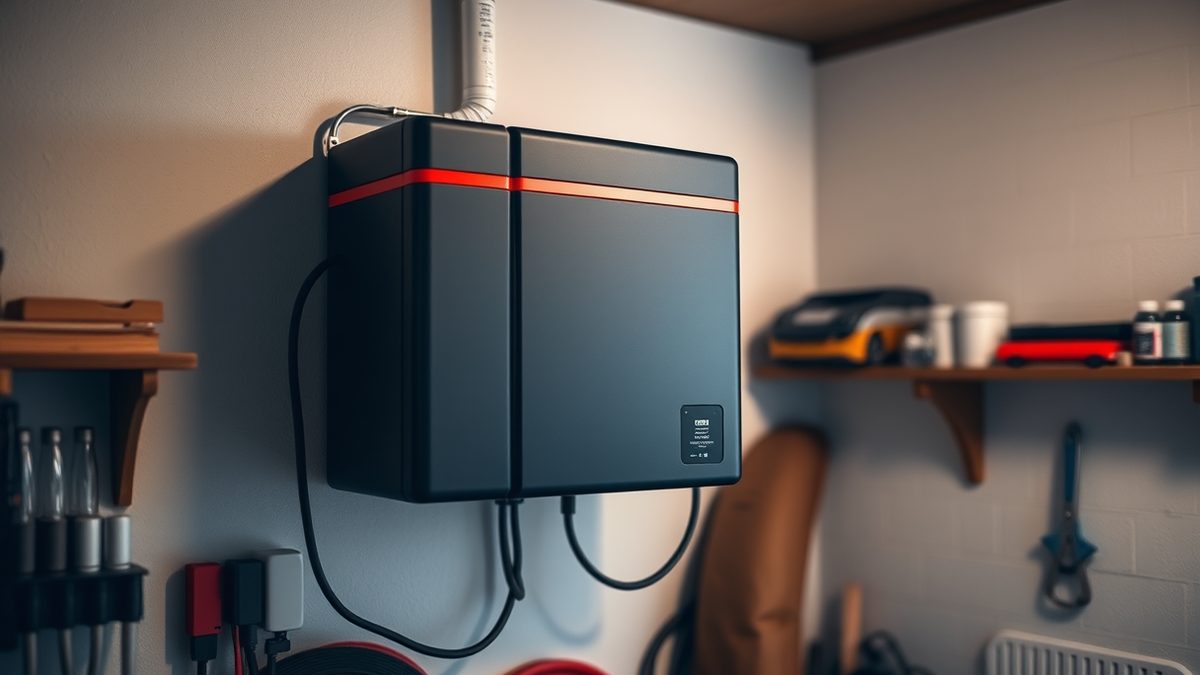
The BBC reported on 29 September that Green Mountain Power, Vermont's largest utility, leases two batteries to each participating home for $55 a month over 10 years. Its virtual power plant, an aggregation of thousands of small devices coordinated like a single generator, has become the state's biggest source of power. More than 5,500 Vermont homes are enrolled.
That is the newest development in a dossier where batteries keep turning up in places that have nothing to do with a car showroom.
A plug on four wheels
RNZ reported on 29 September that New Zealand's Energy Efficiency and Conservation Authority will fund up to 100 two-way chargers in homes and businesses in Auckland and other urban areas. The chargers let an electric vehicle charge as usual, then push electricity back into a house, a business or the national grid when prices peak. EECA policy and regulation manager Murray Bell said a charged car could run a household for up to three or four days during an outage.
The economics are the pitch: charge when power is cheap, discharge when it is expensive, sell any surplus. Bell said the avoided cost of new poles and wires "runs into the billions of dollars" once the country's expected demand growth is counted. The Ministry for Business, Innovation and Employment expects New Zealand's electricity demand to rise by between 35 and 82 percent by 2050.
None of this is plug-and-play yet. EECA says chargers that can discharge to the grid are not widely available in New Zealand. Bell listed the obstacles plainly: few compatible combinations of cars and chargers, manufacturers worried about third-party equipment affecting battery performance, safety concerns about older house wiring, and the practical question of where to bolt the box. Counties Energy, which runs the OpenLoop charging network, will recruit participants and deploy the hardware. Bell said BYD, now New Zealand's second-most popular EV brand behind Tesla, took part in Australian trials and could do the same here.
"We want this basically to be plug-and-play - that any EV owner can turn up, get a charger installed, and they should just be able to plug it into their house and everything should just work," Bell said.
Australia has already run large two-way charging trials, and RNZ reports the technology is available in certain circumstances in New South Wales and South Australia. A smaller trial is also expanding in Queenstown.
Delhi's other battery story
IEEE Spectrum published an account on 29 September from a professor of electrical engineering at Jamia Millia Islamia. It describes a city that lost more than half its power to obsolete equipment and theft in 2002. By 2026, losses had fallen to 5 to 6 percent, a level the article compares with France and Belgium, and better than Greece and Serbia.
The piece is a reminder that the grid a battery plugs into decides how much the battery is worth. Delhi's fix was distribution hardware and accountability, not storage.
Counting the energy we no longer need
Hannah Ritchie's Substack, published on 29 September, walks through numbers from Oxford professor Nick Eyre. In a post-transition system where suitable sectors are electrified and the rest runs on hydrogen, global final energy demand falls from 416 exajoules to 247 EJ. Electricity demand rises from 110 EJ to 189 EJ. The headline claim: electrification is efficiency, and the world needs roughly 40 percent less final energy, not more.
The sector detail matters for anyone modelling batteries. Electric cars convert about 80 percent of their energy into motion, against roughly 20 percent for petrol, so post-transition demand for cars and vans is about a quarter of today's. Half of heavy goods vehicle distance is assumed to be electrified, the rest hydrogen. Buses are 80 percent electrified. Only a third of aviation is, and just 10 percent of marine transport. Buildings are nearly fully electrified, with 90 percent of space heating handled by heat pumps in the model.
Ritchie is explicit that the model is simplistic and likely understates the savings. It assumes no efficiency gains beyond electrification and hydrogen, ignores energy growth as countries develop, and parks every non-electrified sector on hydrogen. She says readers can swap that choice for biofuels in aviation without changing the conclusion.
Germany trains them, then watches them go
VDE, one of Europe's largest technology organisations, published figures on 21 September. They show that international first-semester students in electrical and information technology at German universities have roughly doubled over 20 years and, since 2022, have made up more than half of all first-year students. Every euro invested in educating an international student generates about 16 euros in added value, the association calculates.
Then they leave. VDE says less than half of international students are available to the German labour market after graduation, and that 55.5 percent of international master's graduates, just over a third of all graduates, leave the country. Domestic students are about 7 percentage points more successful than their international peers.
Michael Schanz, who heads the VDE committee that ran the calculations, said the figures show the appeal of studying electrical engineering in Germany. Kira Kastell, who chairs the VDE studies committee, pointed to language, culture and academic comparability as hurdles. Thomas Hegger, an HR consultant and vice chair of the committee, proposed more coaching, language help and transparent scholarships. He floated Baden-Württemberg's model, where non-EU students pay fees covering about a third of costs, as a way to fund support. Schanz also noted that some countries deliberately send scholarship recipients abroad to obtain research findings and technologies.
A battery you can swallow
Chemical & Engineering News reported on 28 September on a battery that works inside a pig stomach for three days and then breaks down. The papery cathode is made from cellulose nanofibers, molybdenum trioxide and activated carbon; a magnesium alloy forms the anode; the electrolyte is a biodegradable ionic liquid made by melting choline chloride and lactic acid; beeswax encapsulates the stack. The work appears in Nature Chemical Engineering.
Giovanni Traverso, a mechanical engineer at MIT, said the team was inspired by edible rice paper used to wrap Asian candies. Delivered by endoscope, the battery powered an RFID tag and an electrical stimulation device that triggered release of a hunger hormone. Voltage dipped from 1.84 V, slightly above a standard AA cell, to 1.45 V over 72 hours. Imaging showed the molybdenum antenna and battery disintegrating into fragments within weeks; the non-resorbable RFID chip passed naturally, and the device degraded within a few months.
Yasser Khan, an electrical and computer engineer at the University of Southern California who was not involved in the study, called powering electronics inside the body one of the field's biggest challenges and the battery an important step. He also set the bar for human use: extensive biocompatibility testing, a clear picture of what the battery breaks down into, how much the body absorbs, and whether any of it harms the gut, especially with repeated swallowing. Traverso said layer thickness and encapsulation could be tuned to make the cells last days to weeks.
What the car industry is actually selling
Set the four non-automotive stories against the car headlines and a pattern shows up. The vehicle is becoming one battery among many, competing for the same grid services, the same charging infrastructure and the same lithium chemistry as a house in Vermont or a charger in Auckland.
That shifts the questions worth asking. Not how big the pack is, but who controls when it discharges, who pays for the wiring, what happens to the warranty, and whether the software that orchestrates thousands of packs is as dependable as the hardware it replaces. Vermont's answer, according to the BBC, is a lease and a utility that treats the fleet as a power station. Auckland's answer is still being tested. Delhi's, a quarter century in the making, was to fix the wires first.
Sources
6- 01Vermont replacing power plants with home batteriesEN
- 02EVs being trialled as giant batteries to power homes for less in AucklandEN
- 03How Delhi cut electricity loss from 50 to 5 percentEN
- 04The world will need less energy after the energy transitionEN
- 05Electrical Engineering Programs Are Popular Internationally, But the Majority Leave Germany AgainEN
- 06This Battery Is Ready to EatEN
All figures and quotations in this text come from the sources listed below.
Content prepared by the editorial team with AI assistance.
Peter Lindqvist
Comments
0- No comments yet — be the first.