How China's tech exports became the centre of a global policy fight
China now makes 90 percent of the world's batteries, and its open-weight AI models are free to download. That combination has pushed export policy off the trade pages and into the White House, Silicon Valley boardrooms and a Brooklyn courtroom.
 Dr. Amara PatelEconomy, business and world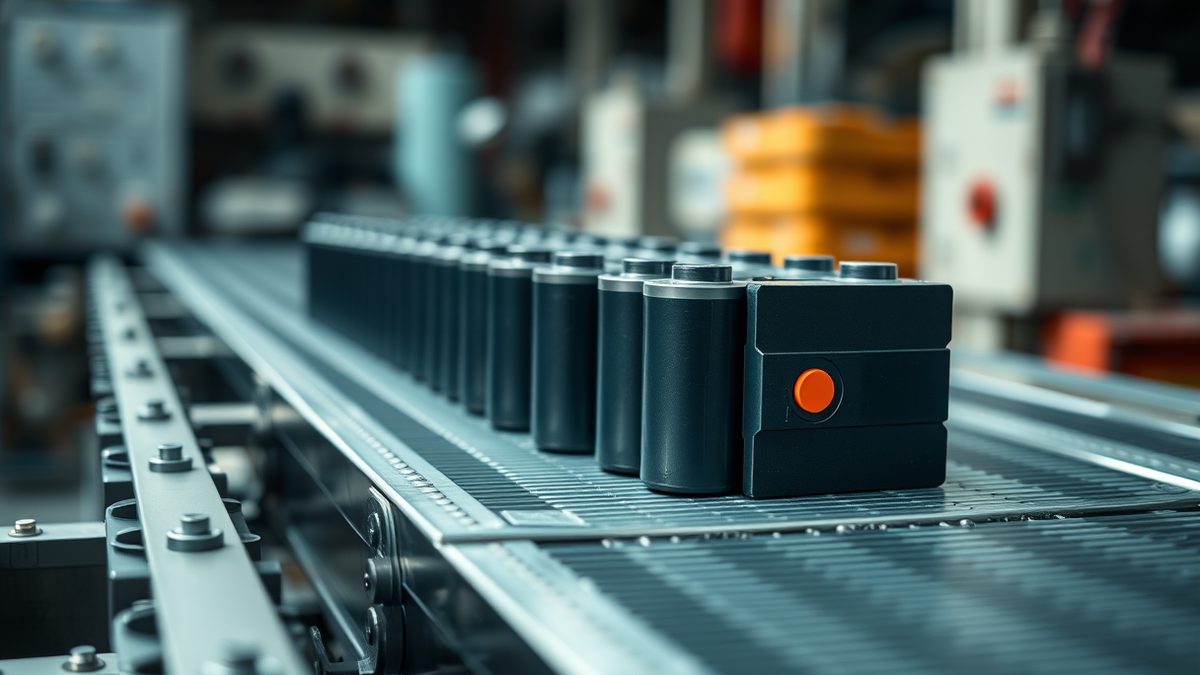
The numbers are not subtle. RNZ republished an ABC News analysis by chief business correspondent Ian Verrender, and it puts China at 90 percent of global battery production. In June a purpose-built LNG-powered bulk carrier called the BYD Zhengzhou docked at the Port of Melbourne with 5,000 newly built electric vehicles on board, the largest single EV shipment ever sent to Australia.
That is the export story in one image. What has changed over the past year is that the same story now runs through AI, chips, robots and criminal law.
Three separate fights are being reported as one. The first is about physical goods: batteries, electric cars and the minerals that go into them. The second is about software, specifically Chinese open-weight AI models that anyone can download for free. The third is about enforcement, and it is playing out in a US federal court in Brooklyn. Each has its own facts, its own numbers and its own set of people who cannot agree on what to do next.
Cars and batteries: the export machine
Australia is a useful test case. It has no domestic car industry, having lost it a decade ago, and few trade barriers, according to the RNZ piece. In the first half of this year, sales for every major Japanese manufacturer except Honda fell. Mazda dropped 17 percent year on year, Toyota 21 percent, Subaru and Mitsubishi 25 percent each, and Nissan 32 percent. Chinese brands went the other way: BYD up 124 percent, Chery up 77 percent and Geely up 495 percent. All three were growing from a much smaller base, which inflates the percentage change, a caveat the analysis itself makes.
Last month, almost a quarter of all cars sold in Australia were fully electric, up from 7 percent a year earlier. Add hybrids and electric vehicles are level with petrol and diesel. Riz Akhtar, founder of the research group carloop, told the ABC that his own EV cost around A$40,000 and that an equivalent Japanese or European model would be more than 25 percent dearer. "Consumers aren't stupid," he said. "They're not going to spend money they don't need to."
Toyota vice-chairman Koji Sato has called for greater cooperation between Japanese producers to cut costs. "Unless things change, we will not survive," he told an annual supplier meeting in March. In Europe, Volkswagen chief Oliver Blume has foreshadowed lay-offs of up to 100,000 workers. VW's share price has halved since his predecessor was removed four years ago, as the company absorbs US tariffs and China's advance.
Batteries are the deeper dependency. MIT Technology Review reported on 10 September that the Trump administration declared a national emergency in late August, effectively banning Chinese batteries from grid-scale energy storage. Import taxes on batteries rose to 25 percent in January, from 7.5 percent. New legislation requires that from 2026, 55 percent of the cost of materials in new storage projects come from outside China and other restricted countries, or the projects lose tax credits.
Analysts expect the ban to slow projects in the near term. Shan Tomouk of Benchmark Mineral Intelligence called an outright ban "a bit of a surprise" that "does create a bit of concern for domestic players in the US." Isshu Kikuma of BloombergNEF said some projects may need to source cells elsewhere at higher cost, and that "worst case, those projects could get canceled." US-made cells remain significantly more expensive than Chinese ones. The article notes the US may have enough domestic capacity by about 2030, with full demand coverage possibly later in the 2030s.
The free model problem
Then there is software, where the economics are stranger because the product is given away.
MIT Technology Review reported on 20 July that Moonshot's Kimi, a free open-source model, appeared to rival models from OpenAI and Anthropic that are very much not free. The reaction inside Trump's orbit was public and personal. David Sacks, the president's AI and crypto czar until March, called Anthropic's models "lobotomized" and "woke." Emil Michael, a senior Pentagon official, called OpenAI's new head of strategic futures a "supreme village idiot."
Sacks argued on 19 July that top AI companies "want the government to eliminate their open source competition." He also said Chinese models are popular because they carry fewer restrictions on use, a claim the same article qualifies by noting built-in state censorship. Dean Ball, a former Trump AI adviser now at OpenAI, criticised a new White House vetting process for model releases as a "de facto licensing regime for frontier AI."
The Guardian reported on 1 August that a letter urging lawmakers not to restrict open models was signed by Microsoft, Nvidia, Palantir and Meta, and that Nvidia chief executive Jensen Huang went to Capitol Hill to lobby party leaders on the issue.
The administration is split in the other direction too. Treasury secretary Scott Bessent suggested the US could sanction Chinese AI firms over alleged intellectual property theft. Commerce secretary Howard Lutnick received letters from startup founders asking him not to cut off access to open models. Trump, asked about safety restrictions, said: "We have to be careful in both ways. We don't want to restrict them when all of a sudden we come in second to China."
The legal detail matters here, and it is often flattened in coverage. The Conversation noted on 15 August that major Chinese models such as Qwen, DeepSeek, Kimi and GLM are generally open-weight rather than open-source: the software and final parameters are released, but not the training data or methodology. Some carry extra obligations. Moonshot's Kimi K3 licence requires licensees above certain revenue or user thresholds to display the model name prominently. MiniMax M3's community licence lists uses prohibited by "applicable laws or regulations." Two bilingual licences developed under Chinese government guidance, the Mulan Permissive Software License version 2.0 and the OpenAtom Model License version 1.0, are written in English and Chinese, with the Chinese version prevailing where interpretations conflict, especially in Chinese jurisdictions.
Anthropic and OpenAI have accused Chinese open-weight model makers of large-scale unauthorised distillation, copying proprietary models by training on their outputs. The Trump administration announced efforts to curb the practice in April. The same Conversation piece notes that some US federal agencies and state governments have already barred employees and contractors from using DeepSeek.
Robots, chips and a courtroom
Hardware enforcement has moved faster than the AI debate. The Guardian reported that the Federal Communications Commission announced a ban on humanoid robots from China, citing national security risk and alleging the machines could steal data or surveil US citizens. The same article said a report that China had begun mass production of specialty chips key to the AI boom triggered a selloff that erased $1tn in market value from other chip makers.
And in Brooklyn, the argument has become criminal. The Guardian reported on 10 September that a US prosecutor described Huawei as a criminal enterprise that stole from American companies. "Theft, lies, cover-up," said Taylor Stout, a trial attorney from the Department of Justice. "For 20 years, that's how Huawei, a massive Chinese telecommunications company, victimized American companies and abused the American financial system." Prosecutors allege Huawei conspired to steal trade secrets from five US companies, including router operating system source code from Cisco Systems and a robotic arm used to test phones from T-Mobile.
Defence lawyer Brian Heberlig framed it differently: "It's about competition, not conspiracy. Innovation, not theft. Ordinary business dealings, not criminal conduct." He said the Cisco and T-Mobile incidents involved individual employees and that management acted to fix them. The case began in 2018 with an indictment over alleged misrepresentation of business in Iran to evade US sanctions. It later expanded to include racketeering. Huawei's chief financial officer, Meng Wanzhou, was detained in Vancouver in 2018 and freed nearly three years later under a diplomatic agreement between the US, China and Canada. Charges against her were dismissed in 2022 under a deferred prosecution agreement, but admissions she made are set to be introduced as evidence. The trial is expected to last three months.
The through line in all three fights is dependency, and the cost of unwinding it. Cheap Chinese hardware and free Chinese models are already embedded in other countries' grids, cars, code and data centres. The policy question, as MIT Technology Review put it, is how much countries should take advantage of cheap available technology versus cutting off a major source to force domestic production at a higher price. Nobody quoted in any of these reports claims that choice is free.
Sources
6- 01How China won the car wars with cheap EVs loaded with technologyEN
- 02China is shaping the future of open-source technology – including AIEN
- 03China's AI models have Trump's AI world at war with itselfEN
- 04China's tech advances are causing chaos from Silicon Valley to the White HouseEN
- 05China's Huawei branded a criminal enterprise as tech firm's US trial opensEN
- 06Can the US battery market untangle from China?EN
All figures and quotations in this text come from the sources listed below.
Content prepared by the editorial team with AI assistance.
Dr. Amara Patel
Comments
0- No comments yet — be the first.