Hydrogen and small reactors: how data centres are reshaping the energy market
Twenty-one hydrogen trains will run on narrow-gauge lines in Calabria, Sardinia and Sicily, while Orlen is looking for partners for AI projects and planning modular SMR reactors. Chinese scientists speak of an era of "electrons and molecules".
 Dr. Amara PatelEconomy, business and world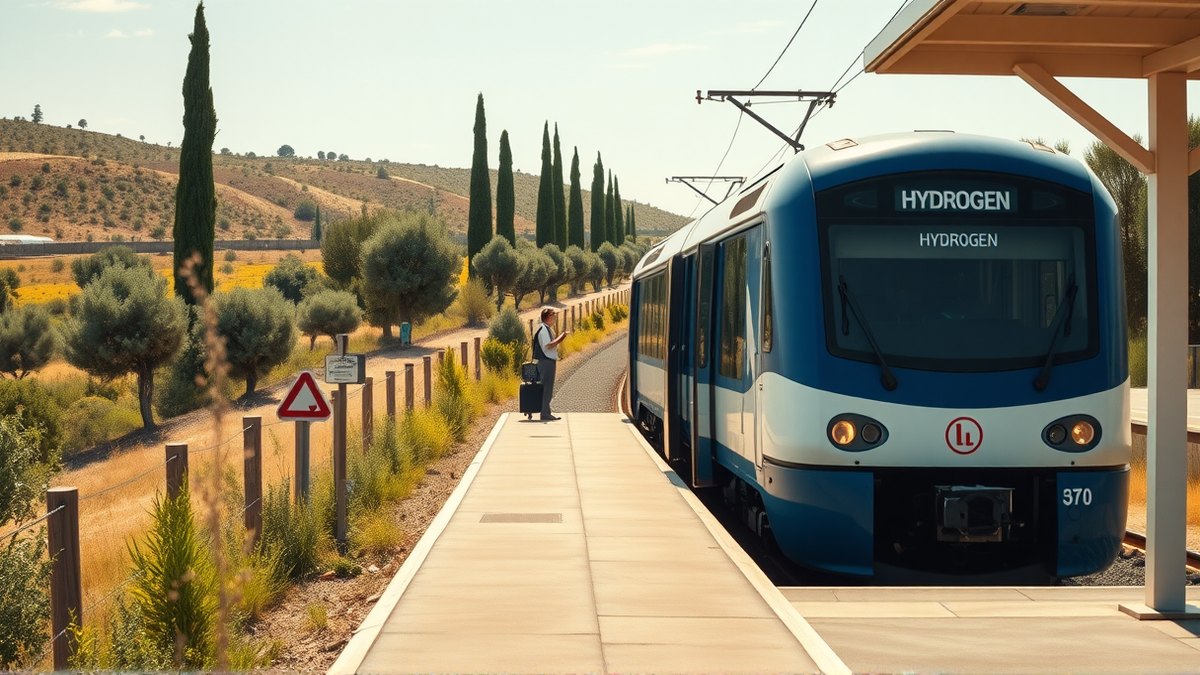
Data centres are changing the power balance. They are also changing where energy money goes. One part of that shift is hydrogen: not the biggest projects, but the ones that enter service first.
Il Sole 24 Ore reports that 21 hydrogen trains built by the Swiss group Stadler will run on narrow-gauge routes in Calabria, Sardinia and Sicily. They are the world's first hydrogen trainsets built for reduced-gauge track. Three operators will take them: Azienda regionale sarda trasporti (10 trains), Ferrovie della Calabria (9) and Ferrovia Circumetnea (2) in Sicily.
Fuels and reactors are a separate thread. The Orlen group has launched a tender to find partners for developing and deploying artificial intelligence: generative AI, machine learning, advanced data analytics, data science and mathematical modelling. The company says it is open to large firms and to smaller research and development outfits. Its statement also recalled that Orlen plans to develop nuclear power based on modular SMR reactors.
The Chinese view of the same problem is broader and covers the whole energy system. In a lecture in Shanghai, Bao Xinhe, an academician of the Chinese Academy of Sciences, described the energy of the future as a "dance of electrons and molecules", as quoted by the Yicai news agency. Electricity will be the foundation. Hydrogen, however, is difficult to store and transport, so it has to be converted into methanol and ammonia, meaning molecular fuels.
Bao gave hard reference points. China depends on imports for about 73 per cent of its oil and about 45 per cent of its natural gas. Catalysis, his field, accounts for 80 per cent of the chemical industry and for 20 to 30 per cent of GDP. His team developed the OXZEO technology and in 2020, together with a fuel company, built the world's first pilot plant with a scale of one thousand tonnes. The stated principle is "build first, demolish later": a system based on renewable sources should be up and running before fossil fuels are phased out.
One thing links these three threads. Energy is ceasing to be the background for computing and is becoming its boundary condition.
Arguments for alternative fuels were also made in China. Bao Xinhe, a member of the Chinese Academy of Sciences, recalled at a conference in Shanghai that China's dependence on oil imports reaches about 73 per cent and on natural gas about 45 per cent. He described the energy picture of the future as a meeting of electrons and molecules, since hydrogen is difficult to store and transport and therefore has to be converted into methanol and ammonia, meaning molecular fuels. The scientist stressed the role of catalysis: it accounts for almost 80 per cent of production in the chemical industry and for 20 to 30 per cent of gross domestic product.
China's OXZEO technology went in 2020 into the world's first pilot plant with a scale of one thousand tonnes, launched together with Yanchang Petroleum. The declared principle of the transition is conservative: build new capacity first, and only then shut down the old.
In Poland the same direction is visible in Orlen's statements. The company is looking for partners for artificial intelligence projects, generative models, machine learning and data analysis, and at the same time it plans small modular reactors. For an industrial customer the logic is identical: without a stable, zero-emission source of energy, no strategy built on data centres adds up.
Sources
3- 01In Calabria, Sardegna e Sicilia i primi treni a idrogeno a scartamento ridotto al mondoIT
- 02包信和院士:未来能源图景是「电子与分子」共舞ZH
- 03Sztuczna inteligencja ma zmienić polskiego giganta. Orlen rusza z wielkim projektemPL
All figures and quotations in this text come from the sources listed below.
Content prepared by the editorial team with AI assistance.
Dr. Amara Patel
Comments
0- No comments yet — be the first.