MeerKAT detects radio bursts from exoplanet Beta Pictoris b, a first
Astronomers report the first direct detection of radio emission from a planet beyond the Solar System, a signal traced to the giant planet Beta Pictoris b with South Africa's MeerKAT array, according to a paper submitted on 15 September.
 Sofia MarchettiScience and health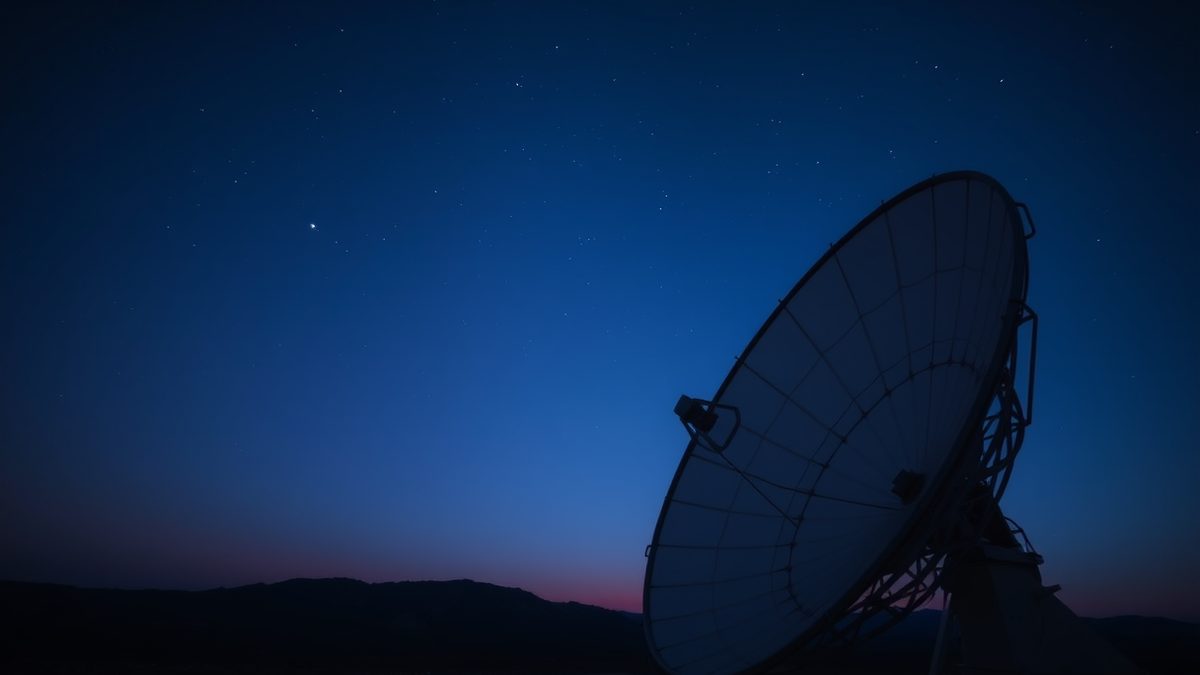
The paper, posted to arXiv on 15 September, describes rapid, recurring, highly circularly polarized bursts plus persistent emission at frequencies between 0.85 and 3.5 GHz. The authors, Kevin N. Ortiz Ceballos, Edo Berger and Yvette Cendes, identify the signal as electron cyclotron maser radiation, the same mechanism behind auroral radio bursts at Jupiter and other Solar System planets. That identification implies a magnetic field of at least 1.25 kG at the planet, which the paper calls the first direct field strength measurement for an exoplanet.
The result matters because magnetic fields shape how a planet's atmosphere escapes and how it interacts with its star's wind. Until now, no radio detection had been unambiguously localized to an extrasolar planet rather than its host star, the authors write.
Follow-up coverage of the MeerKAT work has circulated widely since late September, including in The New York Times and Futurism, though the underlying claim rests on the arXiv preprint, which was submitted for publication.
A cold lava world with an atmosphere
Separately, researchers have described HD 3167 b, a rocky super-Earth orbiting a star 154 light years away, as the coldest lava world with an atmosphere observed so far, according to a report by t3n on 1 October. A year on the planet lasts one Earth day, and one side faces the star permanently while the other stays dark.
"These planets are too hot for life, but by studying them we can draw conclusions about processes that also matter for other rocky planets," said Edwin Kite, an associate professor of geophysics at the University of Chicago and one of the study's authors, in a press release quoted by t3n. "These results open up the possibility of exploring the conditions that may have prevailed during the first few million years of Earth's history." Lead author Brandon Park Coy noted that without an atmosphere, the planet's day side would be "as hot as is theoretically possible." The study was published in The Astrophysical Journal.
More than 30 years have passed since the first exoplanet was confirmed, and over 6,300 planets outside our Solar System have been discovered since, t3n notes. Lava planets remain a small share of that haul. Kite told the outlet that the puzzle is why so many of these worlds retain atmospheres at all, given the stellar wind and high-energy photons they face.
Telescopes built to look
The detection work depends on instruments that are either flying or funded. NASA announced in the week of 21 September that it will proceed with PRIMA, the Probe far-Infrared Mission for Astrophysics, the first of its new Probe Explorers class, Ars Technica reported. The mission has a cost cap of $1.2 billion excluding launch costs and is targeted for launch in 2033, seven years from the announcement.
PRIMA will observe between 24 and 235 micrometers, with optics cooled to 4.5 Kelvin (minus 451 degrees Fahrenheit) using a spare cryocooler left over from the James Webb Space Telescope, modified to run on helium-3 instead of helium-4. Its kinetic inductance detector focal planes will be chilled to 100 milliKelvin. The 1.8-meter mirror is smaller than Roman, but the mission is designed to study planet and atmosphere formation, the coevolution of galaxies and black holes, and how dust and metals change over cosmic time.
PRIMA was the sole finalist after NASA disqualified a competing X-ray observatory, AXIS, earlier this year. Ars Technica reported that NASA said a concept study found AXIS would not meet schedule and budget constraints, and that the scientist leading that study blamed disruptions and mismanagement at NASA's Goddard Space Flight Center. PRIMA will be led by the Jet Propulsion Laboratory, which Ars Technica notes has had few missions in development and a series of layoffs.
The comparison point is the Nancy Grace Roman Space Telescope, launched in late August at a cost of about $4.3 billion. ABC News reported on 28 August that Roman started life as one of two spy satellites donated by the National Reconnaissance Office to NASA in 2012, and that it survived proposed cancellations in 2018, 2019 and 2025 before launching nine months ahead of schedule. Its 2.4-meter mirror matches Hubble's but its field of view is wider than either Hubble or JWST, and it observes visible and near-infrared light.
Roman reached first light on 17 September, when its team activated the 300-megapixel Wide Field Instrument, according to Gizmodo. The first test images show blurry stars against a blue background, still uncooled and unfocused. "After years of effort to build and test the instrument on the ground, we now have confirmation that it is operational in space," Josh Schlieder, an instrument scientist at NASA's Goddard Space Flight Center, said in a NASA blog post quoted by Gizmodo. "There is much to do, but we are on our way to groundbreaking science."
What the data can and cannot say
None of these results settles whether any of the worlds studied can host life, and the sources do not claim otherwise. The Beta Pictoris b detection gives a field strength, not a habitability verdict; the HD 3167 b work models an atmosphere, not a biosphere. What the two share is a shift in method: measuring the planet itself rather than inferring it from its star.
The pipeline is also widening beyond radio and infrared. On 28 September, ScienceDaily reported University of Copenhagen research conducted with NASA, based on blood samples from 52 astronauts who spent months aboard the International Space Station. The study found gut bacteria began fermenting protein more heavily within weeks of arrival in orbit, a shift the researchers suspect is caused by microgravity slowing food through the intestine. Co-author Henrik Roager said the finding may help explain astronaut constipation, and senior author Lars Ove Dragsted noted that protein fermentation products are often associated with kidney damage, mood effects and reduced focus.
That work is not exoplanet science, but it belongs to the same problem set: what happens to biology when gravity stops being a given. Longer missions to the Moon and Mars are the stated reason for the study, and the same question sits behind every atmosphere model for a planet locked to its star.
Meanwhile, the infrastructure around all of this is being argued over in public. Google published a peer-reviewed version of its orbital data center white paper in Joule on 1 October, according to TechCrunch, and its prototype satellite carrying a Tensor Processing Unit launched the same day on a SpaceX rocket. The paper expects launch prices near $200 per kilogram by 2035, based on a roughly 20 percent annual cost-reduction curve since the Falcon 1. Google's Travis Beals told TechCrunch the satellite will run its chip in 15-minute bursts to avoid straining power and thermal systems.
The company's own analysis suggests the scale required is enormous. TechCrunch reported that Google thinks Starship would have to launch roughly 1,800 times before orbital data centers get off the ground, a figure that sits awkwardly against the single-prototype stage the industry is at. A panel at the AI Infra Summit in Santa Clara on 17 September was blunter: Viasat's Sumeet Singh said launch costs of $2,500 to $3,000 per kilogram would need to fall to $200 to $500, and that a single-GPU demo is far from megawatt-class facilities, according to Data Center Knowledge. Deepak Sachdeva, CIO of the US Air Force, said the technology is ready consumer-to-consumer but not for global operational needs, and called for a proof of concept.
Sources
15- 01Discovery of radio emission from the exoplanet Beta Pictoris bEN
- 02Ein Jahr dauert hier nur einen Tag: Dieser Exoplanet koennte uns die Fruehzeit der Erde erklaerenDE
- 03NASA will try to build a billion-dollar space telescope in record timeEN
- 04NASA's Nancy Grace Roman Space Telescope set to explore the universeEN
- 05NASA's New $4B Space Telescope Just Saw Starlight for the First TimeEN
- 06Blood tests reveal why astronauts get constipated in spaceEN
- 07Google thinks SpaceX's Starship has to launch 1,800 times before space data centers get off the groundEN
- 08Space Data Centers Inch Toward Reality, With CaveatsEN
- 09Satlyt, founded by a former Google and SpaceX product manager, raises $8M to run AI on satellitesEN
- 10SpaceX describes surgical intervention before launch of latest crew missionEN
- 11Forecasting space weather risks on power gridsEN
- 12Blackswan Space raises EUR2.5M to take autonomous spacecraft navigation into orbitEN
- 13World Space Week 2026 Celebrates the "Rocket Revolution"EN
- 14Europe's Space Industry Seeks Greater Supply Chain ControlEN
- 15Quantum Space Executes Launch Processing Agreement with All Points Logistics for Prime MissionEN
All figures and quotations in this text come from the sources listed below.
Content prepared by the editorial team with AI assistance.
Sofia Marchetti
Comments
0- No comments yet — be the first.