NASA's Starling swarms a satellite using star trackers and a 20,000-object catalog
NASA's Starling mission has demonstrated a navigation system that fixes a spacecraft's orbit by sighting other objects in space rather than by GPS, with FALCON refining the orbits of more than 200 objects in a three-day run.
 Sofia MarchettiScience and health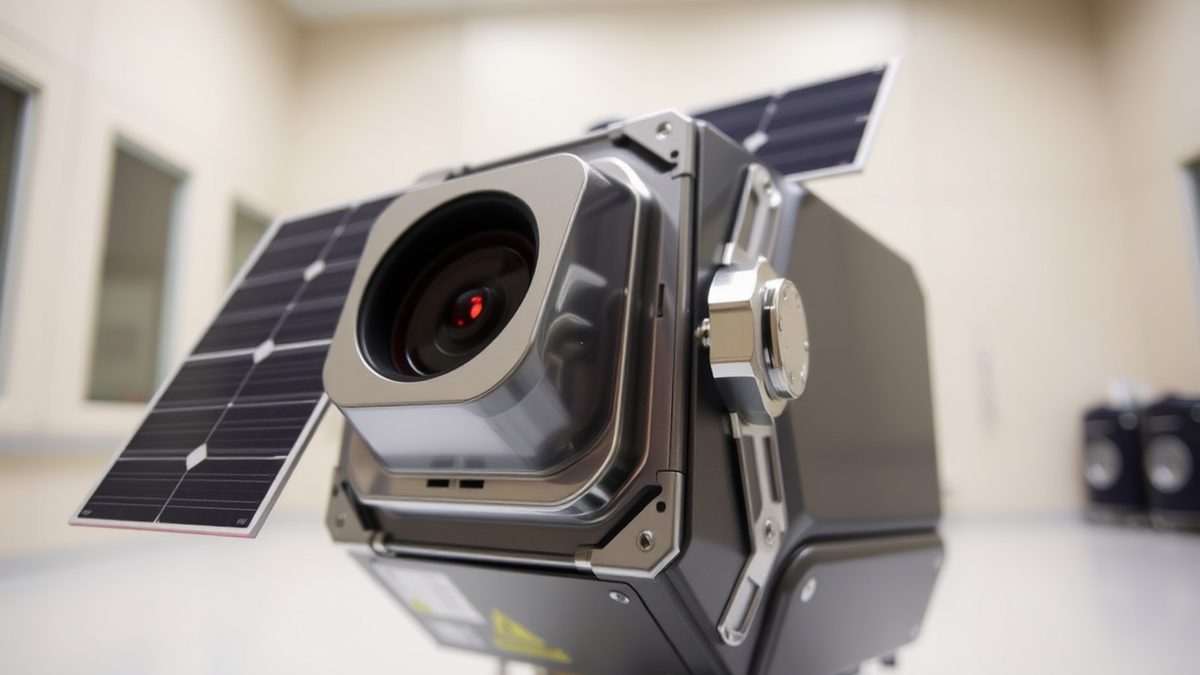
NASA's Starling mission has marked another milestone in spacecraft autonomy. The agency says the FALCON payload, short for Fast Autonomous Lost-in-space Catalog-based Optical Navigation, worked out a satellite's position in orbit by referencing other objects in space instead of a navigational network.
The demonstration was an extension of Starling, a four-spacecraft swarm launched in 2023. FALCON is a joint flight experiment by NASA and EraDrive, a startup spun out of Stanford University. It pairs EraDrive's Era-Core flight software and embedded algorithms with Starling's cameras and an onboard catalog of known satellites, according to NASA's account of the campaign. The hardware was nothing exotic.
FALCON used Starling's onboard star-tracker cameras, standard instruments that identify bright objects in space to inform a spacecraft's orientation and position. In position, navigation and timing experiments, the payload matched objects its cameras observed, including other spacecraft and orbital debris, to a catalog of known space objects maintained and made publicly available by the U.S. Department of War. Those verified objects then served as reference points for determining Starling's own orbit.
In separate experiments, the team loaded the full catalog of approximately 20,000 space objects and their predicted orbits onto the spacecraft. FALCON correlated that data with the spacecraft's observations to estimate Starling's location and the locations of other objects with greater precision than the current catalog data. NASA says FALCON improved the known orbits of more than 200 objects over a three-day period, with no intervention from operators on the ground.
"FALCON is yet another success for the Starling demonstration mission. The results from FALCON can have far-reaching implications for on-orbit space-traffic monitoring, collision avoidance, and alternative navigation," said Roger Hunter, program manager for NASA's Small Spacecraft and Distributed Systems program at NASA's Ames Research Center in California's Silicon Valley. "The number of 'firsts' from Starling just keeps growing."
Why GPS-free navigation matters
Traditional satellite navigation depends on GPS signals, which can be unreliable or unavailable in lunar or deep space environments. That gap is the reason NASA is testing optical alternatives. According to the agency, coordinated networks of multiple GPS-free satellites will be critical to support surface operations for future human exploration of the Moon or Mars. For science missions, knowing the precise location of each spacecraft is necessary for aligning measurements taken from multiple points in space. For space traffic management, autonomous navigation and catalog updates can reduce reliance on ground networks and enhance collision avoidance.
NASA describes the self-orbit determination capability as a first for a spacecraft using optical cameras to navigate by their relative position to other objects in space. Separately, the catalog-update experiments produced better object position predictions onboard Starling than those provided by ground stations. The experiment also shows how a university project can turn into a company. What began as a University SmallSat Technology Partnerships project evolved into EraDrive, which is now commercializing its Era-Core software and related hardware for broader applications. Starling provided the platform for real-world testing.
More testing is planned. Later this year, Starling will extend the FALCON experiment using Era-Core, enabling its four-spacecraft swarm to share tracking data and refine their positions collectively. NASA's Ames Research Center leads the Starling mission, and the agency's Small Spacecraft and Distributed Systems program, based at Ames and within the Research and Technology Mission Directorate, funds and manages it.
Sources
1All figures and quotations in this text come from the sources listed below.
Content prepared by the editorial team with AI assistance.
Sofia Marchetti
Comments
0- No comments yet — be the first.