OpenAI Runs Jalapeno ASICs on AMD Turin Hosts as Liquid Cooling Pushes Past Air
OpenAI is deploying its Jalapeno ASICs alongside AMD EPYC Turin hosts with 1.5TB of memory each, its hardware chief said on 2 October, as the wider data centre build-out confronts a cooling limit that air can no longer meet.
 Rachel NwosuAI, models and technology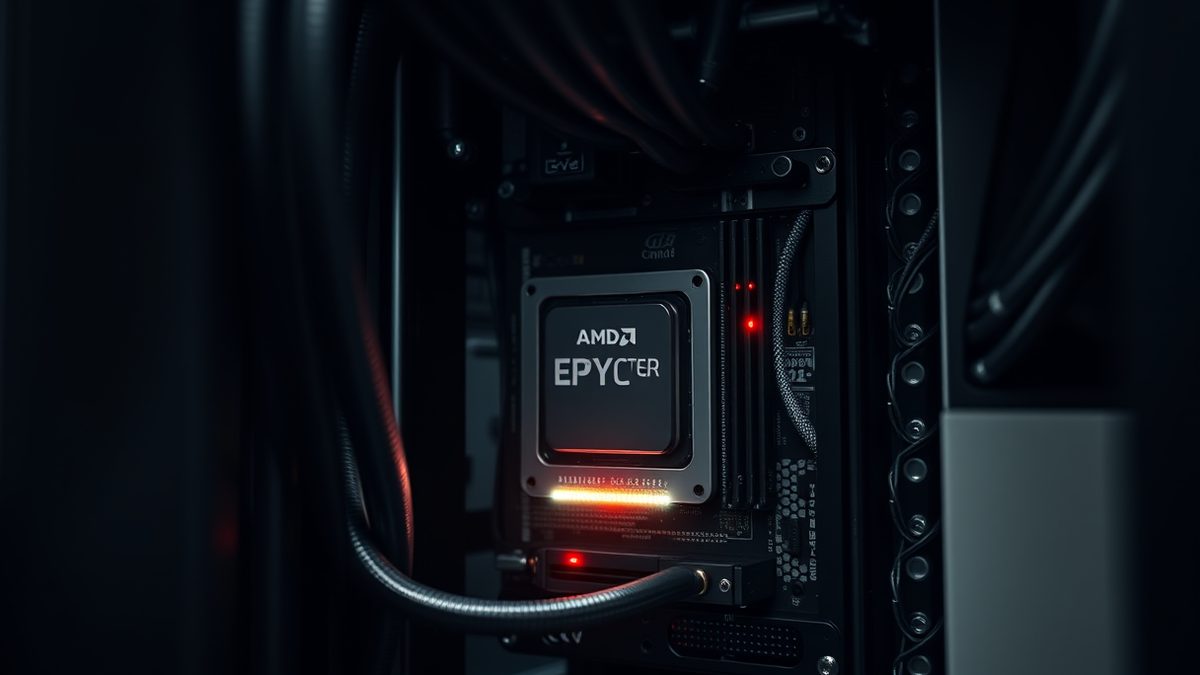
OpenAI's new Jalapeno ASIC is being deployed internally alongside AMD EPYC Turin hosts, each carrying 1.5TB of memory, according to Tom's Hardware on 2 October. The outlet put the question to Richard Ho, VP and Head of Hardware at OpenAI, who called the choice of Turin "pragmatic" and said Nvidia's new Vera CPU is "a little bit behind... on that maturity level."
That is a notable admission from a company that leans heavily on Nvidia silicon. Ho framed it as risk management rather than preference.
"The way we approached that design was really in terms of de-risking and being able to do that design fast," Ho told Tom's Hardware Premium. "For the Jalapeno program, we were trying to make very pragmatic decisions. We wanted to be aggressive on the goals of the performance and the cost, but we didn't want to take unnecessary risks."
The rack-scale deployment was first described by SemiAnalysis, according to the same report. Tom's Hardware noted that Arm-based alternatives such as Google Cloud's Axiom, AWS's Graviton and Arm's own AGI chip are positioned as agentic CPUs, meant to accelerate the reasoning loops that agentic workloads run. Turin is x86. OpenAI chose it anyway, and Ho's answer suggests maturity of the surrounding platform mattered more than instruction set.
Why the racks keep getting hotter
The hardware choices upstream have a physical consequence downstream. Wanma Technology, in a liquid cooling cabinet guide dated 29 September, states that traditional air-cooled server cabinets top out between 8 and 10 kilowatts per rack, a threshold set decades ago when processor power draw was modest. High-performance compute chips now draw 700 watts, 1200 watts, or more per unit, and populating a single cabinet with several of them exceeds what forced air can dissipate.
The result is thermal throttling, lost performance, or outright failure if cooling cannot keep pace. Wanma describes the shift to liquid as a necessity rather than an optimisation for anyone deploying modern compute at scale.
CoolIT, in a sponsored article published by IEEE Spectrum on 22 September, puts a harder number on it: beyond 250 kW per rack, a hybrid liquid and air approach stops working, because a 70/30 liquid-air split still leaves 75 kW of heat for the air system to move. CoolIT says liquid can take effectively all the heat, with air falling below 1 percent of the load, which is what allows a server to run fanless. The company says its loops are built from modular coldplate blocks proven across six generations of fanless designs.
That is vendor framing, and it should be read as such. But the direction is consistent with what operators are buying.
CDUs get a qualification badge
Nvidia moved to standardise part of the supply chain on 21 September, announcing DSX Ready, a qualification programme for partner products that meet its DSX AI factory reference design requirements. The programme launched with two categories: battery energy storage systems and cooling distribution units. Qualified BESS products at launch came from Hitachi Energy, LG Energy Solution and Tesla; qualified CDUs came from LG Electronics, LiquidStack and Vertiv.
Nvidia's blog is explicit about the limits of the badge. Passing qualification "does not replace site-level engineering or imply site-level stability," it says. For CDUs, the path uses a self-qualification suite to determine whether a specific offering meets applicable functional requirements. Builders still have to work out how a qualified unit fits their site, configuration and operating needs.
Eight days later, on 29 September, Trane Technologies announced the LiquidStack CDU 2.X platform at Yotta 2026 in Swords, Ireland. HPCwire reports the unit is architecture-agnostic, with flow capability of up to 3750 litres per minute at 3.5 bar, and is designed to support current GPU platforms plus headroom for next-generation ones including Nvidia Vera Rubin.
"Operators need cooling infrastructure that can adapt as GPU platforms and rack densities evolve," Scott Smith, General Manager of LiquidStack at Trane Technologies, said in the announcement. "CDU 2.X combines the performance and flexibility customers need today with the headroom to prepare for what comes next."
The same announcement cites facility inlet temperatures up to 45C and an ultra-low-harmonics VFD architecture intended to cut harmonic distortion at the source. End-of-row and rack-adjacent deployment are both supported.
Installation is the easy part
Kevin Roof, Director of Offer and Capture Management at LiquidStack, argued in Data Center POST that the industry is asking the wrong question. Deployment gets the attention, he wrote, but operations decide whether performance holds for a decade. Installation is measured in weeks; operations are measured in years.
His specific warning is about blast radius. Evaluating resilience by counting redundant CDUs misses how a failure propagates across the entire fluid distribution and control network. He also flags performance drift, arguing that real-time operational data lets operators catch degradation before a component actually fails. On that reading, a cooling loop is an interconnected system in which a change to rack configuration, accelerators or control strategy can alter behaviour elsewhere in the loop.
Manufacturing tolerances feed into the same problem. XEBEC Deburring Technologies notes that cold plates are built with complex internal passages, intersecting holes, machined channels and sealing surfaces, and that machining leaves burrs. Loose particles can create contamination concerns; burrs near sealing areas complicate assembly. The company's pitch is that deburring belongs inside the machining process rather than as a manual afterthought, which is a supplier argument but points at a real inspection burden.
Fluids, and the questions buyers actually ask
Telecomate's direct-to-chip FAQ, aimed at network engineers and procurement teams, addresses whether cold plate modules can run on non-conductive dielectric fluids. The answer is yes, with caveats: dielectrics remove the short-circuit risk of water-based loops but generally have lower thermal conductivity and higher viscosity than glycol-water mixes, so flow rates, pump sizing and microchannel geometry have to be specified accordingly. Most major DTC vendors publish approved fluid lists and material compatibility matrices covering copper, aluminium, stainless steel, EPDM and fluoropolymer gaskets, according to the FAQ.
It also draws a line between single-phase and two-phase dielectric DTC. Single-phase keeps the fluid liquid and relies on sensible heat rise; two-phase lets it boil on the chip surface and condense in a remote heat exchanger, moving heat as latent energy. For telecom line cards and 1U-2U switches, the FAQ calls single-phase the more pragmatic choice, reserving two-phase for very high TDP ASICs above roughly 500 W per package.
This is guidance from a technical FAQ, not a benchmark, and the same caveat applies to the selection guides. The operational picture is more settled than the marketing.
That picture is why the OpenAI disclosure matters beyond one chip programme. Choosing Turin hosts and running Jalapeno alongside them is a compute decision, but every one of those racks lands in a facility that has to remove the heat. Between the 8-10 kW air ceiling that Wanma describes and the 250 kW threshold CoolIT cites, the space for hybrid designs narrows fast. Vendors are responding with qualification programmes, higher-flow CDUs and fluid compatibility lists. The operators, meanwhile, are being told the hard part starts after the crates are unpacked.
Sources
8- 01OpenAI's Jalapeno ASICs are deployed alongside AMD EPYC 'Turin' CPUs as hostsEN
- 02How Liquid-Cooled Server Cabinets Are Reshaping Data Center Infrastructure for AI WorkloadsEN
- 03The Future Is Fanless: 100% Heat Capture for Liquid Cooled AI ServersEN
- 04NVIDIA Launches DSX Ready to Qualify Power and Cooling Products for AI FactoriesEN
- 05LiquidStack CDU 2.X Brings Flexible Cooling to AI and HPC Data CentersEN
- 06The Real Challenges of Liquid Cooling Begin After InstallationEN
- 07Data Center Liquid Cooling: Deburring and Surface Finishing MatterEN
- 08Direct-to-Chip Liquid Cooling FAQ: Expert Answers to Technical Deployment QuestionsEN
All figures and quotations in this text come from the sources listed below.
Content prepared by the editorial team with AI assistance.
Rachel Nwosu
Comments
0- No comments yet — be the first.