Datacenters vs. chips: the gap between AI plans and packaged silicon
OpenAI started serving GPT-6 Astra Ultrafast on NVIDIA Blackwell GPUs on 1 October, promising up to 8x faster token generation, the same week analysts warned the US is planning far more AI datacenter capacity than its chip packaging supply can support.
 Grace OkonkwoAI, models and technology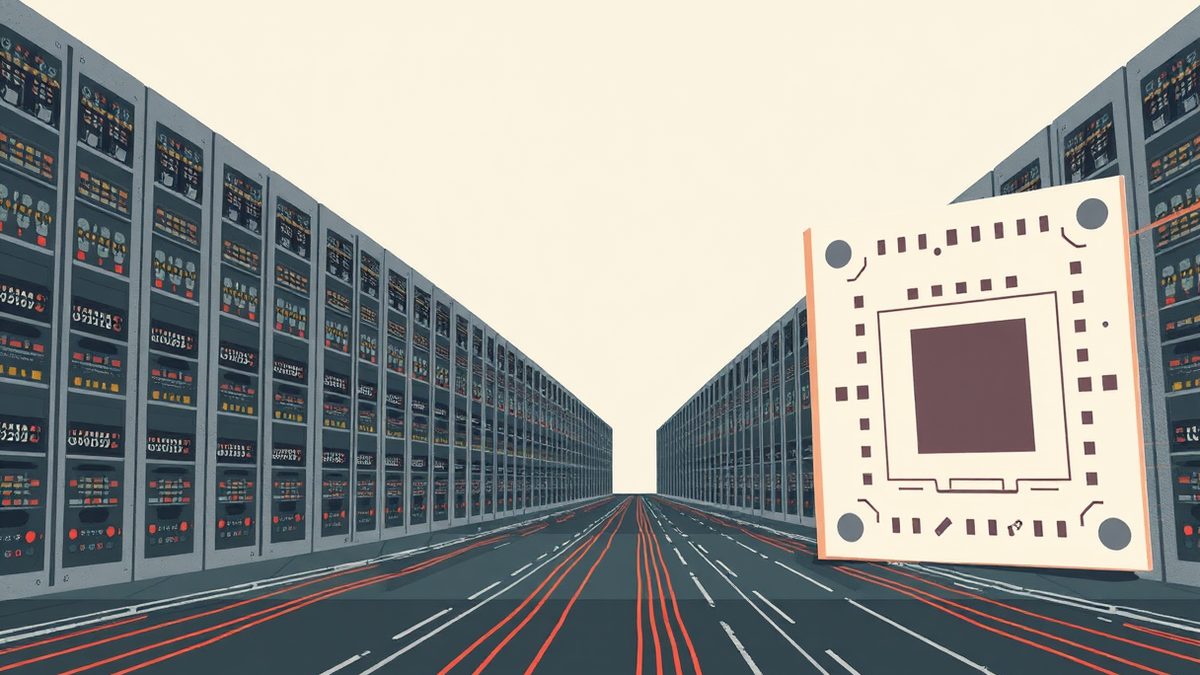
OpenAI's GPT-6 Astra Ultrafast is live in the OpenAI API and for eligible ChatGPT Work and Codex users. That is what NVIDIA's own blog said on 1 October. It is the most recent development in a week when the gap between AI ambition and silicon supply kept widening.
The model runs on Blackwell GPUs and delivers up to 8x faster token generation than the Astra Standard mode, according to NVIDIA. OpenAI inference lead Philippe Tillet is quoted in that post saying the company's models are "exceptionally good at programming Blackwell and Rubin GPUs." OpenAI chief technology officer of compute Uday Ruddarraju added that OpenAI used internal models to optimize inference on NVIDIA hardware. Those are vendor and customer statements, not independent benchmarks. Treat the 8x as a claim attached to a specific comparison: Ultrafast against Standard, on Blackwell.
Packaging, not fabs, is the bottleneck
The more awkward number came a day earlier. On 30 September, The Register reported on a Jefferies report, shared with the outlet, arguing that advanced chip packaging has emerged as a constraint on how fast new AI capacity can come online. Satellite analytics firm SynMax, cited in that report, tracks land clearing and construction progress weekly. It estimates US deployments rising from roughly 11 GW of gross capacity in 2025 to 16-18 GW in 2026, above its previous 14-16 GW forecast, and puts the practical upper limit for 2027 in the low 20s of gigawatts. Yet land clearing has plateaued.
The Register writes that visible activity sits well short of the more than 80 GW implied by some announced pipelines and chip demand models for 2028. A previous Jefferies report found only half the US capacity scheduled for 2026 was under construction, with work yet to begin on as much as 80 percent of the 2028 pipeline. SynMax puts existing advanced packaging capacity at roughly 13 GW of accelerator equivalent, which converts to about 17.5 GW of total datacenter power once CPUs, memory and cooling are counted. Two packaging projects due in 2027 could add 6 GW.
Design tools move in
Into that constraint steps a wave of AI-for-chip-design announcements. On 30 September, The Decoder reported that OpenAI and Synopsys signed a multi-year partnership to build GPT-Synopsys, a model intended to "reason about chip design and verification, and to directly operate Synopsys' tools." Early tests with semiconductor customers are already underway, the companies said, with customer data not used for training and stored encrypted. Synopsys CEO Sassine Ghazi says AI could speed up design significantly.
The same day, Tom's Hardware surveyed the agentic EDA field. Cadence said on 1 June its agent reached what it calls Level 5 autonomy, with Rob Knoth, senior group director of strategy, calling the demo "bounded Level 5 in one domain" and most super-agent tech at "advanced Level 4." Synopsys said its spec-to-RTL workflow shown on 11 March reached L4, and now claims L5 for long-horizon agents. Siemens launched its agent on 16 March with self-verifying loops announced on 26 July. Tom's Hardware notes the uncomfortable part: all speed claims come from vendors or their customers, many with "up to" caveats, and the only evaluator Synopsys named, AMD, has offered an endorsement rather than analysis.
Tom's Hardware's own week-long series, running 28 September to 2 October, adds that OpenAI says AI-assisted design of its Jalapeno chip "established a new baseline" for the industry. Hardware VP Richard Ho told the outlet the chip is for internal use "first and foremost." A companion piece from 29 September describes Architect Labs claiming in late August to have designed a chip almost entirely by AI. Human engineers still define architectures and make fundamental decisions, Tom's Hardware writes.
China builds a parallel stack
On the other side of the export controls, Huawei's rotating chairman Eric Xu claimed this week that its Ascend NPUs have surpassed Nvidia in Chinese market share. "It's pretty hard to collect data about the market share of Nvidia in China, but based on the data we have collected, Ascend has surpassed Nvidia," he said, in a Q&A-style release covered by The Register on 30 September. Xu also said Huawei lacks capacity to satisfy Chinese demand and has no plans for a full international push. Nvidia executives said on their Q2 earnings call that H200 shipments to China amounted to less than 1 percent of datacenter revenues.
Software is following. The South China Morning Post reported on 30 September that DeepSeek open-sourced six modules tailored to Ascend chips, including an Ascend-compatible version of TileLang that officially supports the Ascend 950 accelerators. The stated goal is an "independent and controllable" software ecosystem.
Hardware is following too. On 1 October, the SCMP reported Huawei consumer chief Richard Yu saying the company had shipped about 100,000 Mate XT 2 trifold phones since the 12 September release, with the model on track to pass 1 million sales and planned launches across Asia-Pacific, the Middle East and potentially Europe. The phone is the first to integrate mobile processors using the LogicFolding architecture based on Huawei's Tau Scaling Law.
Bernstein's assessment, reported by the SCMP on 22 September, is a useful calibration. It estimated the Kirin 9050 Pro was made on technology equivalent to a 7nm node and beat Apple's 3nm A17 Pro in Geekbench 6 multicore tests, narrowing the gap to Apple to about three years from roughly four. It still trailed Apple's 2nm A20 Pro by around 30 percent in performance.
Demand keeps outrunning supply
Ars Technica reported on 28 September that China's Ministry of Industry and Information Technology asked Alibaba and ByteDance to share plans to buy Nvidia's RTX Pro 5500 chips, gaming parts that could be put into servers. Ars also cites reporting that Nvidia CEO Jensen Huang has blamed export controls for cutting Nvidia's share of China's advanced AI chip market from about 95 percent to zero, and quotes author Stephen Witt calling Huang "the president's most influential adviser on technology issues."
Elsewhere the supply chain keeps tightening. Emergence AI's Satya Nitta told EE Times on 30 September that "you cannot make chips any faster, but what you can do is definitely get more chips per wafer yielding with AI," describing agents that spot failure patterns across thousands of products. Qualcomm, meanwhile, used its Snapdragon Summit to detail the Snapdragon 8 Elite Gen 6 and Elite Extreme Gen 6, moving to TSMC N2P and, on the Extreme part, LPDDR6 memory at 127.2GB/s, per ServeTheHome's 26 September writeup. MaxLinear's Puma 9, announced 28 September and analysed by Light Reading on 29 September, adds DDR5 support as DDR4 supply stays tight, with modems expected in 2027. Both are reminders that memory and packaging capacity decide what gets built, whatever the accelerator roadmap says.
Sources
15- 01How NVIDIA GPUs Help Accelerate OpenAI's GPT-6 Astra UltrafastEN
- 02America is planning more AI datacenters than its chip supply can fillEN
- 03Huawei boss claims homegrown AI chip sales top Nvidia in ChinaEN
- 04OpenAI and Synopsys team up to build an AI model that designs chips like a seasoned engineerEN
- 05The state of agentic AI in chip design tools in 2026EN
- 06AI Chip Design WeekEN
- 07Silicon is starting to design siliconEN
- 08Experts worry about Nvidia's AI chip sales in China and influence over TrumpEN
- 09China's DeepSeek open-sources tools to help Huawei chips supplant Nvidia in AIEN
- 10Huawei steps up Tau chip roll-out, with Mate XT 2 on track for 1 million salesEN
- 11China's Huawei trims mobile chip gap with Apple as Tau Scaling Law pays off: BernsteinEN
- 12Emergence AI Targets Fabeless Chipmakers With Neuroformal AIEN
- 13Qualcomm Unveils Snapdragon 8 Elite Gen 6 and Elite Extreme Gen 6EN
- 14MaxLinear claims new 'Puma 9' DOCSIS chip is a big cost-cutterEN
- 15MaxLinear intros 'AI-ready' Puma 9 DOCSIS chipsetEN
All figures and quotations in this text come from the sources listed below.
Content prepared by the editorial team with AI assistance.
Grace Okonkwo
Comments
0- No comments yet — be the first.