Perovskite research moves from single additives to multifunctional chemistry
A Zhengzhou University review reported by pv magazine on 2 November argues that zwitterions can do more in perovskite solar cells than passivate defects, pointing to a wider shift toward multifunctional additives and tighter process control. The same review cites a tin perovskite cell lifted from 10.54% to 13.31% efficiency with the amino acid L-asparagine.
 Sofia MarchettiScience and health
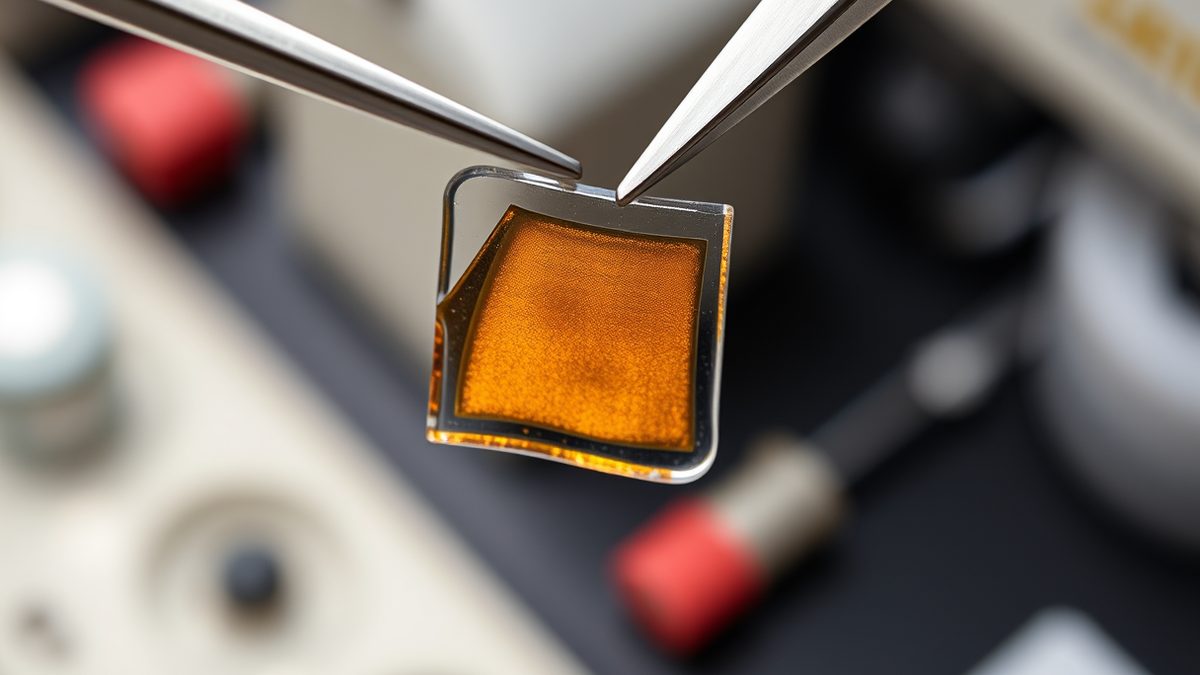
Zwitterions as multifunctional additives
Zwitterions are neutral molecules that carry positive and negative charges. The review says the dual charge does more than passivate defects.
The review says one molecular unit can handle defect passivation, crystallization modulation and interfacial energy-level tuning, a combination the authors say conventional Lewis acid/base passivators and single ionic additives do not offer. That matters because perovskite cells still lose efficiency to defects and degrade under heat and humidity, so each additive has to improve performance and durability at once. The reported efficiencies remain lab-scale. Neither commercial module lifetimes nor manufacturing yields appear in the published results.
Betaine-type zwitterions are the most extensively studied, the review says. In tin perovskites, the amino acid L-asparagine raised cell efficiency from 10.54% to 13.31%.
Formamidine sulfinic acid enabled 22.06% in a wide-bandgap device. The authors say the effectiveness of these mechanisms depends on molecular structure, how the compound is incorporated and where it sits in the device. Liquid-type zwitterions could address poor solubility, they add.
Automation and salt additives target film formation
At the University of Osaka, researchers built an automated platform that watches perovskite film formation as it happens. It measures color changes on a subsecond timescale and resolves the motion and impact of antisolvent droplets within a few milliseconds. Asia Research News reported on 2 November that the system, described in ACS Nano, pairs those measurements with machine learning. The team then used the analysis to guide fabrication of a lead-based device that reached 24.4% power conversion efficiency.
“We want to move beyond trial and error by measuring what happens to the film while it is actually forming,” lead author Ryosuke Kado said.
Separately, researchers at Argonne National Laboratory used two salts, zinc bromide and methylammonium chloride, to lower the melting point of the perovskite precursors. The film briefly liquefies, then atoms settle into a more uniform structure. Nanowerk reported on 30 October that the method, published in Science, produced a solar cell at 26.5% efficiency and an LED at 26.1% external quantum efficiency. “Defects have been the bottleneck for perovskites for almost a decade,” study author Yanqi Luo said.
Stability gets a lithium-removal step
Stability is the other half of the problem. Scientists at the Korea Institute of Energy Research used nickel oxide to pull lithium ions out of the hole transport layer, then removed them by filtration, pv magazine reported on 27 October. The champion cell reached 25.24% efficiency and kept more than 90% of its initial efficiency after 500 hours of continuous operation. It retained 95% under damp-heat testing at 85 C and 85% relative humidity. The process enables oxidation of spiro-OMeTAD in less than five seconds without the additive tBP, and conductivity in the hole transport layer rose by a factor of 2.5.
The efficiency gap remains
Not every result lands in the same range. A Bioengineer.org report on 26 October described a caesium tin iodide cell that reached 10.76% after a model-guided redesign, up from 8.98% for an unoptimised counterpart. Tin perovskites avoid lead but oxidise in air, which has kept them behind their lead-based rivals.
All-perovskite tandem devices are further ahead. Real devices of that class have reached 30.1%, against a theoretical maximum near 45%, Bioengineer.org reported on 30 October.
A simulation study from Huazhong University of Science and Technology projected 31.13% for a tandem cell with serrated front and buried interfaces, a 3.41% increase over the flat baseline, Bioengineer.org reported on 30 October. Simulations are not devices. The gap between the two numbers is where the commercial argument still sits.
Sources
28- 01Zwitterions could be much more than defect passivators in perovskite solar cellsEN
- 02Bright spark: Robots and AI track solar cell fabricationEN
- 03Salt-assisted crystal growth boosts perovskite solar cell and LED performanceEN
- 04Researchers improve perovskite cell stability with lithium-removal processEN
- 05Simulated and Real: Tin Perovskite Solar Cell Hits 10.76% After Model-Guided RedesignEN
- 06Serrated Surfaces Could Push All-Perovskite Tandem Solar Cells Toward 31 Percent Efficiency in SimulationsEN
- 07Hanwha Q-Cells shifts focus to research and development in EuropeEN
- 08Rapid LLM development is outrunning the research meant to explain it, study findsEN
- 09 The Star Wars Eclipse — Want to see the 2027 total solar eclipse on Tatooine? Head to Tunisia EN
- 10Here’s how solar and wind developers can hold on to tax creditsEN
- 11Waaree doubles Texas solar module manufacturing capacity to 3.2 GWEN
- 12Germany awards 288 MW of solar in rooftop tender at average price of €0.0967/kWhEN
- 13Solar PV cuts Spain’s electricity costs by €17.02 billion over 18 monthsEN
- 14Slovenia tenders solar-plus-storage projectEN
- 15Shenzhen Nanshan Power seeks majority stake in Trina Solar’s tracker businessEN
- 16Scientists reverse liver cell aging and cut Alzheimer’s-linked protein in halfEN
- 17Solar Topics in Small Business Innovation Research and Small Business Technology Transfer (SBIR/STTR) - Department of Energy (.gov)EN
- 18Flexell Space and Satoro Agree to Collaborate on In-Orbit Demonstration of Next-Generation Space Solar CellsEN
- 19As Diesel Costs Surge for Farmers & Rural Businesses, Solar Offers a LifelineEN
- 20Tesla Powerwall 3 now boosts heat pumps to store cheap solar as heatEN
- 21Quantum Interconnects Link Two 120-Qubit Processors (IBM Research)EN
- 22Hyperion Research: Nearly 20% Growth in HPC and AI-for-Science Server Market, Dell Takes Lead from HPEEN
- 23Cellnex signs €375m loan with EIB to support rollout of 5G infrastructureEN
- 24Cranberry Bogs Were Unprofitable, Then Solar Saved The DayEN
- 25The Share of Solar Generation with Co-located Battery Storage Is IncreasingEN
- 26 On this day in space! Oct. 30, 1964: NASA's weird Lunar Landing Research Vehicle takes 1st test flight to help Apollo astronauts land on the moon EN
- 27 Astronauts deploy solar array on 100th US spacewalk by International Space Station crew members EN
- 28Microsoft Research Focus – Edition #97EN
All figures and quotations in this text come from the sources listed below.
Content prepared by the editorial team with AI assistance.
Sofia Marchetti
Comments
0- No comments yet — be the first.