Roscosmos restarts tests for long-delayed crewed spacecraft, keeps 2028-2029 launch date
Russia's state space corporation will begin parachute drop tests of its next-generation crewed spacecraft this autumn, Ars Technica reported on 30 September, with a first crewed launch still pencilled in for 2028 or 2029.
 Sofia MarchettiScience and health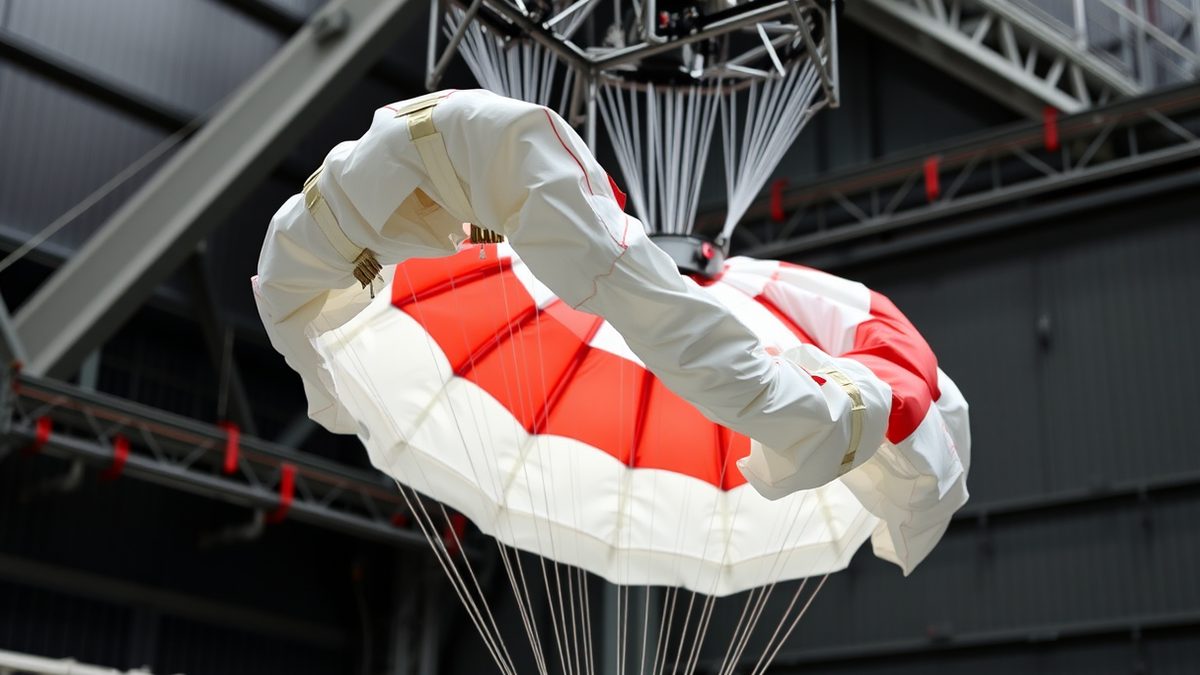
The spacecraft has had at least four names since the project was conceived in 2009: PPTS, PTK NP, Federatsiya and, from September 2019, Orel or Eagle. Ars Technica reported on 30 September that the current Roscosmos chief executive, Dmitry Bakanov, appears to have dropped the Eagle branding favoured by his predecessor Dmitry Rogozin. A recent Interfax story cited by Ars calls the vehicle PTK NP again.
According to the Interfax comments translated for Ars Technica by Rob Mitchell, Bakanov said the first step is the launch and testing of a new, promising, reusable manned transport spacecraft. In the fall, he said, there will be a parachute drop and testing in the Far East. The same report says the spacecraft will undergo tests in emergency rescue modes during an emergency at the launch pad later this year, and in 2027 tests in the zone of maximum dynamic pressures.
What the autumn tests actually are
Ars Technica notes it is not clear from the report whether the tests will involve real flight hardware, boilerplate vehicles or mockups. The reference to the zone of maximum dynamic pressures presumably means Max-Q, which suggests some kind of launch abort test will take place. That would be a significant step toward a spaceflight.
The same article says Russian space officials are currently holding to a debut crewed launch in 2028 or 2029, likely on the Angara A5M rocket. Ars cautions this is probably not a date to write down in ink just yet. Four years ago, Russian President Vladimir Putin spoke confidently about the Eagle spacecraft and the resumption of Russia's lunar programme.
The intended role has not changed much in two decades. Whatever it ends up being called, the vehicle is meant to replace the Soyuz spacecraft for flying cosmonauts into low Earth orbit, and it is meant to be versatile enough to fly humans to the Moon. The European Space Agency and Russia began discussing collaboration on a next-generation crewed spacecraft about twenty years ago; Europe would have supplied a service module for a capsule carrying up to six passengers. Europe pulled out, and Roscosmos went ahead alone. Ars describes the project as always seeming more of a Potemkin village than an effort encompassing real hardware.
Other mission science and hardware news this week
The same day Ars published its Russia update, two other space stories landed with concrete numbers. Tech.eu reported on 30 September that Blackswan Space, a Lithuanian company founded in 2019, closed a €2.5 million round led by Iron Wolf Capital, bringing total funding to €3.2 million. Its RPO Kit, a plug-and-play payload for autonomous rendezvous and proximity operations, is scheduled to fly in Q4 2027, ahead of the first European in-space refuelling mission, ASTRAL, planned for 2028 and backed by up to €3.3 million from the UK Space Agency and ESA.
Jake Geer, managing director of Orbit Fab UK, said in the Tech.eu piece that Blackswan had been selected to provide one of the most critical components, the RPO Kit, for the ASTRAL refuelling demonstration. Viktoras Jucikas, founding partner at Iron Wolf Capital, said a satellite in orbit today is blind and deaf without the ground and cannot tell what has parked next to it, avoid a collision on its own, or be easily repaired or refuelled.
Endpoints News reported on 30 September that Varda, a California startup working on pharmaceutical manufacturing in space, raised a $251 million Series D. The publication frames the area as long seen as the next step for drug production.
Not all of this week's hardware news is about orbit. PV Magazine reported on 30 September that Belgium's Federal Public Service Economy tested 10 photovoltaic cables from undisclosed manufacturers in a 2024 campaign. Only one achieved the Cca reaction-to-fire class its maker declared; the other nine were classified Dca by the ISSeP laboratory. The authority then asked the manufacturers for evidence, and after they submitted additional accredited laboratory tests from the same production batches, FPS Economy decided not to pursue the cases further.
Sources
5- 01So what's happening with Russia's new, long-delayed crewed spacecraft?EN
- 02Blackswan Space raises €2.5M to take autonomous spacecraft navigation into orbitEN
- 03Varda gets $251M to make medicines in space, a long-sought area for drugsEN
- 04Belgium reveals results of PV cable assessmentEN
- 05Launching Vespper DOCX MCP: 3× faster, 2× cheaper, more accurateEN
All figures and quotations in this text come from the sources listed below.
Content prepared by the editorial team with AI assistance.
Sofia Marchetti
Comments
0- No comments yet — be the first.