Satellite radar maps a 2,600-year-old mudbrick complex beneath Egypt's Nile Delta
The Independent reported that satellite radar and electrical resistivity surveys found a 2,600-year-old mudbrick structure three to six metres below Roman and Ptolemaic debris at Buto in the Nile Delta. It measures 128 by 62 metres, about a football field.
 Sofia MarchettiScience and health
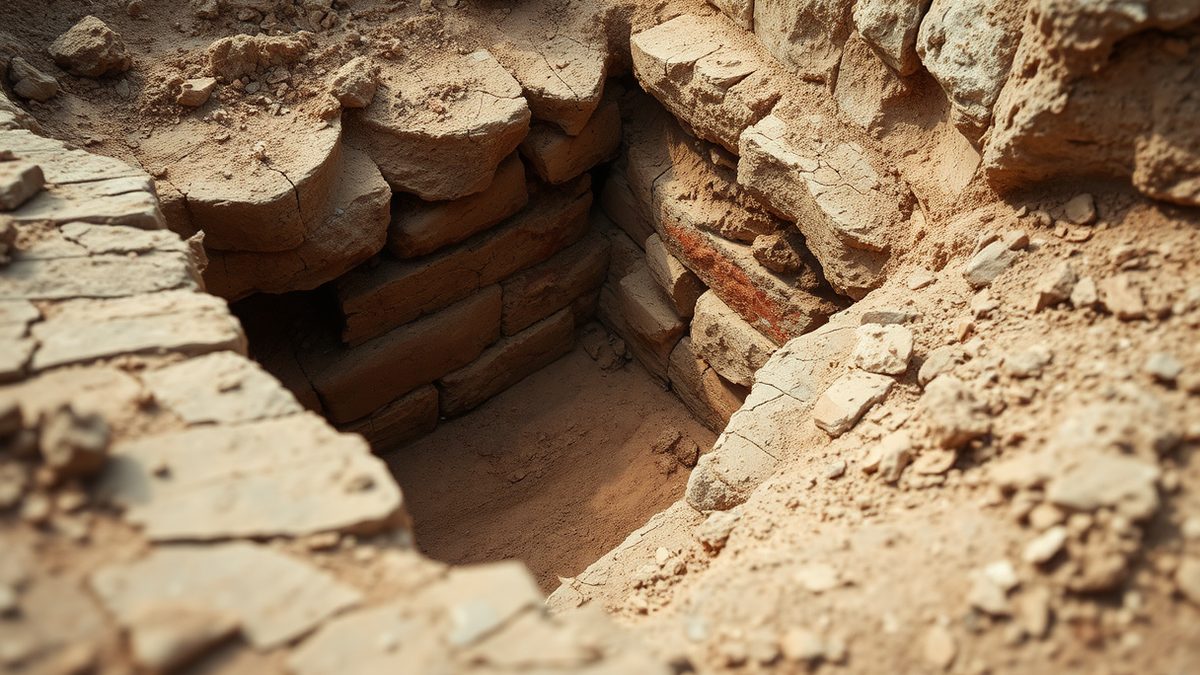
The find opens a layer of the Nile Delta that digging could not reach. The older deposits sit below the water table in waterlogged clay. What the building was remains unresolved. The team has dug only a small pit so far.
A 128 by 62 metre anomaly under Kom C
Sentinel-1 radar images showed an oval anomaly beneath a mound known as Kom C at Tell el-Fara'in, about 85 miles northwest of Cairo. It measured 420 feet long and 203 feet wide, or 128 by 62 metres.
To test what the radar suggested, the team ran electrical resistivity tomography (ERT) along 15 parallel lines across about 5,400 square metres, or 58,100 square feet. The method sends currents through the ground. It measures how different materials resist them, producing a cross-section without a trench.
The survey produced a layered picture. From the surface to 3 metres down, the survey found displaced mudbricks, pottery shards and broken limestone from the Ptolemaic and Roman periods. That debris points to centuries of rebuilding on the site. The survey found a large mudbrick structure between 3 and 6 metres down. It dates to the 26th dynasty, also called the Saite period, which ran from 688 to 525 B.C. That makes the building roughly 2,600 years old.
A joint team published the work in the journal Acta Geophysica. It came from Egypt's Kafr El Sheikh University and Durham University in the UK.
Why a satellite did the digging
Occupation at Buto ran from around 3800 B.C. to the Early Islamic era of the 7th century A.D. Each period built over the last.
Sentinel-1 sends microwave pulses down from orbit and measures how they reflect back. The returning signal carries subtle differences in surface moisture, elevation and reflectivity that can hint at structures buried underneath. The constellation's radar probes were launched between 2014 and 2025.
The researchers wrote about combining geophysical measurements with remote sensing. They said it gave "a very accurate vision in detecting buried settlements in a complex region". They added that 3D inversion algorithms were "particularly effective in delineating buried mudbrick walls and architectural structures".
The sand layer under the walls
At 6 to 7 metres down, below the mudbrick structure, the survey hit a thick layer of clean sand. The team reads it as an artificial foundation. It is a sandbox laid down to spread the building's weight over clay that swells when wet and shifts as it dries.
The team dug a 10 by 10 metre pit 6 to 7 metres deep. It confirmed the resistivity model. It uncovered mudbrick walls resting on the sand, plus amulets depicting Egyptian deities including Wadjet and a small offering basin.
The authors list a large tomb, a shrine, a priestly residence or a religious service complex. Hussein Bassir is director of the Antiquities Museum at Bibliotheca Alexandrina. He said the sand cushion showed the builders "profoundly understood their environment".
What the site was
Buto is modern Tell el-Fara'in. It was the sacred home of Wadjet, the cobra goddess of Lower Egypt, and one of the most important religious cities of the pharaonic period. The city was largely unoccupied for roughly 1,500 years before it was resettled. Ptolemaic remains at the site date from 305 to 30 B.C., and Roman material from 30 B.C. to A.D. 395.
What happens next
The team plans to expand the non-invasive surveys with larger equipment. The aim is to reach deeper, older levels of the settlement. The study says another temple may remain buried under a thick clay layer. That is in addition to the known temple at the site.
Sources
28- 01Satellite surveys reveal ancient Egyptian complex buried beneath the Nile - The IndependentEN
- 02Mysterious 2,600-year-old Egyptian building discovered from space - Live ScienceEN
- 03Mysterious 2,600-year-old Egyptian building discovered from space - YahooEN
- 04Satellite Imagery Reveals a 2,600 Year-Old Complex Buried Beneath an Ancient City in Egypt - GizmodoEN
- 05Massive 2,600-year-old Egyptian complex under Nile discovered from space - YahooEN
- 06Satellite surveys reveal ancient Egyptian complex buried beneath the Nile - inklEN
- 07Space Satellites Detect a Massive 2,600-Year-Old Buried Egyptian Complex Larger Than a Football Field Hidden Beneath Nile Mud - Istituto ImpariamoEN
- 08NASA's Hubble and Webb discover ancient worlds that remember their pastEN
- 09NASA is racing against time to save the Hubble Space TelescopeEN
- 10 A rainbow of ancient rocks on Mars | Space photo of the day for Nov. 2, 2026 EN
- 11 Trump declares 'American space superiority for all eternity' in election night proclamation EN
- 12After Texas' blue wave, what happens to Elon Musk and SpaceX?EN
- 13 NASA's Swift space telescope crashes back to Earth after failed rescue attempt EN
- 14SpaceX signs deal with Qualcomm to provide network technology for U.S. mobile serviceEN
- 15All 5 genetic “letters” of DNA and RNA discovered in a 4.5-billion-year-old asteroidEN
- 16Massive Ancient Secret Spotted Beneath Egypt From SpaceEN
- 17 Drone warfare in space: Swarms of autonomous, laser-shooting cubesats could defend Western satellites in orbit EN
- 18 PHP vulnerability post-mortem reveals bug was known two years ago — Small team of maintainers knew of the issue before it was made public, as new PHP2Shell chaEN
- 19MIT scientists break a 20-year rule and unlock never-before-seen crystal structuresEN
- 20AI helps Stanford scientists discover a “natural Ozempic” with a surprising advantageEN
- 21 NASA asks industry for ideas about saving Hubble Space Telescope EN
- 22 Ancient star collisions could explain mysterious Little Red Dots and 'impossible' black holes EN
- 23 Voting in space: NASA astronauts cast ballots from International Space Station EN
- 24 Dimorphos in sight: Europe's Hera probe gets its 1st look at battered space rock (photo) EN
- 25This space company is betting its future on a propellant available everywhereEN
- 26 Robot cube explores the International Space Station | Space photo of the day for Nov. 3, 2026 EN
- 27 On this day in space! Nov. 3, 1957: Laika the dog launches with Sputnik 2 EN
- 28Qualcomm Dragonwing Nabs a Big SpaceX Starlink Mobile Nationwide US 5G Network WinEN
All figures and quotations in this text come from the sources listed below.
Content prepared by the editorial team with AI assistance.
Sofia Marchetti
Comments
0- No comments yet — be the first.