Wearables turn homes into sleep labs, but accuracy limits persist
A University of Texas at Austin study tracked 82 young adults with wrist-worn wearables for several months and found physical activity lengthened REM latency, offering the most reliable validation to date of the link between exercise, sleep quality and psychological health.
 Sofia MarchettiScience and health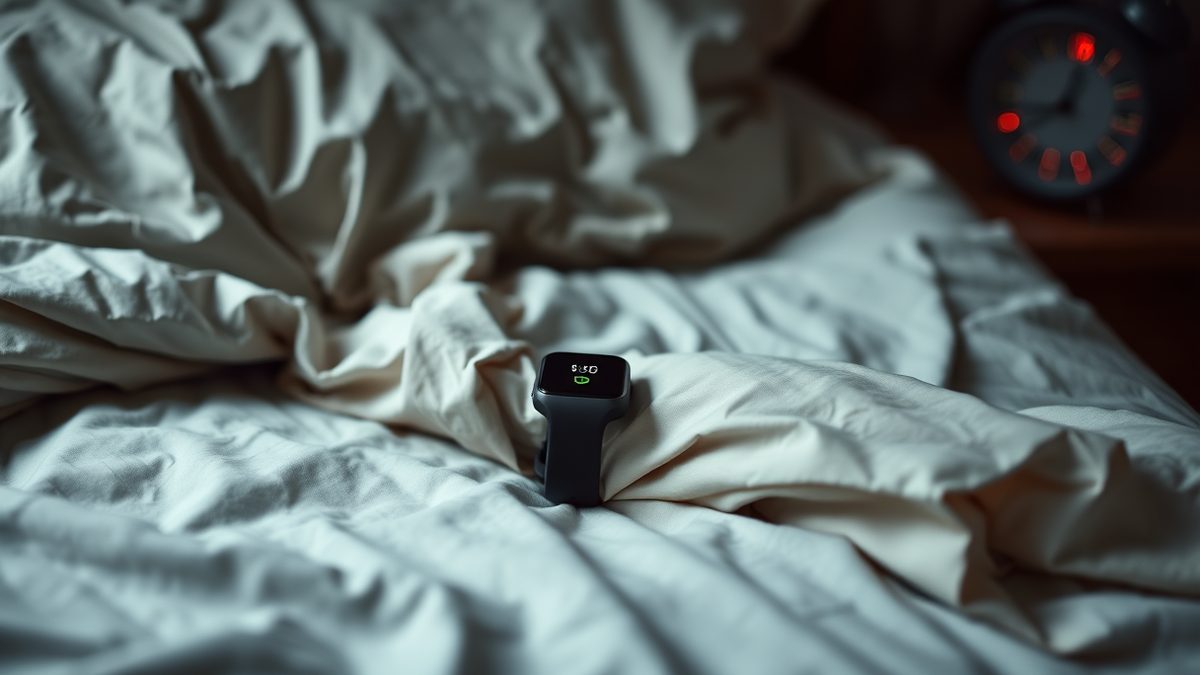
The study, published in Nature Scientific Reports, used a commercial Fitbit-style wrist tracker to record movement and heart rate, from which periods of deep non-REM sleep and REM sleep were inferred. A separate smartphone app collected self-reported well-being data. The University of Texas at Austin said the work provides the most reliable validation to date of the connection between physical activity, sleep quality and psychological health, according to its 1 April news release.
That matters because sleep research has long been confined to laboratories.
"You can learn a lot from lab studies, but obviously there are limitations to studying the sleep patterns of individual participants in just one night," said Benjamin Baird, a research assistant professor of psychology and one of the authors, in the UT release. "It's an unfamiliar, clinical-type setting, which can be stressful. And you can't really look over time, either. So, there are always questions about generalizability from that kind of design."
The Texas team found that both low-intensity and moderate-to-vigorous physical activity were linked to deeper, more restorative sleep, and that better sleep was in turn associated with more energy and less stress the following morning. The key difference from earlier work was the use of consumer-grade wearables to monitor participants continuously over weeks and months rather than a single night in a clinic.
David M. Schnyer, a co-author and chair of the Department of Psychology, framed the shift bluntly in the UT release. "We've shown using a standard Fitbit that anyone could wear, not even an expensive scientific device, that it is actually sensitive to these sorts of sleep architecture measures, and in a way that's showing predictive results," he said. "The world is your oyster now. You can use this device to study all manner of different sleep architecture data related to lifestyle, related to mood and mood disorders, in the field, not in a lab, that people might have thought was not possible previously."
From 82 participants to millions of nights
The Texas sample was small: 82 young adults. But the broader consumer sleep-tracking boom has given researchers access to millions of hours of data, as ABC News reported on 24 September 2024. Sleep Cycle, a Swedish app with about 2 million active nightly users, detected an above-average number of brief awakenings in the area around a New South Wales earthquake after seismic waves rippled through Sydney's sandstone bedrock.
Michael Gradisar, Sleep Cycle's head of science, told ABC News that population-level sleep data can act as an early warning system. During the Omicron wave in New York, the company saw an increase in night-time coughing roughly one week before confirmed cases rose as a population, he said. "Sleep is one of the first things to go wrong in a person's health," Gradisar told the broadcaster. "Sleep is the canary in the mine."
Regulators have started to take the hardware more seriously. In early 2024 Samsung's smart watch sleep apnoea detection system received approval from the US health regulator after an eight-month review, the first consumer smart watch to clear that hurdle. Apple's smart watch, the most popular in the world, received the same regulatory approval in September 2024, according to ABC News.
"The single-night tests are hugely noisy and inaccurate," Danny Eckert, director of the Adelaide Institute for Sleep Health at Flinders University, told ABC News. "We've never been able to monitor accurately what's going on with sleep apnoea in the home. Now we can do it every single night for weeks, months and years."
A 2022 study co-authored by Eckert found up to half of single-night diagnostic studies for sleep apnoea, the current gold standard, misclassify severity. Sleep apnoea may affect as many as a billion people worldwide and is under-diagnosed, ABC News reported, partly because conventional diagnosis requires an inconvenient and often expensive night in a sleep lab.
Not everyone greeted the first wave of consumer sleep tech with enthusiasm. Gabriel Pires, a sleep researcher in Brazil, told ABC News that he and colleagues initially published papers warning that the new devices did not work well. Mike Gradisar, then a professor of sleep science at Flinders University, was also sceptical before he moved to the private sector. The pandemic changed the market: device sales grew, investment followed, and Apple added sensors for heart electrical activity, blood oxygen content and body temperature.
David Walsh, the developer who built the first Apple Watch sleep-tracking app, released AutoSleep in early 2016. Eight years later the paid app had more than 5 million users, he told ABC News. He described how testing his own creation made him acutely aware of small behavioural effects on sleep duration, including an after-work beer that could shave hours off sleep time.
China's parallel push
Wearables are only one strand of a wider digital health expansion. In China, patients book hospital appointments through WeChat or Alipay, consult doctors on telemedicine platforms and chat with AI doctor avatars about conditions from insomnia to diabetes, Rest of World reported on 24 September 2026.
Ruby Wang, a physician and consultant, told Rest of World that the infrastructure difference shapes adoption. "In the U.K. and in the U.S., tech is always an add-on in the health system," she said. "You are trying to screw an extra bit onto a rusty machine, whereas in China, because the infrastructure and the digital rails are so technologically enabled, society accepts that as normal."
Wang's forthcoming book, China Cure: The Rise of a Biotech, AI Medicine, and Global Health Superpower, argues that Western observers should study China's approach even where it is not directly exportable. She told Rest of World that the West would never accept an AI doctor avatar, but that awareness matters. China now conducts more clinical trials than the U.S. and accounts for half of global drug licensing deals, according to the same interview.
For wearable sleep research, the unresolved question is not whether the data exist. It is whether the devices are accurate enough for the claims built on top of them. The Texas study suggests a consumer Fitbit can capture sleep architecture measures with predictive value. Earlier scepticism, the 2022 sleep apnoea finding and the regulatory reviews all point the same way: the field is moving from lab to wrist, but validation is still catching up.
Sources
3- 01Move More, Sleep Better, UT Study FindsEN
- 02Sleep-tracking devices are wiring the world for the study of sleep. What will we find?EN
- 03China is excelling in health tech. That's good news for the worldEN
All figures and quotations in this text come from the sources listed below.
Content prepared by the editorial team with AI assistance.
Sofia Marchetti
Comments
0- No comments yet — be the first.