AI science money goes to lab robots as forecast puts market at $4.44bn
The Business Research Company forecast on 3 November that the market for artificial intelligence in life sciences will reach $4.44 billion in 2026, up from $3.59 billion in 2025. Two funding rounds reported in the days before point at where that money is going: robots and chemistry benches, not model training.
 Grace OkonkwoAI, models and technology
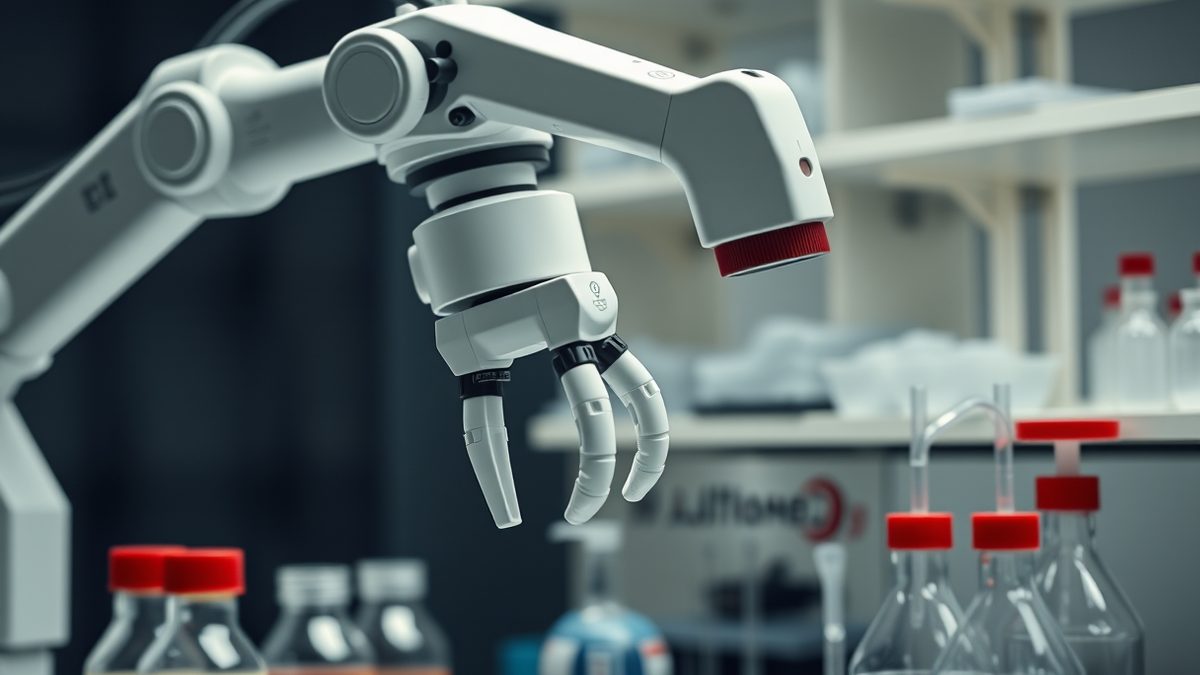
The Business Research Company published its forecast on 3 November. It expects the market for artificial intelligence in life sciences to reach $4.44 billion in 2026, up from $3.59 billion in 2025.
Lab automation turns AI science budgets into hardware and service contracts. That makes the rounds a buying signal for research teams picking vendors they will still need supported in three years.
Warp Sciences came out of stealth with $215 million to build a U.S.-based chemistry contract research organization, The Robot Report reported on 28 October. A day later, Opentrons Labworks said it had raised $40 million in a Series E led by Avego, with BroadOak Capital Partners participating, citybiz reported. Warp's round is more than five times the size of Opentrons'. The two rounds landed within a day of each other, and they point at robots and chemistry benches rather than model training. That makes the pair a test of two sales models in one market.
Opentrons sells installed robots into labs that already have them. Warp sells chemistry as a service.
Both want the same pharmaceutical and biotech customers. Neither company disclosed a valuation, and neither published customer results showing that discovery actually got faster. The two sit at opposite ends of one problem.
Weil said "AI has dramatically accelerated software engineering and mathematics, but it has yet to make the same impact in the physical sciences". James Flexner, managing partner at Avego, put the narrower version: "every AI-driven discovery still has to be tested in a real lab". The sizes differ for a reason. Opentrons sells capacity to labs that already buy instruments, a business with an installed base and a sales channel. Warp sells a service that has to be trusted with molecules a customer has not patented yet. That trust gap shapes how each company sells.
Warp's first service is lead optimization analog synthesis. It makes variations of molecules that research teams can compare as they hunt for a drug candidate.
Experienced chemists guide the experiments while the lab becomes increasingly automated, and the AI models are trained on data from those physical experiments. The company says it has no proprietary drug pipeline of its own. Weil was most recently chief product officer and vice president of science at OpenAI. Chief Scientific Officer Solomon Reisberg held medicinal chemistry leadership roles at Terremoto Biosciences. That pairing of AI product experience and drug-hunting chemistry is the pitch. It is also the reason Warp can sell chemistry as a service without owning a molecule.
Neither company is selling a model. Both are selling bench time.
Opentrons has deployed more than 11,000 robots in laboratories across more than 80 countries. Its installations reach 90% of the world's 20 largest pharmaceutical companies and every top-20 U.S. research university, the company said. It also counts 14 of the 15 largest global biopharmaceutical companies as customers. That install base is the asset. A startup selling chemistry services has to win each customer from scratch; Opentrons can sell software and new instruments into labs that already run its machines. The difference matters when sales cycles run for months. It also matters when a lab wants a new protocol without replacing its fleet.
Atwood said "millions of scientists spend much of their day on manual work a robot can do". That is the pitch.
The Series E proceeds fund AI-driven experimental execution, deeper integration with third-party instruments and software, and entry into new markets and regions. The Flex platform pairs robotic instruments with software. It automates and standardizes experimental procedures.
Warp is also selling geography. In a 2024 survey by the Biotechnology Innovation Organization, 74% of respondents reported contracts with Chinese companies for preclinical and clinical services, according to Reuters. The BIOSECURE Act, signed into law in December 2025, set a framework for restrictions on federal procurement and funding involving designated biotechnology companies of concern. Reisberg said he had worked with overseas chemistry partners that delivered speed and value, but that he still worried about protecting the intellectual property behind his programs. Warp's answer is a U.S.-based partner with IP protection at the center of the relationship.
Whether drug developers will pay for proximity is the open question.
Not all of the tooling is commercial. OpenScience, an open-source research agent published on GitHub on 31 October, takes a task in plain language, plans it, runs code and experiments, and records every step. It ships connectors to ChEMBL, UniProt, PubMed and arXiv, plus ten adapters for NVIDIA BioNeMo endpoints that the project labels experimental. Hardware vendors are integrating as well. Carterra and Grenova Robotics combined Carterra's Vega with the KX2 collaborative robot into an automated HT-SPR work cell, AOL reported on 28 October. The forecast is the part with a number attached. The Business Research Company expects the AI-in-life-sciences market to grow 23.6% in 2026 and to reach $10.43 billion by 2030, a 23.8% compound annual growth rate from 2026. Those are projections from a market research firm, not audited results.
A forecast counts spending; a funding round counts investor conviction that the spending will arrive. The gap between the two is where the automation vendors currently live. The rounds point at instruments, reagents and chemistry time rather than at foundation models.
Sources
20- 01Warp Sciences emerges from stealth, to apply robotics to drug researchEN
- 02Opentrons Raises $40 Million Series E Led by Avego to Expand AI-Driven Laboratory AutomationEN
- 03Open Science: The open-source AI workbench for scientific researchEN
- 04Life Sciences Market for Artificial Intelligence Projected to Reach $10.43Bn by 2030EN
- 05Opentrons Announces $40M Series E Round to Standardize AI-Driven Science on Its RobotsEN
- 06Carterra and Grenova Robotics Integrate Carterra Vega with KX2 Collaborative Robot to Create Automated HT-SPR Work CellEN
- 07Rapid LLM development is outrunning the research meant to explain it, study findsEN
- 08Hanwha Q-Cells shifts focus to research and development in EuropeEN
- 09Android-Smartphones sichern Fotos jetzt automatisch auf Windows-PCsEN
- 10CyberKord raises €2.7M to automate IT and cybersecurity operations with AIEN
- 11Quantum Interconnects Link Two 120-Qubit Processors (IBM Research)EN
- 12Accelsius Supports NSF Data Center Efficiency Research at VillanovaEN
- 13Hyperion Research: Nearly 20% Growth in HPC and AI-for-Science Server Market, Dell Takes Lead from HPEEN
- 14Chinese automakers reportedly head to Beijing for talks on EU hybrid export quotasEN
- 15Avoiding an uncontrolled reentry; boost Hubble and keep the science – IsaacmanEN
- 16 On this day in space! Oct. 30, 1964: NASA's weird Lunar Landing Research Vehicle takes 1st test flight to help Apollo astronauts land on the moon EN
- 17Microsoft Research Focus – Edition #97EN
- 18AI acceleration of science – a personal reflection - Wellcome Sanger Institute BlogEN
- 19What Women in Indonesia and Malaysia Want From Research on Climate and HealthEN
- 20Claude helped plan risky bird flu research. What did the AI add?EN
All figures and quotations in this text come from the sources listed below.
Content prepared by the editorial team with AI assistance.
Grace Okonkwo
Comments
0- No comments yet — be the first.