Documentation assistants in the emergency department do not change the status quo
Ambient scribes are the most advanced AI that has actually reached the emergency department. According to a STAT report, they have not changed the daily reality of the department.
 Sofia MarchettiScience and health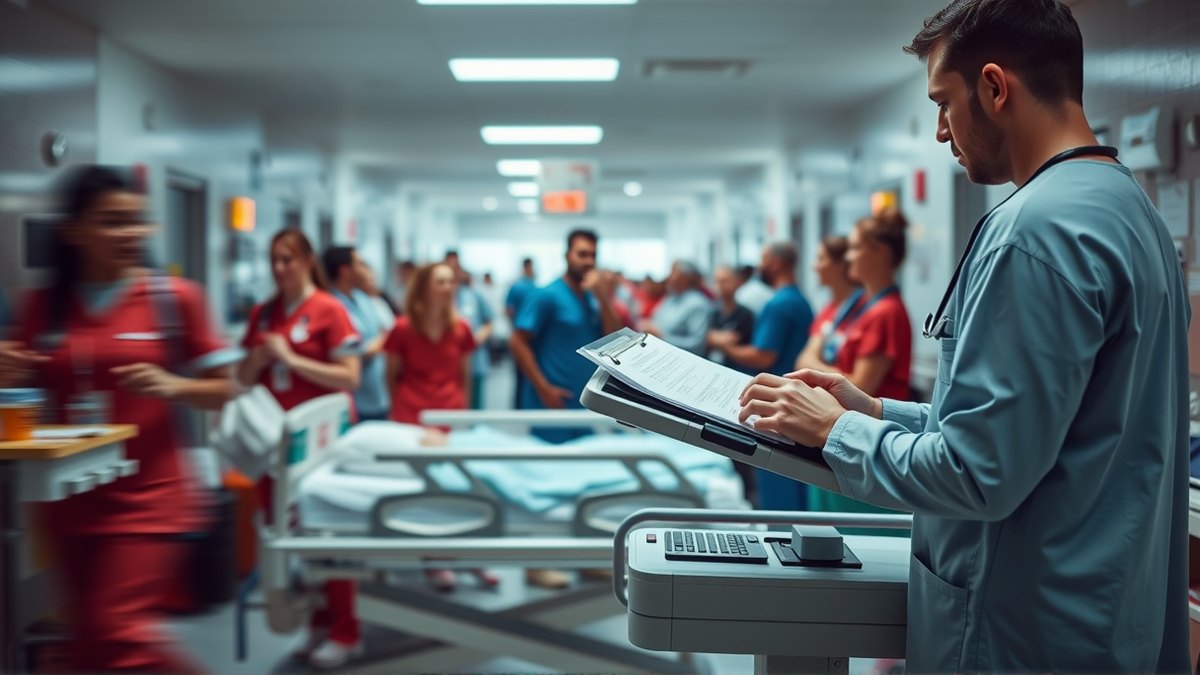
The emergency department at Brigham and Women's Hospital in Boston opened in 2022. By 2025 it was already too small. One evening in early September there were 59 patients in the department, and 152 if you count everyone in the waiting room. Christopher Baugh, a physician there, puts it plainly: "As for acute care rooms, we have 61 of them. You cannot take 152 patients into 61 rooms." Beds went wherever they could fit, and some patients lay in the corridors.
Here, in the chaos of the emergency department, the limits of what AI actually changes in medicine are most visible. The most advanced technology present in the ER is the so-called ambient scribe: software that listens to a doctor's conversation with a patient and helps write it into the medical record. A STAT report from 9 September 2026 sums up the impact briefly: it has not changed the status quo.
That does not mean the tools are useless. Hospitals that have deployed them report the same real benefits: fewer hours spent on documentation, less administrative burden on the team, and better communication with the patient. The problem is that relief for people does not automatically translate into department throughput. Rooms, beds and staff are still missing, and the queue forms at a different point in the thread, at resources rather than at the keyboard.
The numbers from that evening are worth setting against what AI can change at all. A language model can turn a recording of a conversation into an entry in the record; it cannot open a new room or hire a nurse. That is why improving the system "on the way out", meaning throughput, requires changes in resources and not only in the software layer. This distinction matters for every decision to buy another tool for the emergency department.
Where evidence is really missing
The same problem, a gap between promise and evidence, is described in a commentary published on 17 September 2026 in npj Digital Medicine by Arjun Mahajan, Nigam H. Shah and Dylan Powell. The authors point out that the rapid development of large language models in medicine complicates the classic approach to generating and evaluating evidence: models change faster than studies are run, and the designs and reporting methods of prospective clinical trials are too varied to assess the effectiveness and safety of clinical models quickly and reliably.
The practical conclusion for hospitals is this. Deployments that shorten time spent on documentation have a solid basis and can be accounted for. Promises about department throughput, costs or treatment outcomes, however, require separate studies designed for them. Without that, it is easy to end up in a situation where the AI assistant pleases the doctors while patients are still waiting in the corridor.
Sources
2- 01Can AI fix health care? In the chaos of emergency rooms, the technology comes up shortEN
- 02The evidence challenge facing large language models in medicine (npj Digital Medicine)EN
All figures and quotations in this text come from the sources listed below.
Content prepared by the editorial team with AI assistance.
Sofia Marchetti
Comments
0- No comments yet — be the first.