Beijing: let AI revive heritage, but not tell our stories for us
At a culture forum in Beijing, writers and researchers argued over whether models will replace artists. The writer Mark Handler had a short answer: we do not need AI to tell our stories.
 Helen MarshCulture, food and lifestyle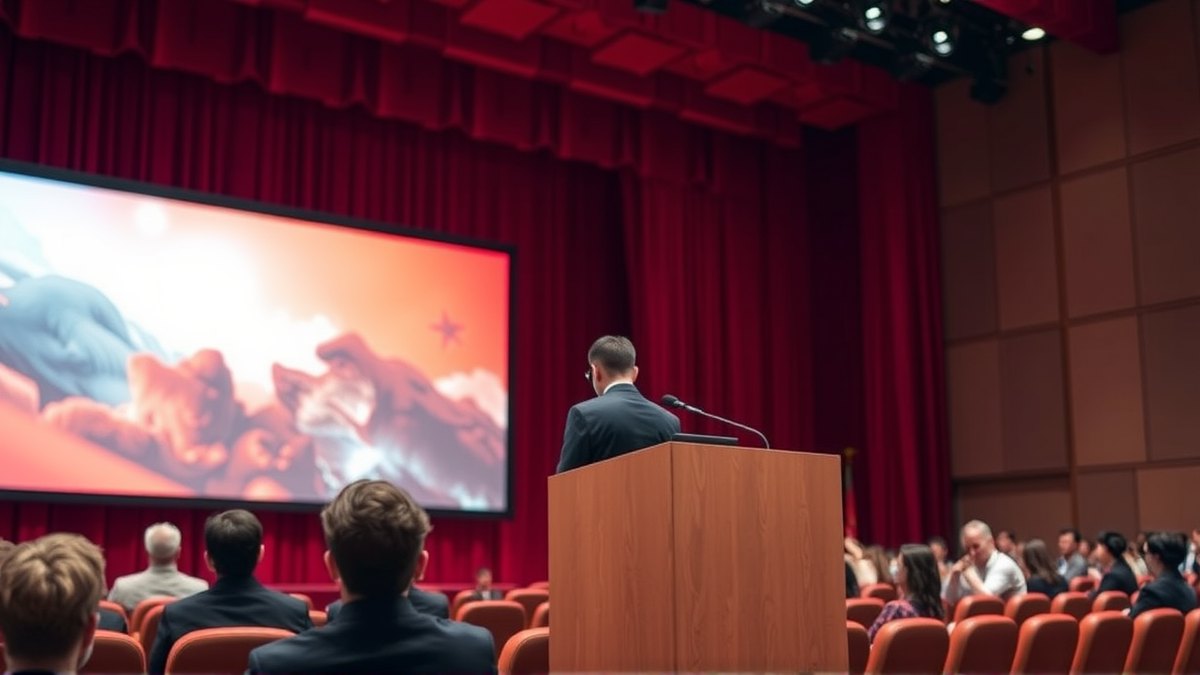
The Culture Forum took place in Beijing on 23 September 2026, and one of its panels was called "Cultural heritage and artistic creation". Artificial intelligence was not a separate item on the programme. It ran through the whole discussion, because the question of where machine creativity ends now also shapes how the past gets told. On stage were the Chinese writer A Lai, the director of the National Theatre of China, Tian Qinxin, and Mark Handler, a lecturer at the Beijing Film Academy and a dramatist.
"We do not need AI to tell our stories"
Handler built his remarks around the image of an ancestral family home. Such places hold a family's history, he said, but today their members live in different cities, often in different countries. He imagined a programme called "a garden of family memory" that would store archives, photographs, stories and recollections, open to everyone wherever they are. Then he went further. Models could "bring to life" Confucius, Laozi and Sun Zi, he proposed, and even set them against one another, so that young audiences could grasp Chinese philosophy immersively. He also drew a clear line. As a writer, he holds that a person tells stories better than a machine, because a person draws on real experience, while AI only repeats what it has gathered from people. In his view, models should organise and aggregate enormous data sets and build complex structures. Video production, for instance, requires preparing and calculating every possible variant in advance, and no human can carry that. So AI is to supply a list of options, and the screenwriter picks from it what to tell. That is a division of labour, not a replacement.
Dunhuang on a 60-metre screen
Tian Qinxin proposed a completely different path, showing how digital tools enter the stage. The National Theatre of China, together with the Dunhuang Academy, prepared the musical "Call to Dunhuang". It recreated 45 000 square metres of paintings from the Thousand Buddha Grottoes in Dunhuang and more than 2 000 polychrome figures, an aesthetic output stretching from the 4th to the 14th century. In Beijing's skating arena "Ice Ribbon", the company put up a 60-metre screen in full greyscale and additional high-resolution screens. Artificial intelligence techniques were combined with two-dimensional animation, three-dimensional effects and live photography. On the same day, at a related investor event, companies at the intersection of technology and culture presented their solutions. Shanghai Jianwei Libao, a company founded in 2009 that works on heritage protection, presented a shift from traditional restoration towards preventive conservation supported by digital tools and AI technology. Its vice-president Liu Wenzhuo stressed that the company has worked exclusively on heritage for eighteen years. The Beijing debate therefore points in two directions at once: models are to take over technical work and scale, but not narrative. Where identity is at stake, the final word stays with people.
Sources
2All figures and quotations in this text come from the sources listed below.
Content prepared by the editorial team with AI assistance.
Helen Marsh
Comments
0- No comments yet — be the first.