Boston Dynamics' new Atlas hand drops the pinky as humanoid production ramps up
Boston Dynamics unveiled a new four-fingered hand for its Atlas humanoid on 1 October, with 13 degrees of freedom and a design built for tool use rather than human mimicry.
 Grace OkonkwoAI, models and technology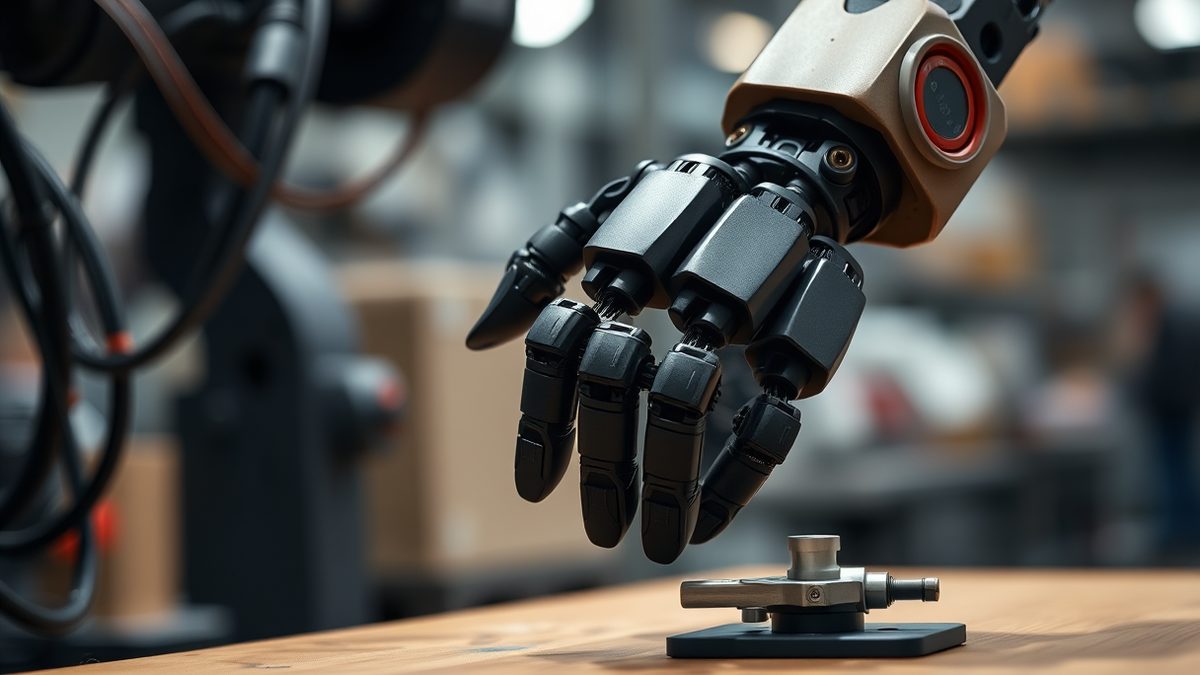
Boston Dynamics unveiled a new four-fingered hand for its Atlas humanoid on 1 October. The finger count drops from five, and the degrees of freedom from seven to 13, in a design the company says is built for manipulation rather than grasp variety.
The hand is directly actuated, uses one actuator type, and is designed for mass manufacturing, according to The Robot Report. "There's no pinky because the team determined that the additional dexterity and tasks you'd be able to accomplish is not worth the extra complexity of three additional degrees of freedom, the size, the power consumption, all of the things that come with adding additional actuators," said Dylan Thrush, a mechanical engineer on the Atlas team. Before the design was finished, chief product and technology officer Zachary Jackowski asked the team to tape their pinky and ring finger together for a day and report back. The team agreed the robot hand did not need a pinky.
The news came a week after Boston Dynamics opened its Robotics Metaplant Application Center at Hyundai Motor Group Metaplant America in Georgia. The company describes it as a training center for integrating Atlas into Hyundai's automotive manufacturing operations.
The factory floor is where humanoids are actually appearing
Tesla is pushing a similar narrative but with documented friction. Ars Technica reported on 26 September that Tesla's Fremont factory stopped making the Model S and Model X as of May 2026, moving line workers and engineers to Optimus. The Information's reporting, cited by Ars, describes production line equipment struggling to align components, with hundreds of robots per week produced against a target of more than 1,000 per week by the end of 2026. Optimus hands and forearms together contain more than 100 small components such as screws, assembled manually. Touch sensors proved unreliable enough that Tesla developed a replaceable glove-like sensor layer. One source described the robots as requiring programming for specific tasks in controlled environments.
The gap between demonstration and deployment is visible in the numbers. China shipped more than 19,000 humanoid robots in the first half of 2026, 77.9% of global shipments, according to figures attributed to IDC by TechNode. Global shipments reached nearly 25,000 units, up 432.1% year over year.
Against that, the International Federation of Robotics reported on 24 September that the global operational stock of industrial robots rose 9% to a record 5 million units in 2025, with more than 600,000 new installations. Humanoids remain a rounding error in that total.
Analyst forecasts diverge sharply. SemiEngineering cited Goldman Sachs research projecting annual humanoid shipments above 6 million units by 2035, up from fewer than 15,000 in 2025. IDC raised its 2030 forecast to more than 750,000 units.
The parts problem behind the production problem
Component suppliers are positioning around the gap. Vishay Precision Group will present custom force and torque sensing at RoboBusiness 2026, arguing that off-the-shelf sensors are too large for small robot limbs, have measurement ranges too broad for signal accuracy, and lack the thermal and environmental adjustments needed in compact joints. ForceN's Robert Brooks will give a force and torque sensing session at the same event, drawing on three years of work with humanoid companies.
"With sixty years of experience in aerospace-grade force sensing, we connect experimental mechanics with smart system integration, helping engineers test, validate, and add sensing with outstanding accuracy and reliability," said Ron Zukerman, innovation director at Vishay Precision Group.
Data is the other bottleneck. Innodata opened a motion-capture lab on 30 September, with CEO Rahul Singhal stating that every robotics team hits the same wall: not enough real-world interaction data, and what exists is expensive and slow to produce. Franklin Tanner, vice president of robotics and physical AI, told The Robot Report that physical AI "has to earn its tokens one interaction at a time."
Not everyone is chasing the human form. Maven Robotics CEO Hamza Derbas told The Robot Report his company started from jobs rather than morphology, and that humanoid firms "were starting with the human form factor and trying to work backwards into a problem to be solved." Maven has raised $100 million and runs robots 16 hours a day, five days a week, with up to 99% uptime.
Destro AI came out of stealth on 30 September with an $8 million seed round, built around an intelligence layer that also directs human workers. "One of the biggest reasons we are winning against robotics companies is because we are not a robotics company," founder Manthan Pawar told TechCrunch.
In Europe, Bruno Siciliano, professor of automation and robotics at the University of Naples Federico II, told Il Sole 24 Ore that the fully anthropomorphic version with legs is not always productive in an industrial plant, citing cost, stability, movement agility and regulation. He pointed to BMW's rethink of its use of Figure AI humanoids in South Carolina.
Figure itself retired its F.02 fleet in unusual fashion, sending robots into a 75-tonne electric arc furnace in Imatra, Finland, according to heise online. The company said keeping the units operational would have been too costly, and dismantling them too time-consuming, with resources redirected to the F.04 generation.
Sources
12- 01Boston Dynamics drops pinkie on new humanoid handEN
- 02Tesla workers balk at training Optimus humanoid robots as replacementsEN
- 03China accounts for 77.9% of global humanoid robot shipments in H1, IDC saysEN
- 04Five Million Robots Now Operate in Factories GloballyEN
- 05Memory At The Edge: Non-Volatile Memory Challenges And Requirements For Humanoid RobotsEN
- 06Vishay Precision Group to Showcase Custom Sensing Capabilities for Humanoid Robotics at RoboBusiness 2026EN
- 07ForceN to give a crash course on force and torque sensing for humanoids at RoboBusinessEN
- 08Innodata opens motion-capture lab to help humanoids move more like peopleEN
- 09How Maven Robotics plans to automate industrial work, one task at a timeEN
- 10Destro AI's secret sauce is getting robots and humans on the same pageEN
- 11Umanoidi, il professore di robotica Bruno Siciliano: «L'Ue punta sull'interazione tra uomo e macchina»IT
- 12Figure mustert humanoide F.02-Roboter aus und lässt sie in Schmelzofen springenDE
All figures and quotations in this text come from the sources listed below.
Content prepared by the editorial team with AI assistance.
Grace Okonkwo
Comments
0- No comments yet — be the first.