UBTECH's Liuzhou plant can build a humanoid every 10 minutes, but the market is still small
UBTECH's Liuzhou factory, which opened on 12 September, is designed to turn out more than 10,000 humanoid robots a year at a line rate of one unit every 10 minutes, according to Interesting Engineering, a capacity that dwarfs the roughly 7,000 humanoids sold worldwide in 2025.
 Rachel NwosuAI, models and technology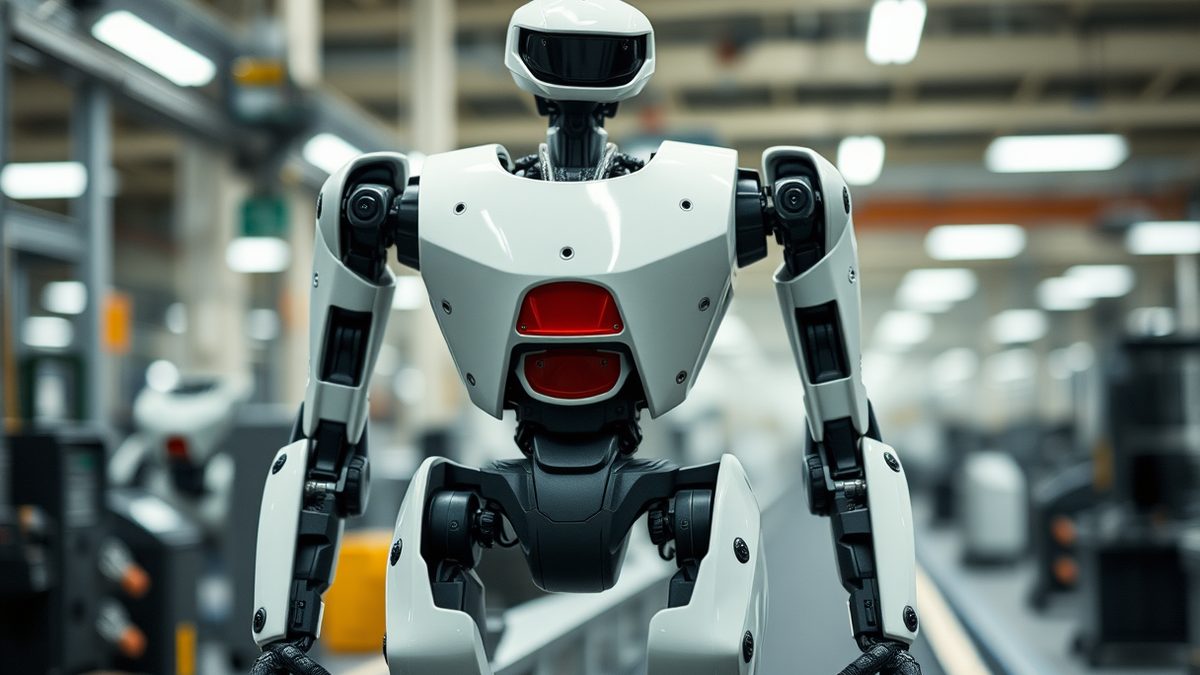
China shipped more than 19,000 humanoid robots in the first half of 2026, accounting for 77.9% of global shipments, according to figures attributed to IDC by TechNode on 29 September. Global shipments reached nearly 25,000 units, up 432.1% year over year.
That is the demand picture the Liuzhou plant is being built against. The 14,000-square-metre facility in Guangxi assembles one robot every 10 minutes across the Walker S and Cruzr lines, Interesting Engineering reported, a rate the publication says is enabled by a flexible mixed-line configuration that lets several humanoid models share the same line. Each finished unit needs more than 2,000 screws of different specifications, and each gets a unique serial number tied to component sources, assembly parameters and inspection records.
UBTECH developed the plant with Siemens Digital Industries Software. NDTV, cited in the same roundup, reported that every unit undergoes more than four hours of testing and a 360-degree optical inspection, and that the automated warehouse stores 112 robots in 65 square metres. Driverless forklifts and automated guided vehicles move parts and finished units through the site, while Cruzr robots handle depalletising, palletising and material loading. The stated annual capacity is a design target, not independently verified output.
Capacity against a small market
The gap between that throughput and actual demand is the central tension. Global humanoid robot sales were only about 7,000 units in 2025, according to the International Federation of Robotics, as cited by Adalytica on 28 September. UBTECH alone is preparing for annual output that exceeds the entire market's recent global sales.
UBTECH's own numbers show both sides. It delivered 921 full-size humanoids in the first half of 2026, generating 1.27 billion yuan in revenue, but still posted a 339 million yuan loss, Adalytica reported. Many humanoids are still bought for experimentation rather than production lines, which means factory utilisation will hinge on whether manufacturers, logistics groups and industrial customers decide the machines are reliable enough to justify deployment.
Pang Jianxin, a UBTECH vice president, tied the milestone to local supply chains. "Without the Chinese supply chain, mass-producing complex components would be extremely difficult unless cost advantages were completely sacrificed," Pang said, according to Infomance. He added that Chinese robotics benefits from "a very strong supply-chain base, manufacturing capability, as well as research and development strength."
The Liuzhou line is not the only signal that the sector is moving from pilots to production. In a separate disclosure, the Axis Intelligence deployment tracker counted eight distinct humanoid deployments in primary sources as of 26 September, five of them with operator-side confirmation rather than vendor disclosure alone. The tracker also recorded Tesla's Optimus as a documented non-deployment, stating that Tesla's own filing lists the programme at California and Texas sites with status "Construction" and no unit count ever published in a production report.
What the data problem looks like from New Jersey
Deployment is one bottleneck. Training data is another. Innodata opened a motion-capture laboratory on 30 September, saying it will capture 3D motion directly from bodies rather than inferring it from 2D video, and independently validate the performance data robots generate internally.
"Physical AI is growing faster than any other segment in AI, but every robotics team hits the same wall: There isn't enough real-world interaction data, and what exists is expensive and slow to produce," CEO Rahul Singhal said in the announcement. Franklin Tanner, Innodata's vice president of robotics and physical AI, told The Robot Report that "physical AI has to earn its tokens one interaction at a time."
The lab, built with Vicon, uses infrared optical tracking cameras that Innodata says measure movement down to the sub-millimetre level. Tanner also flagged a gap that no current dataset closes: "We don't have training data right now where humans and robots are interacting," he said.
For all the throughput on show in Liuzhou, that is the part of the stack that still has to be earned.
Sources
6- 01China accounts for 77.9% of global humanoid robot shipments in H1, IDC saysEN
- 02UBTECH Opens High-Volume Humanoid Robot FactoryEN
- 03UBTECH Opens Humanoid Robot Factory in LiuzhouEN
- 04This Country Just Opened a Humanoid Robot Factory Where Robots Help Build Other RobotsEN
- 05Humanoid Robot Deployment Tracker 2026: Every Verified Factory and Warehouse DeploymentEN
- 06Innodata opens motion-capture lab to help humanoids move more like peopleEN
All figures and quotations in this text come from the sources listed below.
Content prepared by the editorial team with AI assistance.
Rachel Nwosu
Comments
0- No comments yet — be the first.