China Tightens Travel Curbs on AI Talent as Export-Control Fight Widens
China's new entry-exit rules, in force since late September, let authorities block engineers and founders from leaving if their expertise in batteries, rare earths or AI is judged a threat to industrial and technological security.
 Dr. Amara PatelEconomy, business and world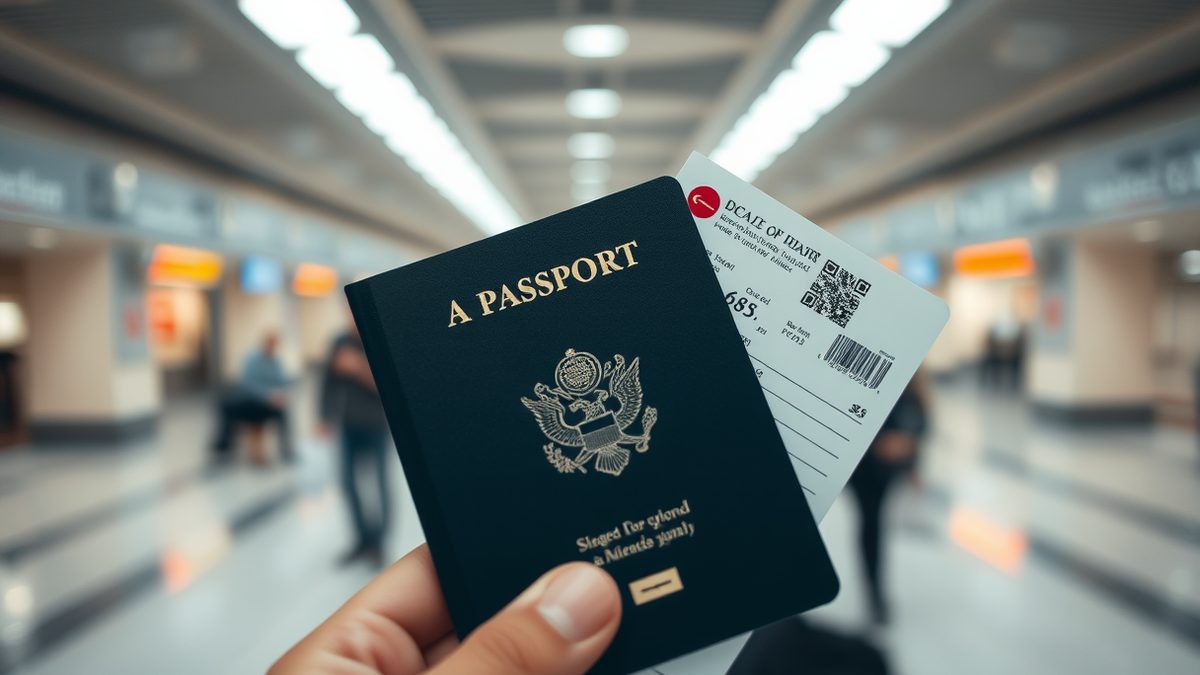
On 1 October, Vision Times, a Chinese-language outlet, reported that the travel restrictions extend to family members of AI specialists. The measures are also paired with tougher tax scrutiny of wealthy individuals abroad. This followed an earlier report from DW on 24 September, which said the measures had taken effect "last week" and described them as an attempt to stop high-end technology and talent from escaping abroad.
DW reported that the rules give Chinese authorities the power to stop engineers, founders and other specialists from leaving if their expertise in batteries, rare earths or artificial intelligence is judged a threat to "industrial and technological security."
Why now
The timing is not incidental. China's property crash has weakened domestic consumption. Bank lending fell to a record low over the summer, and new car sales in August dropped nearly a quarter year on year, according to DW. The same report cited Bloomberg Intelligence estimating that some $1 trillion in Chinese wealth left the country last year. That is the largest outflow of "hot money" since records began in 2006.
Henry Gao, a law professor at Singapore Management University, told DW that the curbs "offer a rare glimpse into the true state of China's economy" and suggest Beijing is "deeply concerned about economic weakness and substantial capital outflows." Natixis chief Asia-Pacific economist Alicia Garcia-Herrero said the $50,000 foreign-exchange quota for households has not changed. However, authorities are "squeezing the people and agents that money usually travels with."
The most concrete case is Manus, an AI startup founded in Beijing by two Chinese nationals. It moved its headquarters to Singapore last year, partly to sidestep US investment curbs. When Meta tried to acquire it for $2 billion last December, Beijing blocked the deal and barred the founders from leaving the country, according to DW.
The export side
Restricting outbound people is one half of the policy. The other half is controlling what China sends out and what it lets in. On 28 September, the Ministry of Industry and Information Technology published a five-year battery plan. Dated 14 September and issued jointly by seven agencies, the plan targets initial large-scale use of all-solid-state batteries by 2030, 15,000 charge-discharge cycles for long-life lithium batteries and parts-per-billion defect rates for leading manufacturers, according to CnEVPost.
The plan also pushes sodium batteries, supports corporate mergers and calls for a digital identity system for EV power batteries. It includes battery passport arrangements and mutual recognition of carbon footprint data.
On the inbound side, the pressure is on Nvidia. Ars Technica reported on 28 September that China's Ministry of Industry and Information Technology has asked Alibaba and ByteDance to share plans to buy Nvidia's RTX Pro 5500 chips. These are gaming parts that could be put into servers for AI models. The report, which cites sources familiar with the talks who spoke to The Information, frames it as a possible relaxation. Nvidia CEO Jensen Huang blamed US export controls for cutting Nvidia's share of China's advanced AI chip market from about 95 percent to zero.
"Jensen is now the president's most influential adviser on technology issues," Stephen Witt, author of The Thinking Machine: Jensen Huang, Nvidia, and the World's Most Coveted Microchip, told NPR, in comments relayed by Ars Technica.
Chinese firms are not waiting. On 30 September, DeepSeek open-sourced six software modules tailored for Huawei's Ascend AI chips. This includes an Ascend-compatible version of TileLang, a programming language designed to be easier to program than Nvidia's CUDA, according to the South China Morning Post. The Decoder reported that the two companies also optimized a supernode of 128 Ascend 950 chips.
The ecosystem gap is the target. Nvidia's dominance rests partly on an estimated four million developers worldwide who build with CUDA, according to The Decoder. Huawei's current rotating chairman, Eric Xu, said the company cannot accept a future that hinges on whether others are willing to sell chips to China. Huawei plans to sell fewer chips abroad because it cannot meet domestic demand.
What Washington is doing
US lawmakers are moving the other way. On 24 September, the House Energy and Commerce Committee unveiled the Communications and Technology Transparency Act. It would widen the Federal Communications Commission's Covered List from "communications equipment or service" to "information and communications technology or service," according to the South China Morning Post. Products on the list cannot legally be imported, marketed or sold as new in the US. The same report noted Lenovo has been drawn into a patent dispute involving memory devices.
Two datasets complicate the decoupling story. China's generative AI user base passed 700 million at the end of June, up 16 percent from 602 million at the end of 2025, according to the China Internet Network Information Centre, as reported by SCMP. A Carnegie China study found China employed 41 percent of the world's leading AI researchers last year against 34 percent for the US. That is a reversal from 2022, when the US led 46 percent to 27 percent, SCMP reported.
That is the tension in the policy. China is tightening the exits for people while trying to keep the doors open for the capital and compute its AI industry still needs.
Sources
8- 01China's new travel rules unsettle tech giants and talentEN
- 02China unveils 5-year battery plan targeting large-scale all-solid-state use by 2030EN
- 03Experts worry about Nvidia's AI chip sales in China and influence over TrumpEN
- 04China's DeepSeek open-sources tools to help Huawei chips supplant Nvidia in AIEN
- 05China's AI industry closes ranks as Deepseek ships open-source software for Huawei's Ascend chipsEN
- 06China tech faces fresh scrutiny as US blacklist bill introduced, Lenovo case emergesEN
- 07China's generative AI user base crosses 700 million, covering over half the populationEN
- 08China overtakes US as top workplace for elite AI researchers, study findsEN
All figures and quotations in this text come from the sources listed below.
Content prepared by the editorial team with AI assistance.
Dr. Amara Patel
Comments
0- No comments yet — be the first.