Decoy processors carry Samsung and SK hynix HBM into China
A loophole in US export controls lets HBM from Samsung and SK hynix reach China's AI chip industry inside packages declared as cheap server processors, DIGITIMES reported on 4 November. Smugglers sell HBM3E in Shenzhen for about $4,000 a unit, against a few hundred dollars a year earlier.
 Dr. Amara PatelEconomy, business and world
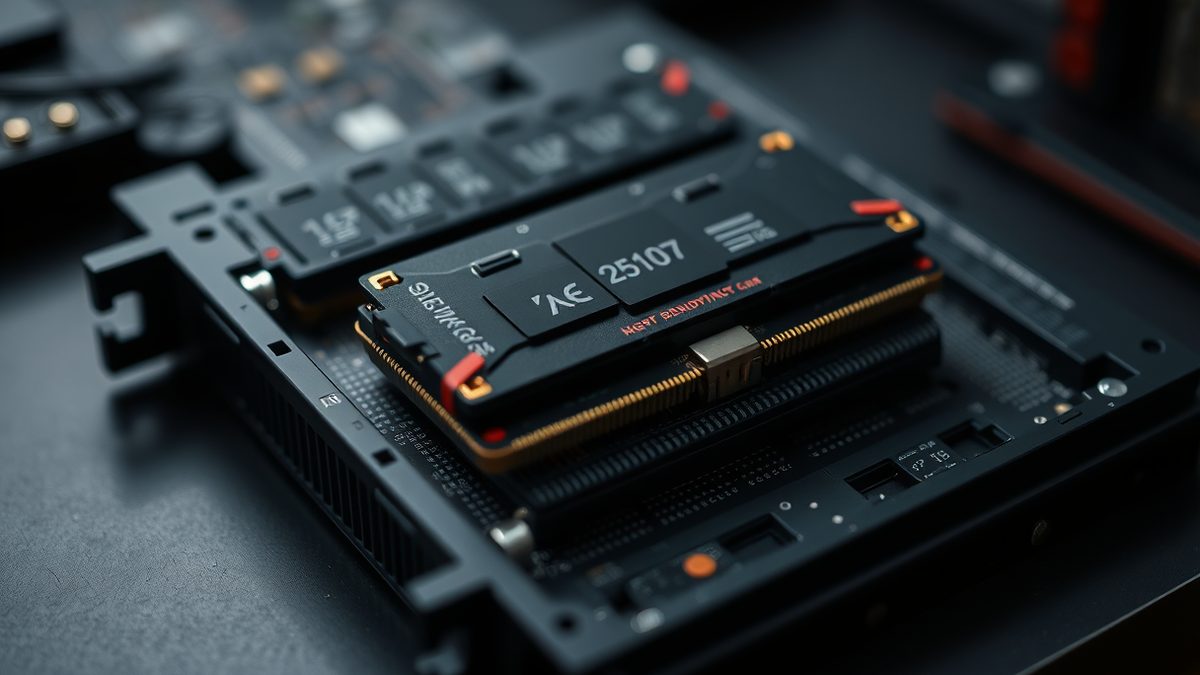
Standalone HBM cannot be exported to China. Mount the same memory on a substrate beside a low-end server processor, and the package is judged by the processor instead.
That is the gap smugglers use, according to Wccftech, which traces it to December 2024 rules that exempted HBM already integrated into logic chip products. CryptoBriefing dates the same gap to June 2024 rules that evaluate packaging by the server processor rather than the memory attached to it. The two accounts differ on the date, not on the mechanism. Packaging firms in Taiwan, South Korea and Southeast Asia bond the memory to the processors. The packages ship to Hong Kong declared under the processor's classification code.
In practice, restricted memory travels under an unrestricted code, and enforcement has to catch it in transit. It is unclear whether the December 2024 rules close the processor-classification gap or push smugglers to another workaround. China's own HBM is the alternative.
From Hong Kong, couriers carry the packages into mainland China in luggage, car trunks and the bags of daily commuters.
Chinese workshops then heat the boards until the solder softens, lift the memory stacks off and throw the processors away. Heating too fast or too slowly can warp or crack the stacks, and smugglers accept the failure rate because the margins absorb it. Wccftech described one operator as a man in his 40s, fluent in Chinese and Korean. He runs a firm that on paper designs chips. His products are deliberately too weak for any data center to buy, which gives him a reason to order top-tier HBM.
The black-market price signal
A Shenzhen chip broker told The Information that a single HBM3E unit changed hands for several hundred dollars a year ago. It now costs about $4,000.
One AI chip package needs six to eight stacks. At those prices the memory alone runs to $24,000 or $32,000 before the processor, the server or the power bill. Nvidia's top-tier B300, also on the US control list, has ended up in China as well, according to Wccftech.
Huawei has told customers to source the memory for its AI chips themselves, according to The Information as reported by Tom's Hardware and The Decoder.
Samsung and SK hynix together hold more than 80% of the global HBM market. China's CXMT has started risk production of HBM3E and is expected to reach mass production by the end of this year. Tom's Hardware reported that low yield keeps its chips expensive to produce and procure.
Who buys and who is exposed
CryptoBriefing named Huawei's AI systems including the Ascend 960DT as the most prominent buyer category.
Huawei's current top part, the Ascend 950DT, sells for about $37,000, Tom's Hardware reported. That is roughly Nvidia B200 money for half the performance of the previous-generation H100. The company says the 960DT will match the H100.
Samsung and SK hynix say they comply with US export guidelines. CryptoBriefing said it found no evidence that either company is participating in the smuggling.
South Korea's customs authority had uncovered trade violations worth $560 million by May, already above the previous full-year record. A third of that total involved strategic goods such as chips exported without proper authorisation or with false declarations.
Taipei moves from customs fines to criminal charges
Taiwan's economics minister, Kung Ming-hsin, said on October 12 that the government plans to add advanced semiconductors and AI servers to the controlled goods list under the Foreign Trade Act. That would turn an administrative penalty into a criminal offense.
On Monday the Legislative Yuan's Economics Committee held a public hearing on a DPP amendment. It would ban exports of specified integrated circuits, key wafer materials, components and chipmaking equipment to mainland China without government approval. The proposed penalties are up to 10 years in prison and fines of NT$5 million to NT$10 million, or US$155,000 to US$310,000.
Startup Fortune reported that the plan would restrict sales to all customers in China, not only blacklisted firms such as Huawei.
Prosecutors in Keelung indicted nine people in August, including the general manager of Flying Tiger Technology and staff at the local units of Nvidia and Super Micro. The case involved 74 Nvidia B300 servers diverted to Chinese buyers for more than NT$600 million, or US$18.5 million, in profit. None of the nine faced an export charge. Prosecutors relied on breach of trust and document forgery under the Criminal Code.
What happens next
Huawei plans to launch the Ascend 960DT early next year and says it will double the performance of its current chips.
The Institute for AI Policy and Strategy, in a memo published on 2 November, recommends location verification on exported chips and whistleblower payments of 10% to 30% of penalties. Delay-based verification, which measures a chip's response time to trusted servers, could be active within a year, the memo says.
Sources
28- 01Smugglers Reportedly Pair Top-Tier HBM With Throwaway Server Chips To Dodge U.S. Export Controls, Then Melt Them Apart In ChinaEN
- 02Decoy processors carry Korean HBM past US export controls into ChinaEN
- 03AI chip smugglers exploit export loopholes to move banned HBM to ChinaEN
- 04AI chip smugglers exploit trade control loophole to bring banned HBM from South Korea into ChinaEN
- 05How to Secure Advanced U.S. ChipsEN
- 06Huawei tells customers to find their own AI chip memory, effectively outsourcing procurement to the black marketEN
- 07Taiwan moves to make AI chip smuggling to China a crimeEN
- 08Taiwan to criminalize Nvidia AI chip smuggling to ChinaEN
- 09Nvidia leans on OpenAI, think tanks to shape chip export rulesEN
- 10China's First Frontier AI Export Controls: Mofcom Announcement No. 48EN
- 11AMD Forecast Exceeds Estimates After AI Chip Demand SoarsEN
- 12Bosch gives chips their own division, eyeing €5bn in sales by 2030EN
- 13The Download: controlling AI agents and “Super Intelligence” loyalty testsEN
- 14Apple warns of ‘unprecedented’ rise in memory chip pricesEN
- 15SK hynix says US chip equipment license remains valid - Aju PressEN
- 16Is There Room for Small-Scale OSATs in India’s Chip Packaging Boom?EN
- 17Chinese automakers reportedly head to Beijing for talks on EU hybrid export quotasEN
- 18Chery October sales rise 5.3% as NEVs hit record and exports top 200,000 againEN
- 19Marvell Snaps Photonics Chipmaker Lumentum to Bolster AI ConnectivityEN
- 20Huawei’s Tau Scaling Law roll-out reaches base stations in blow to US chip curbsEN
- 21Li Auto launches 2026 i6 with unchanged starting price, upgraded in-house chip and batteryEN
- 22China’s CXMT defends bet on risky new DRAM architecture to circumvent US chip curbsEN
- 23As AI cyber risks grow, Chinese chip expert urges shared ethics standards with US rivalsEN
- 24TeamViewer Flaw Lets Remote Computers Attack Users Who Connect to Control ThemEN
- 25AI, fuelled by advanced chips, set to power semiconductor manufacturing: industry veteranEN
- 26Washington’s Overlooked Leverage Over China’s Chip Ambitions - LawfareEN
- 27Chinese AI chipmaker Iluvatar CoreX says new GPU matches Nvidia’s H200 as chip gap closesEN
- 28Oracle Cloud to Offer Google TPUs and New AI ChipsEN
All figures and quotations in this text come from the sources listed below.
Content prepared by the editorial team with AI assistance.
Dr. Amara Patel
Comments
0- No comments yet — be the first.