DirectHop: a one-gram robot that jumps with centimeter accuracy
Researchers at the University of Washington have built a robot weighing about one gram. It jumps again and again, rights itself after a fall and uses little power, which could suit inspections or environmental measurements.
 Grace OkonkwoAI, models and technology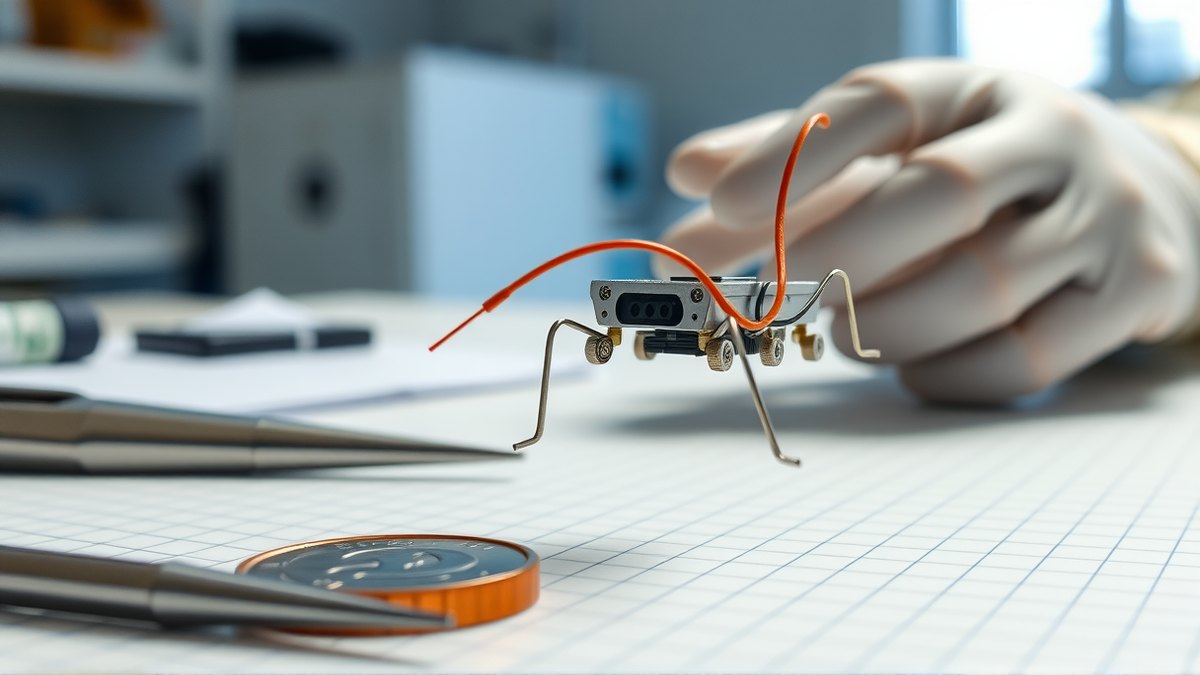
A robot the size of a finger that hops on its own. On 23 September 2026 researchers at the University of Washington presented a jumper weighing about one gram. It strings several jumps together and clears an ordinary stair step to within a centimeter. t3n and the university both reported on the system, called DirectHop.
How the jump works
A tiny electric motor and three folding legs drive the robot. The researchers say the jump height can be controlled to within one centimeter. That is what turns a series of jumps into a path you can steer, instead of a string of random hops. The prototype fits in a palm. When the robot falls over, a short, fast movement of the motor sets it upright again. In the tests that worked in 90 percent of cases.
Sawyer Fuller, associate professor of mechanical engineering at the University of Washington and lead author of the work, names three core problems: varying the jump distance, righting the robot and supplying energy again for the next jump. DirectHop solves all three with a completely new design, Fuller said. On-board power, control and navigation are the next tasks, he adds. Small walking robots are hard precisely because those three things have to work together. A device that jumps well once is not a working robot.
Why jump instead of fly
The researchers estimate that hopping is about two orders of magnitude more energy-efficient than flying. That matters for small powered robots, because the power supply is the hardest constraint. Every gram of battery comes at the expense of the mechanics. A comparison from biology makes the principle clear. A flea jumps about 50 times its own body height without spending energy the whole time. A mosquito, by contrast, hovers only as long as it applies force.
Classical mechanical engineering has solved the problem differently so far. Many jumpers are spring-loaded and released by latches. Springs and latches are hard to build and control at very small scales, and releasing a spring is an all-or-nothing process, so the jump distance can hardly be dosed. DirectHop therefore does without the spring entirely. It uses a very small electric motor that accelerates fast enough to trigger the jump directly. According to the university, the results were presented on 30 September at the International Conference on Intelligent Robots and Systems (IROS).
Possible fields of use
The tasks named are those where large machines are too expensive or too heavy: finding gas leaks in a refinery, monitoring water and fertilizer levels on farmland, or exploring unknown terrain. Extremely light, energy-saving robots are also discussed for exploring other celestial bodies.
For German robotics the approach is interesting above all for its method. Progress today comes less from larger motors than from the combination of precise control, mechanical simplicity and an energy calculation over the whole path. In practice, such systems can only be deployed if they survive operation without a constant hand.
Jumping costs about two orders of magnitude less energy than flying, and at a total weight of one gram that is decisive.
Sources
2- 01University of Washington: DirectHop – hopping robot hops where you need itEN
- 02t3n: Zentimetergenau – Kleiner Roboter kann ohne Probleme eine Stufe hochspringenDE
All figures and quotations in this text come from the sources listed below.
Content prepared by the editorial team with AI assistance.
Grace Okonkwo
Comments
0- No comments yet — be the first.