ENIAC and Manchester Baby: 30 tons, 5,000 solder joints and a program in memory
ENIAC cost 487,000 dollars, weighed more than 30 tons and had about five million hand-soldered connections. Three years later, a machine in Manchester ran the first program stored in memory.
 Helen MarshCulture, food and lifestyle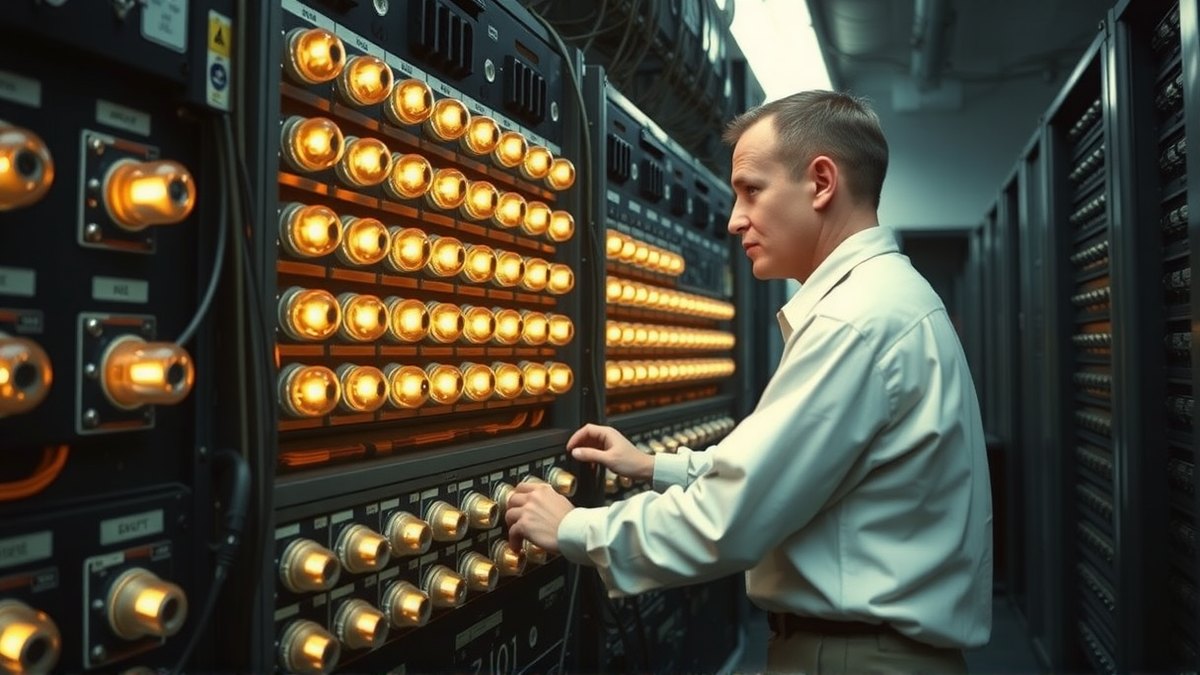
ENIAC, short for Electronic Numerical Integrator and Computer, was the first programmable, electronic, general-purpose digital computer. It was finished in 1945. John Mauchly and J. Presper Eckert designed it for the United States Army Ballistic Research Laboratory, which later became part of the Army Research Laboratory. The machine's first program was not artillery tables. It was a feasibility study of a thermonuclear weapon.
The idea for ENIAC took shape in June 1941, when the army was computing firing tables for artillery with Friden calculators and differential analyzers. Mauchly supervised the work. In August 1942 he proposed a fully electronic computing machine, and the army gave the University of Pennsylvania a six-month research contract worth 61,700 dollars. The construction contract was signed on 5 June 1943, and work began in secret at the Moore School of Electrical Engineering under the code name "Project PX", with John Grist Brainerd as chief engineer. Herman Goldstine persuaded the army to fund the project.
ENIAC was finished in 1945 and first put to practical use on 10 December 1945. The machine was formally dedicated at the University of Pennsylvania on 15 February 1946. It cost 487,000 dollars, the equivalent of about 7 million dollars in 2024, and the press called it a "giant brain". It ran on the order of a thousand times faster than electromechanical machines. The army formally accepted it in July 1946, and in 1947 it was moved to Aberdeen Proving Ground in Maryland, where it ran continuously until 1955.
How much of it there was
At the end of its service in 1955, ENIAC contained 18,000 vacuum tubes, 7,200 crystal diodes, 6,000 relays, 70,000 resistors, 10,000 capacitors and about 5 million hand-soldered connections. It weighed more than 30 short tons, or 27 metric tons, stood about 3 metres high, one metre deep and 30 metres long, occupied 28 square metres and drew 150 kilowatts. Input data went in on an IBM card reader and results came out on a card punch from the same company. Much of the programming fell to the women mathematicians: Jean Jennings, Marlyn Wescoff, Ruth Lichterman, Betty Snyder, Frances Bilas and Kay McNulty. In 1997 the six ENIAC programmers were inducted into the Women in Technology International Hall of Fame. In 1946 the researchers left the university and founded the Eckert–Mauchly Computer Corporation.
Manchester, 21 June 1948
The Manchester Baby, also called the Small-Scale Experimental Machine, was the first electronic computer with a program stored in memory. Frederic C. Williams, Tom Kilburn and Geoff Tootill built it at Victoria University of Manchester and ran the first program on 21 June 1948. The machine was not designed as a practical computing tool. It was a test bed for the Williams tube, the first truly randomly addressable memory. It had a 32-bit word and a memory capacity of 32 words, or 1,024 bits. Because it was meant to be the simplest possible computer with a stored program, the hardware implemented only subtraction and negation, and the remaining operations were carried out in software. The first of the three programs written for it determined the largest proper divisor of 2 to the power of 18, that is 262,144, testing every number downwards in turn. The program consisted of 17 instructions and ran for about 52 minutes before reaching the correct result of 131,072, executing roughly 3.5 million operations. That gives an effective speed of about 1,100 instructions per second. Once the Baby proved the design was feasible, the university started work on a full-scale machine, the Manchester Mark 1, which quickly became the prototype for the Ferranti Mark 1, the first commercially available general-purpose computer. Earlier, on 12 May 1941, Konrad Zuse publicly demonstrated the Z3, the first working programmable, fully automatic computer with binary arithmetic, but without the conditional branching characteristic of a Turing machine.
Sources
2All figures and quotations in this text come from the sources listed below.
Content prepared by the editorial team with AI assistance.
Helen Marsh
Comments
0- No comments yet — be the first.