Rail and wire: from 27 September 1825 to the telegraph that caught a murderer
The first public railway to run steam locomotives opened in County Durham. Twelve years later the first telegraph in regular service was strung along the tracks, and one of its messages led to the arrest of John Tawell.
 Naomi FeldmanCulture, food and lifestyle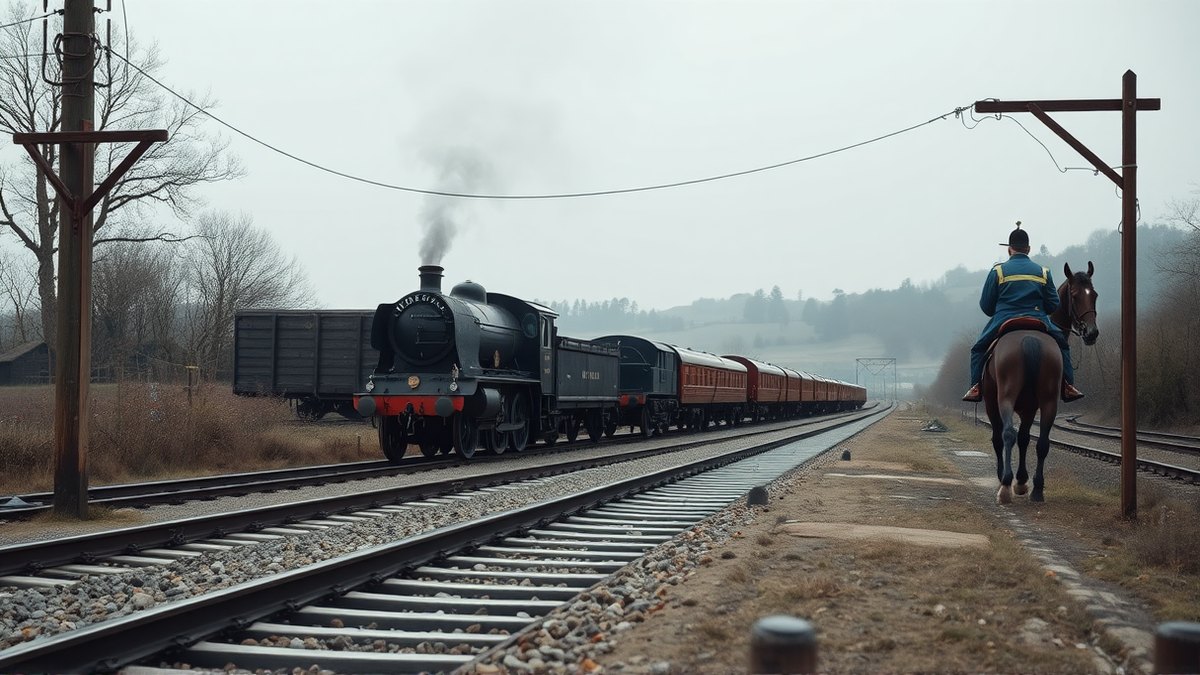
The Stockton and Darlington Railway ran in north-east England from 1825 to 1863 and was the world's first public railway to use steam locomotives. Its first line linked the collieries near Shildon with Darlington and Stockton in County Durham, and it opened officially on 27 September 1825. Hauling coal to the ports soon turned a profit, and the line was extended to the new port at Middlesbrough. Steam locomotives pulled the coal wagons from the start. Passengers, though, rode in horse-drawn carriages until 1833, when steam-hauled carriages came in.
The company helped build a stretch of the main east coast line between York and Darlington, but it grew mainly around the Middlesbrough docks, west towards Weardale and east towards Redcar. In the late forties of the nineteenth century it ran into serious financial trouble and was nearly taken over by the York, Newcastle and Berwick Railway. The discovery of iron ore in Cleveland, and the revenue that followed, saved it. In the early sixties of the nineteenth century the railway took over lines crossing the Pennines to the western main line at Tebay and Clifton. In 1863 the North Eastern Railway absorbed the company, taking over 200 miles of route, about 320 kilometres, and roughly 160 locomotives. Stockton and Darlington still ran independently as the Darlington section until 1876. The anniversaries of the opening were marked in 1875, 1925, 1975 and 2025.
Needles instead of code
The Cooke and Wheatstone telegraph was built in the thirties of the nineteenth century and was the first telegraph system to enter commercial service. The English inventor William Fothergill Cooke and the scientist Charles Wheatstone built it. The receiver was a set of needles that electromagnetic coils set moving, pointing to letters on a board. Early users liked that, because they did not want to learn codes. In January 1837 Cooke proposed a 60-code mechanical telegraph to the board of the Liverpool and Manchester Railway, but the board judged it too complicated: what was needed was a simple signal between the station in Liverpool and the winding-engine house of the haulage rope at the top of the incline beyond the long tunnel. Earlier, in 1836, Cooke had consulted Michael Faraday about the design.
The most successful Cooke and Wheatstone arrangement worked on the Great Western Railway line. The first installations used five needles and six wires over the thirteen miles from Paddington to West Drayton, and this was the world's first commercial telegraph. Because some of the wires lay in the ground and decayed, a two-needle system with more codes came in. For the first time in the history of telegraphy it required skilled operators, since the new code had to be learned rather than simply read off a board. When the line was extended to Slough in 1843, a single-needle, two-wire arrangement went in. Cooke also gave up cables in lead pipes in favour of uninsulated wires suspended on poles on ceramic insulators. He patented this solution and it quickly became the standard. The single-needle system remained in service as late as the thirties of the twentieth century.
The message that stopped a murderer
The Cooke and Wheatstone telegraph helped catch the murderer John Tawell. When it was established that Tawell had boarded a train to London, the telegraph sent a signal ahead to the terminus at Paddington, where he was arrested. The novelty of using the telegraph this way against crime brought it publicity and increased public acceptance of the new invention.
Sources
2- 01Stockton and Darlington Railway (Wikipedia, en)EN
- 02Cooke and Wheatstone telegraph (Wikipedia, en)EN
All figures and quotations in this text come from the sources listed below.
Content prepared by the editorial team with AI assistance.
Naomi Feldman
Comments
0- No comments yet — be the first.