Rejewski and Enigma: rebuilding the machine in 1932, handing it over in 1939
Marian Rejewski reconstructed the military Enigma without ever seeing one. He worked on it with Zygalski and Różycki for nearly seven years, and five weeks before the war broke out the Poles handed their results to the French and the British.
 Naomi FeldmanCulture, food and lifestyle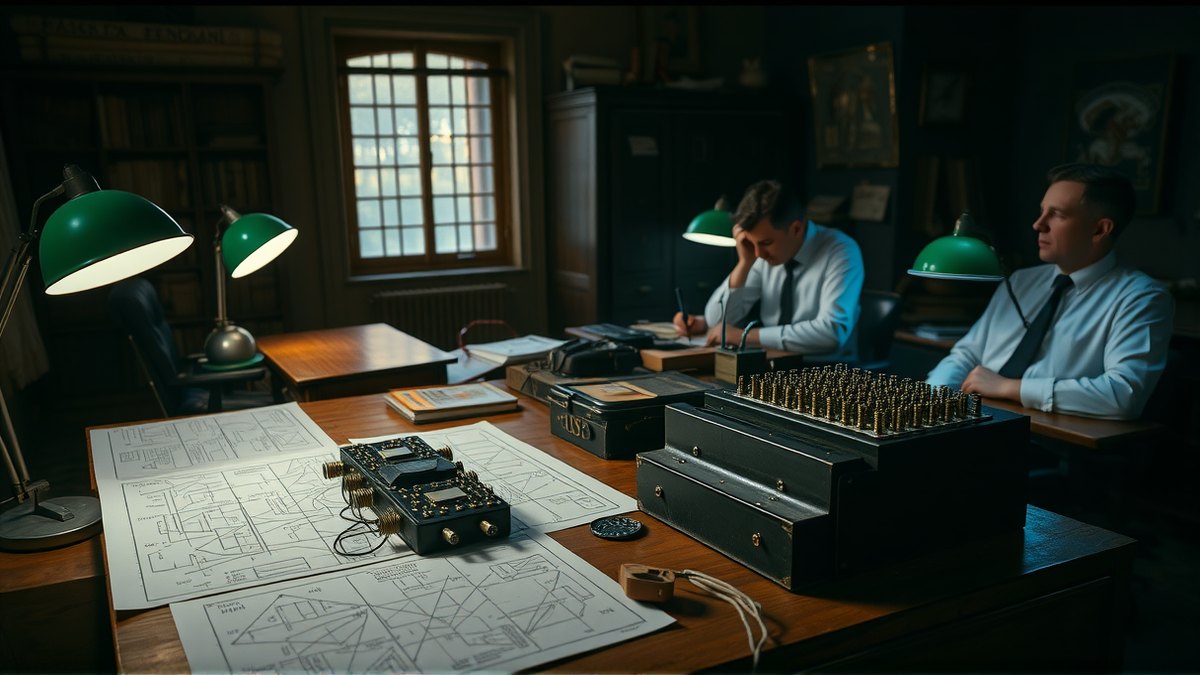
Marian Adam Rejewski was born on 16 August 1905 and died on 13 February 1980. He was a Polish mathematician and cryptologist. At the end of 1932 he reconstructed the German military Enigma cipher machine without having seen it. For nearly seven years afterwards he worked on it at the Cipher Bureau of the Polish General Staff, alongside two fellow mathematician-cryptologists, Jerzy Różycki and Henryk Zygalski. The three of them built techniques and equipment for breaking Enigma ciphers, even as the Germans kept changing the machines and the encryption procedures.
Rejewski was born in Bydgoszcz, then Bromberg in the Prussian province of Posen, the son of Józef and Matylda, née Thoms. After secondary school he studied mathematics at the Mathematical Institute of Poznań University, housed in Poznań Castle. In 1929, shortly before finishing his studies, he began attending a secret cryptology course. It had opened on 15 January for selected mathematicians who knew German, and the Cipher Bureau of the General Staff ran it. Afterwards the bureau hired some of the students for part-time work at its Poznań branch. On 1 September 1932 the twenty-seven-year-old Rejewski and two colleagues, mathematics graduates of Poznań University, Henryk Zygalski and Jerzy Różycki, were taken on by the bureau in Warsaw. Their first task was to reconstruct the four-letter German naval code. At the end of 1932 Rejewski was asked to spend a few hours a day breaking the Enigma cipher. His work on it may have begun in late October or early November 1932.
The method of characteristics
Rejewski drew on group permutation theory and on intelligence material from French sources, which came from the German spy Hans-Thilo Schmidt. By 1938 he had invented a device called the cryptologic bomb, and Henryk Zygalski developed his sheets, which made cipher-breaking more efficient. Rejewski also built a catalogue of cryptologic cards. The work on Enigma demanded tools the team had to make itself. All it had was theory and scraps of information about the machine.
Five weeks before the war
Almost five weeks before World War II broke out in Europe, at the end of July 1939, the Polish Cipher Bureau met its French and British counterparts at a conference south of Warsaw and passed on its Enigma-breaking techniques and technology. Neither the French nor the British had made any progress on the matter before that, and the handover let Britain begin reading German Enigma ciphers. What the British learned from decrypted messages became part of what was called Ultra. When Germany invaded Poland, key personnel of the Polish Cipher Bureau were evacuated through Romania to France. There they set up a radio centre, PC Bruno, with French backing.
After the war Rejewski returned to Poland and for two decades said nothing about his work, partly so as not to draw the attention of the Soviet-dominated authorities. In 1967 he broke his silence, giving the Military Historical Institute his recollections of working in the Cipher Bureau.
Sources
2All figures and quotations in this text come from the sources listed below.
Content prepared by the editorial team with AI assistance.
Naomi Feldman
Comments
0- No comments yet — be the first.