Food delivery: robots and drones could cut the cost to 1 dollar
Autonomous food delivery costs less than delivery by people, and the gap is set to widen sharply. Austria now charges 2 euro per parcel.
 Naomi FeldmanCulture, food and lifestyle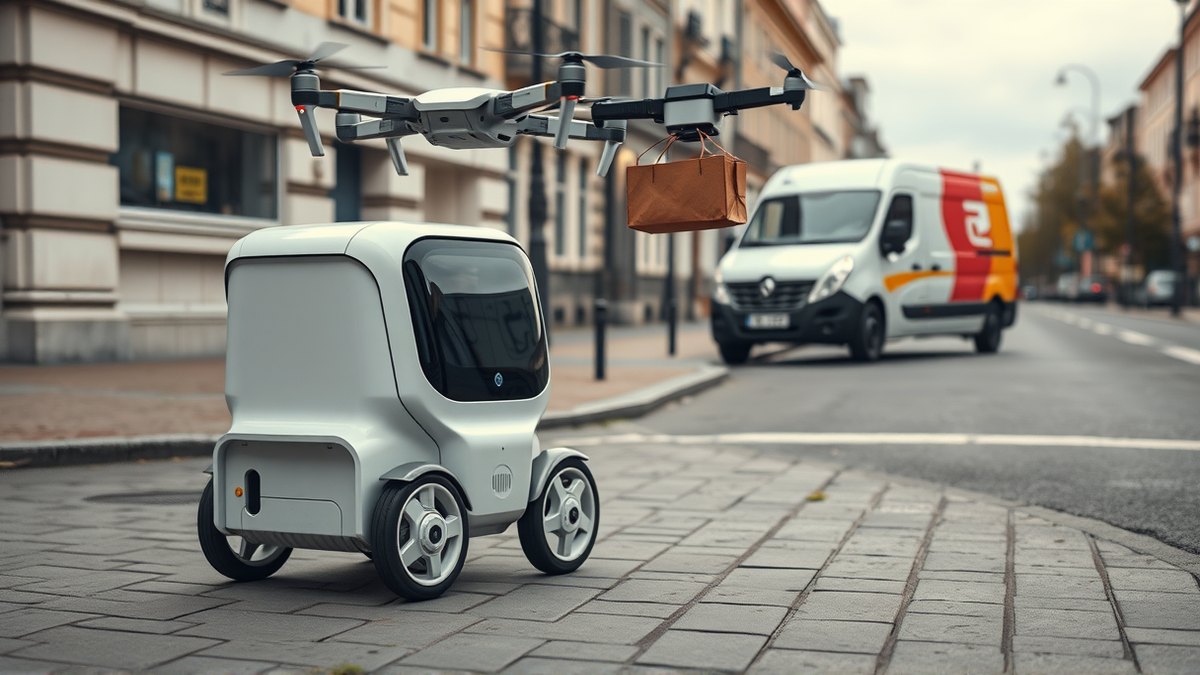
In April 2026 the German technology site heise.de summed up market analyses of delivery. Autonomous food deliveries cost less than those handled by people, and the cost gap is set to widen clearly soon. The headline was blunt: robots and drones could push the cost of a food delivery down to 1 US dollar.
The same site describes how the regulatory and commercial environment is shifting. Since 22 April 2026 Austria has charged 2 euro per parcel from online retail. That comes on top of the EU parcel customs duty for the EEA and the EU handling fee. For food sellers with delivery it is another fixed cross-border cost. Earlier, on 28 January 2026, Amazon announced it would close all Amazon Fresh and Amazon Go stores. Food is to be sold only online and in Whole Foods supermarkets.
Technology in the cold chain
A shorter chain also demands better quality control. On 18 June 2026 heise described an "electronic nose" that reliably identifies spoiled food and even detects allergens. It is accurate enough to beat a person checking the best-before date. Regulation is a separate thread. As the site notes, an online seller does not have to state the minimum shelf life before purchase, although on the packaging in a physical shop it is mandatory. Then the data: at the end of December 2025 the German nutrient database Bundeslebensmittelschlüssel 4.0 was released licence-free for more than 7 100 food products.
The Chinese version of mobile delivery
A trade fair in Beijing showed an alternative to the classic courier. As 凤凰网/环球时报 reports, queues formed in front of the mobile kitchen truck 京东七鲜小厨 in the Shougang Park complex. One worker ran three frying stations and turned out simple dishes in 2 to 3 minutes. Delivery and cooking merge into a single point: the vehicle stands where the people are instead of driving to them from a distant central kitchen.
Where the savings come from
The economics are simple. A driver's labour costs the same every time and it is rising. A machine's trip gets cheaper as the machines spread and the scale grows. The site points to the other side of the coin. If delivery gets down to a dollar, the delivery business stops being a logistics business and becomes a technology business, and the winner is whoever has the fleet and the data. For restaurants that means pressure on margins. For the consumer it raises a question: does the lower cost of delivery turn into a lower price, or into more orders?
A shop without staff and a kitchen at home
The same site shows that automation works beyond the last mile. In Norway, where workers are scarce, small shops have been run remotely via cameras. The outlet operates although it has no permanent crew, and it can keep long opening hours (heise, 20 February 2025). The kitchen project goes the other way. Described at the turn of 2025 and 2026, a sourdough fermenter on an RP2040 microcontroller with sensors and low-power heating elements holds a constant temperature at which sourdough rises best. These are two ends of the same phenomenon. Technology pushes people out of one point in the chain and brings them back at another, now as a tool in the home kitchen.
Sources
2All figures and quotations in this text come from the sources listed below.
Content prepared by the editorial team with AI assistance.
Naomi Feldman
Comments
0- No comments yet — be the first.