Chinese kitchen robots: exports hit $470 million, up 51 percent
China shipped $470 million worth of catering robots in 2025, 51.3 percent more than a year earlier. One worker runs three machines at once.
 Helen MarshCulture, food and lifestyle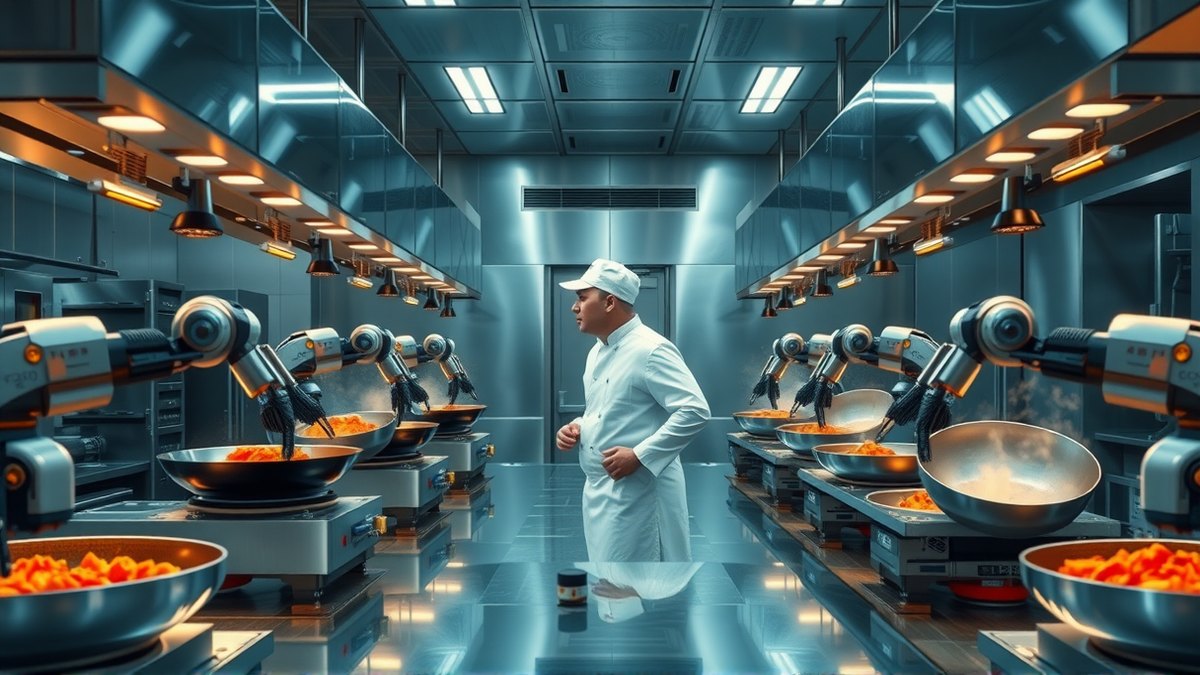
Catering robots took center stage at the CIFTIS 2026 services trade fair in Beijing. 环球时报, citing 凤凰网, describes a queue in front of an almost ten-meter-long mobile kitchen truck from 京东七鲜小厨, with the smell of fried pepper and meat in the air. One worker ran three machines. He picked the recipe for 炒土豆丝 (fried potato strips) on a screen, poured in the ingredients, and about three minutes later the dish was ready. "Fast dishes take two or three minutes, slower ones do not go past five," the operator says.
熙香科技 showed a different model. In a smart kitchen for companies, schools and hospitals, robotic arms and vision algorithms handle everything from the delivery of prepared vegetables to the cooking, synchronized with the production plan. City manager 云龙 says a canteen for 1 000 people serving nine dishes a day can run fully unattended. At the fair in Zhongguancun, visitors saw the 无界动力 K15 robot move between tables in a cafe, deliver coffee, collect waste and disinfect the countertop.
Exports and foreign markets
The Chinese industry is already exporting. The report 《全球及中国餐饮机器人产业投资咨询报告》 puts the export value of Chinese catering robots at $470 million in 2025, up 51.3 percent year on year. The main destinations are Southeast Asia, the Middle East and Europe. Reuters, cited by the newspaper, reports that unattended cafes, noodle bars and flower shops are spreading fast in South Korea, where their number reached about 9 000 at the end of 2024.
"A thousand shops, one taste"
At the same time, companies are racing for consistency of taste. 华声在线 describes robots from the brand 芯厨师 preparing pepper with meat in 2 minutes 17 seconds in Changsha, Hunan province, and a quick stir-fry in 1 minute 30 seconds. Founder 廖辉 brought the brand to market in 2021. In 2025 the team ran five product iterations and rolled out the fifth generation; today the main product is in its seventh. The devices work in more than 200 cities in China and more than 20 cities abroad, where they account for 15 to 20 percent of sales. The company points to the size of the vessel: a 50-centimeter cast-iron wok with a capacity of 23 liters that holds 5 kg of product at once, while most competitors handle 1.5 to 3 kg. Industry data cited by the newspaper say more than 60 percent of Chinese restaurant chains lost customers during expansion because the taste of their dishes was unstable.
The home version
The technology is also moving into the home kitchen. 人民网 reports that pre-sales began in Wuhan on 24 September 2026 for the fully autonomous CR3 kitchen robot from Haier. The device has a power of 3 500 W and keeps the wok temperature between 140 and 180 degrees Celsius, a range considered key to "wok hei," the Chinese flavor note. Haier built in more than 600 digital recipes and six nutrition systems, among them a low-sodium one for seniors and a high-protein one for people who train. A 2026 study by the agency 艾媒咨询 indicates, however, that the biggest weakness of the market remains the gap in taste and degree of searing compared with dishes prepared by hand.
Sources
3All figures and quotations in this text come from the sources listed below.
Content prepared by the editorial team with AI assistance.
Helen Marsh
Comments
0- No comments yet — be the first.