Honeywell's phase-change thermal buffer tested at Equinix's Ashburn AI facility
Equinix has tested and installed Honeywell Aerospace's Thermal Response Module at its Co-Innovation Facility in Ashburn, Virginia, Urban Acres reported on 3 November. The unit uses phase-change materials to hold coolant temperatures steady when GPU loads spike or power wobbles.
 Rachel NwosuAI, models and technology
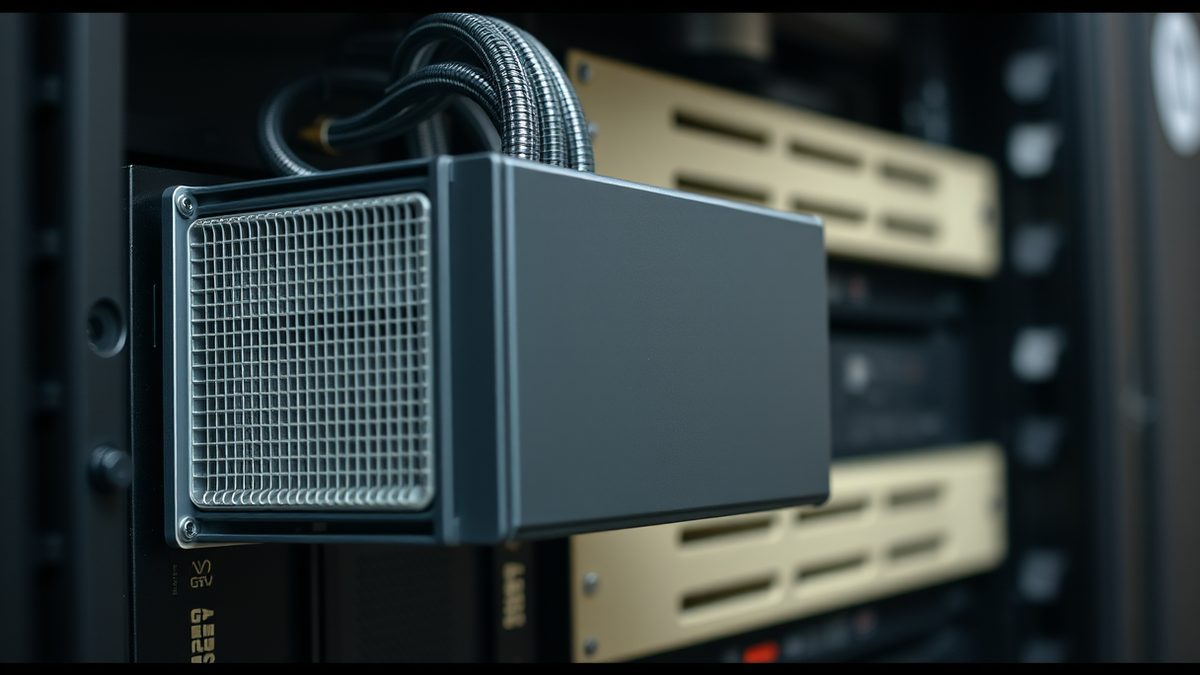
Aerospace thermal buffer lands in Ashburn
Equinix tested and installed the module at its Ashburn Co-Innovation Facility, which it uses for development and evaluation work. Honeywell Aerospace designed it for liquid-cooled AI infrastructure.
The Thermal Response Module acts as a thermal buffer inside a cooling loop. It sits between the coolant distribution unit and the servers and uses phase-change materials to store and release heat when needed. Honeywell says the unit delivers 7.6 times more cooling power than chilled water and stabilises the loop within seconds. It can be configured to provide several minutes of buffering, the company said. The idea is to hold coolant temperatures steady while the wider cooling system catches up. Onboard state-of-charge sensing is part of the package.
Pawel Wlodarczak, design innovation director for Global Design at Equinix, said the trial showed the module could handle rapid GPU cooling load swings. It needs a smaller footprint than buffer tanks, he said.
Honeywell says the module can be integrated into existing cooling loops without a redesign. It does not depend on a specific coolant distribution unit supplier or architecture, according to the company. That matters for operators who have already committed to a CDU vendor. Honeywell also frames the work as a crossover: thermal management built for aircraft and defence systems, applied to halls full of accelerators. Rich DeGraff, president and CEO of Control Systems at Honeywell Aerospace, said AI workloads create a comparable challenge in protecting mission-critical systems.
Why buffering matters as AI racks densify
Honeywell says brief cooling interruptions can damage expensive hardware. GPU performance can dip too.
The market numbers explain the interest. Omdia figures cited by Honeywell put liquid cooling in fewer than half of data centres, with the market expected to grow 20% a year over the next five years. Operators are moving to direct-to-chip cooling, where liquid runs through cold plates mounted on the processors. Hardware is moving faster than the plumbing. At OCP 2026 in San Jose, ASRock Rack showed a fully liquid-cooled NVIDIA Vera Rubin NVL72 rack carrying 72 Rubin GPUs. NVIDIA lists that rack at 3,600 PFLOPS of NVFP4 inference and 20.7TB of HBM4. Cooler Master used the same show to launch a 2.5 MW in-row CDU. It separates facility water from the IT coolant loop and supports central management of up to 32 interconnected units.
Denser racks leave less headroom for error in the loop.
A buffer does not add compute capacity. It changes what happens in the seconds after a power disturbance or a sudden jump in demand. Operators price that in service-level agreement risk, which Honeywell says the module can reduce. The same pitch applies to power: Honeywell says the module can help shift some power from cooling to computing.
Retrofits and measurement remain the hard part
Most existing halls were not designed with liquid in mind.
Data Center Knowledge reported on 2 November that retrofits are technically feasible but rarely simple. Supply and return lines have to reach servers through rooms already crowded with network and power cabling. Fully loaded AI racks can exceed 3,000 pounds, which strains the raised floors common in older sites. Mechanical plant may need new pumps, heat exchangers, water loops or dry coolers, and downtime is hard to avoid during the work. That is the gap the module targets.
Cost comparisons cut both ways. Matt Green, chief executive of HVAC firm Brucker, estimated an open-loop evaporative system can cost 60% to 70% less upfront than a closed-loop alternative with comparable heat-dissipation capacity.
Measurement is the other operational change. Liquid-side instrumentation now covers temperature, pressure, flow rate and level, plus leak detection and coolant health indicators such as pH, turbidity, conductivity and refractive index. Condensation is a specific risk, and a common practice is to keep coolant supply at least 2°C above the measured ambient dew point. Air-side management does not disappear either. Residual heat still has to be removed.
Deployment tools and next steps
Getting equipment to site has become a business of its own.
Technimove launched a Configuration Centre in London to receive, build, test and stage hardware before deployment. The facility covers rack integration, pre-cabling and GPU infrastructure assembly. Cooler Master, meanwhile, is offering a 300 kW air-assisted liquid cooling system aimed at facilities without dedicated water infrastructure. It uses modular radiator racks and hot-swappable components. Honeywell says its module can be scaled from edge deployments to larger AI clusters. Cooler Master manufactures in China and is expanding capacity in Vietnam.
What buyers still lack is the boring part: price and independent performance data. Neither company has said what the module costs. No broader deployment schedule appears in their statements either. Until third-party testing compares it with buffer tanks on real workloads, the 7.6 times figure remains a vendor claim.
Sources
14- 01AI Data Centre Cooling Gets Aerospace-Grade Thermal Buffer - Urban AcresEN
- 02Honeywell tests aerospace cooling module for AI data centres - DataCenterNews Asia PacificEN
- 03Liquid Cooling Retrofits: Hard, but Sometimes Worth It - Data Center KnowledgeEN
- 04Liquid Cooling Is Changing What Data Centers Need to Measure - Data Center KnowledgeEN
- 05OCP 2026: Cooler Master Scales Liquid Cooling from Cold Plates to 2.5 MW CDUs - Data Center FrontierEN
- 06Liquid-Cooled NVIDIA Servers at the ASRock Rack OCP 2026 Booth - ServeTheHomeEN
- 07Technimove Boosts Data Centre Deployments with London Centre - Data Centre MagazineEN
- 08Can Evaporative Cooling in Data Centers Still Make Sense? - Data Center KnowledgeEN
- 09 China deploys 'world's first' 800-volt DC power system for massive AI data center EN
- 10UK’s most polluting power plant could power country’s largest AI datacentreEN
- 11Tutor Intelligence raises Series B to scale model training, robot deploymentsEN
- 12ARIA’s Scaling Inference Lab Deploys Lumai’s Optical Compute TechEN
- 13 Astronauts deploy solar array on 100th US spacewalk by International Space Station crew members EN
- 14CATL signs deal with Germany's Intilion to deploy 3 GWh of sodium-ion storage over 5 yearsEN
All figures and quotations in this text come from the sources listed below.
Content prepared by the editorial team with AI assistance.
Rachel Nwosu
Comments
0- No comments yet — be the first.