How China's technology policy turned export controls into a supply chain weapon
China now accounts for roughly 90 percent of the world's battery production, and its EV exports arrived in Australia in June aboard a single ship carrying 5000 cars. Here is how Beijing built that position, and what Washington is trying to do about it.
 Dr. Amara PatelEconomy, business and world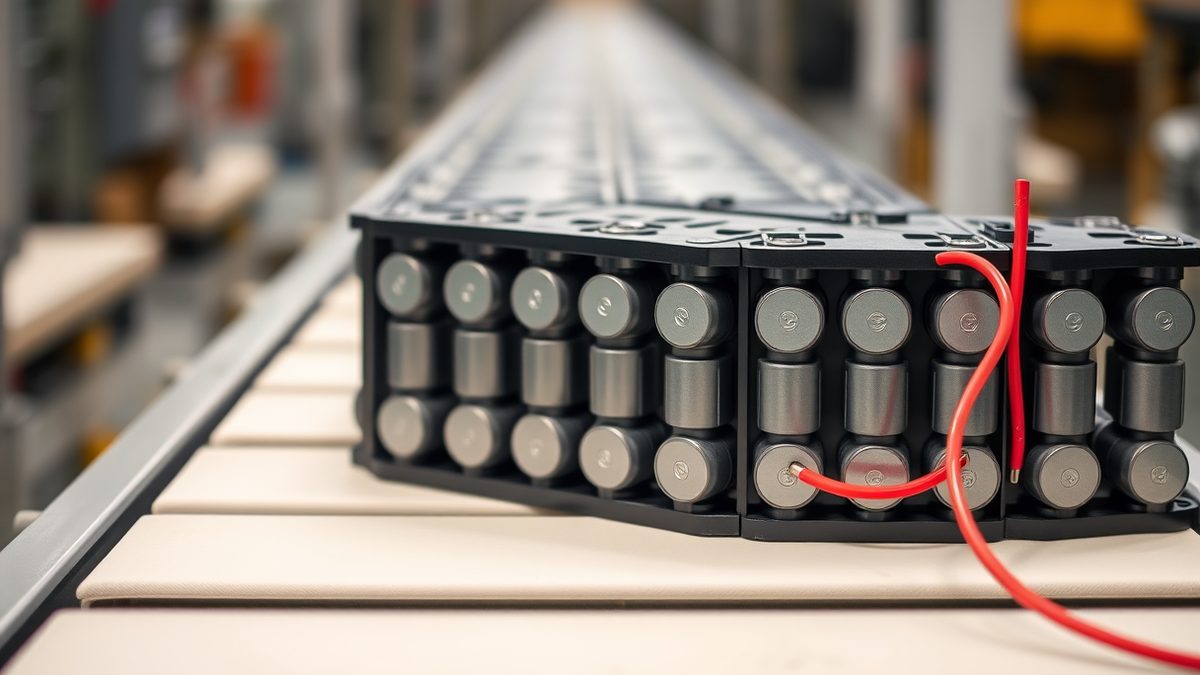
Two events, six weeks apart, frame the technology competition between Washington and Beijing. In June, a purpose-built LNG-powered bulk carrier called the BYD Zhengzhou docked at the Port of Melbourne on its first voyage to Australia, carrying 5000 newly built electric vehicles. RNZ republished an analysis by ABC News chief business correspondent Ian Verrender, who called it the largest single EV shipment ever sent to Australia.
Then in late August 2026, the Trump administration declared a national emergency that essentially bans Chinese batteries from grid-scale energy storage systems, MIT Technology Review reported on 10 September. The order bans installation of "any foreign-produced bulk-power system electric equipment" that poses a national security risk. It names battery energy storage systems, inverters and transformers.
Same technology. Two very different responses.
What China actually built
The Chinese position did not appear overnight, and it was not purely a private sector achievement. According to the RNZ analysis, Beijing forged a strategic policy on electric vehicles as far back as 2000, poured cash and financial incentives into the project in 2009, and encouraged battery firms such as BYD to move into automobile manufacturing. The stated motives were twofold: reduce China's reliance on imported oil, which made it captive to foreign powers, and cut pollution.
Alongside the vehicle push, China ran a parallel strategy of dominating the refining and production of industrial metals. The RNZ piece notes that in addition to steel, China dominates minerals essential to battery production including lithium, cobalt, manganese and graphite, and churns out almost all the world's anode and cathode production. South Korea concentrated on the more expensive nickel-magnesium-cobalt battery chemistry. China opted for the cheaper lithium-iron-phosphate version. On the RNZ account, China now accounts for 90 percent of the world's battery production.
That figure matters more than any single model launch. It means that even when a non-Chinese company designs a competitive product, the cell inside it, the processed minerals behind the cell and the refining capacity that produced them are frequently Chinese.
The Australian test case
Australia functions as an international auto industry litmus test. It has had no domestic car industry since its demise a decade ago and little in the way of trade barriers, which makes it a useful gauge of consumer taste. And the taste has shifted fast.
In the first half of 2026, sales for every major Japanese auto manufacturer bar Honda sank, according to RNZ. Mazda shed 17 percent compared with the same period last year, Toyota was down 21 percent, Subaru and Mitsubishi dropped 25 percent each, and Nissan was off 32 percent. Each Chinese supplier, meanwhile, notched spectacular gains off a much smaller base, which exaggerates the percentages: BYD sales jumped 124 percent, Chery leapt 77 percent, and Geely soared 495 percent.
"It costs around $40,000. It's quiet, it's comfortable, drives well and is loaded with technology," said Riz Akhtar, founder of the research group carloop, describing his own Chinese-made EV. He told RNZ the equivalent Japanese- or European-built vehicle would be more than 25 percent more expensive, and added: "Consumers aren't stupid. They're not going to spend money they don't need to."
Last month, almost a quarter of all cars sold in Australia were fully electric, up from just 7 percent a year earlier. Add in hybrids, and EVs are now neck and neck with petrol- and diesel-fuelled automobiles. Toyota vice-chairman Koji Sato has called for greater cooperation between Japanese producers to streamline production and lower costs. At an annual supplier meeting in March he said: "Unless things change, we will not survive."
In Europe, Volkswagen chief Oliver Blume has foreshadowed staff lay-offs of up to 100,000 workers, according to RNZ, after years in which the company dropped the ball on technology. VW's share price has halved since his predecessor was axed four years ago, under pressure from Donald Trump's tariffs and China's rapid march to auto industry dominance.
The AI front, and the split it caused
If batteries and EVs are the mature front of this competition, artificial intelligence is the live one. The trigger was Kimi, a free, open source model that Chinese AI company Moonshot launched in July 2026. According to MIT Technology Review, it appears to rival the intelligence of models from OpenAI and Anthropic.
The reaction in Washington was not a single response but a public argument. David Sacks, Trump's AI and crypto "czar" until March, branded Anthropic's models as "lobotomized" and "woke" and criticised top AI companies that "want the government to eliminate their open source competition." Emil Michael, a top Pentagon official, called OpenAI's new head of strategic futures a "supreme village idiot." Dean Ball, a former Trump AI advisor now working for OpenAI, criticised a new White House review process that vets AI models' security before release as a "de facto licensing regime for frontier AI."
The dividing line is whether cheap Chinese open-weight models are a threat to be blocked or a price collapse to be welcomed. Chip manufacturers see revenue opportunities from increased AI usage, and tech companies worried about OpenAI and Anthropic's dominance lean toward openness. Anthropic and OpenAI, facing profit pressure from free alternatives, argue Chinese-made models pose security risks. The Guardian reported on 1 August that Treasury secretary Scott Bessent suggested the US could sanction Chinese AI firms over alleged intellectual property theft, while commerce secretary Howard Lutnick received letters from startup founders asking him not to cut off access to open models. Microsoft, Nvidia, Palantir and Meta published a letter urging lawmakers to refrain from restricting open models, and Nvidia chief executive Jensen Huang went to Capitol Hill to lobby in support of them.
Trump's own position, as quoted by the Guardian, was cautious in both directions: "We have to be careful in both ways. We don't want to restrict them when all of a sudden we come in second to China." He added: "I know many of these people. I don't want to restrict them from doing great work."
The standards fight nobody televises
Less visible than model launches is a slower contest over technical and legal standards, which is where China's policy has been most deliberate. Writing in The Conversation, a China expert and open-source researcher describes how the Chinese government made open-source development part of its national technology strategy, supporting domestic platforms such as the state-guided OpenAtom Foundation and Gitee, a Chinese alternative to GitHub.
The licensing details are where this gets concrete. Major Chinese AI models such as Qwen, DeepSeek, Kimi and GLM are generally open-weight rather than open-source, meaning the model software and its final parameters are available but not the training data and methodology. Moonshot's Kimi K3 licence requires licensees exceeding specific revenue or user thresholds to "prominently" display the Kimi model name, while MiniMax M3's community licence lists uses prohibited by "applicable laws or regulations," raising questions over which jurisdictions apply. Bilingual licences developed under Chinese government guidance, including the Mulan Permissive Software License version 2.0 and the OpenAtom Model License version 1.0, are written in English and Chinese, but the Chinese version prevails in cases of conflicting interpretation, especially in Chinese jurisdictions.
Chinese models are also designed to align with government censorship and propaganda, according to the same article. That is a real risk for foreign users, and it sits alongside the more familiar accusation from Anthropic and OpenAI that Chinese open-weight model makers engage in large-scale, unauthorized distillation, a technique used to copy proprietary AI models. The Trump administration announced efforts to curb the practice in April 2026.
What the battery ban costs
The US is not idle on the supply chain side. Import taxes for batteries increased to 25 percent in January, up from 7.5 percent, and new legislation requires that starting in 2026, 55 percent of the cost of materials used for new energy storage projects must come from outside China and other restricted countries or the projects will not qualify for tax credits.
The August executive order goes further, and analysts quoted by MIT Technology Review expect it to slow deployment of grid-connected storage in the near term. Shan Tomouk of Benchmark Mineral Intelligence called the outright ban "a bit of a surprise" that "does create a bit of concern for domestic players in the US." BloombergNEF analysis suggests projects could face delays as developers wait for clarity, and Isshu Kikuma, an energy storage analyst there, said some may need to find alternative cell sources that will likely be more expensive than Chinese imports. "Worst case, those projects could get canceled," he said.
Domestic capacity is coming. New factories from LG Energy Solutions, Samsung SDI, Ford and SK On are set to come online or ramp up by next year, and a slowing EV market is pushing some plants originally designed for vehicle batteries to retool for grid storage. But MIT Technology Review reports the US may not have enough capacity to meet its own demand until about 2030, and possibly not until later in the 2030s if factories fail to run at full capability. US-made batteries remain significantly more expensive than Chinese ones, and even switching to imports from South Korea would likely cost more.
That is the shape of the problem in 2026. The cheap technology exists, it is largely Chinese, and cutting it off means paying more for a slower build. The alternative is depending on a single supplier for the hardware the grid runs on.
Sources
5- 01How China won the car wars with cheap EVs loaded with technologyEN
- 02China's AI models have Trump's AI world at war with itselfEN
- 03China's tech advances are causing chaos from Silicon Valley to the White HouseEN
- 04China is shaping the future of open-source technology, including AIEN
- 05Can the US battery market untangle from China?EN
All figures and quotations in this text come from the sources listed below.
Content prepared by the editorial team with AI assistance.
Dr. Amara Patel
Comments
0- No comments yet — be the first.