Humanoid robot factory push meets a data problem
Innodata opened a motion capture lab on 30 September to generate training data for humanoid robots, the same day Inbolt closed an 11 million euro round for robot vision and MindOn shipped a model it says cuts inference latency from 82ms to 32ms.
 Rachel NwosuAI, models and technology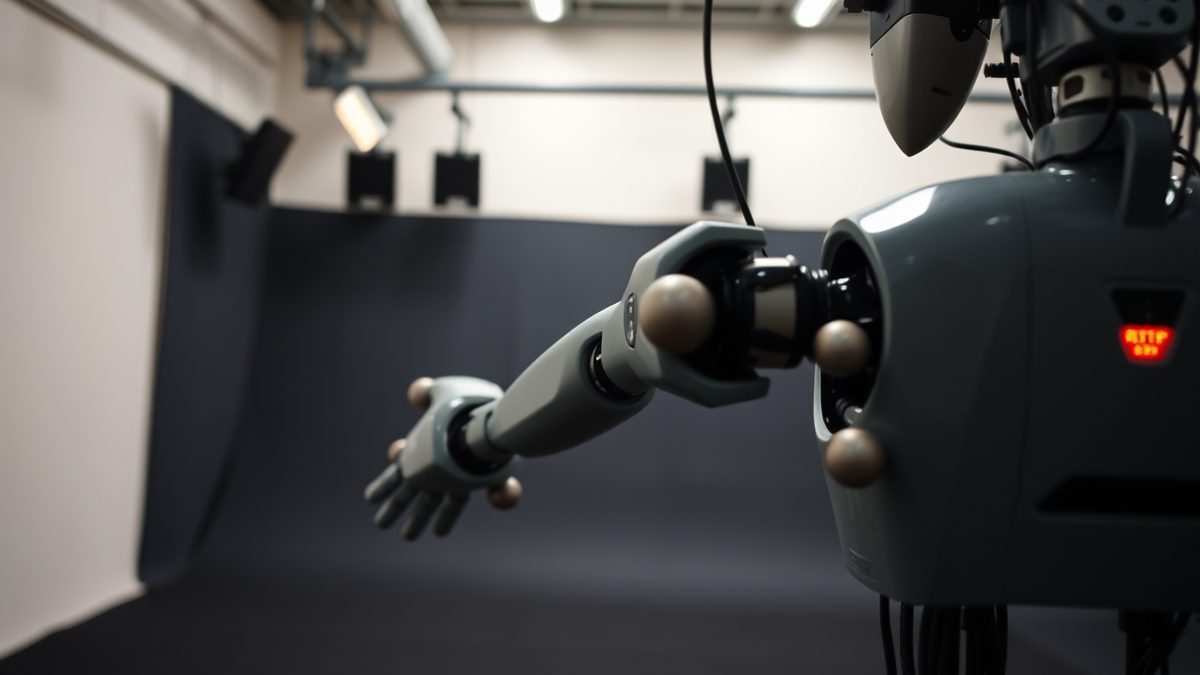
On 30 September, New Jersey data engineering firm Innodata opened a research and development laboratory for 3D motion capture for robots. The facility will record movement directly from human and mechanical bodies. It will also validate, independently, the performance data robots generate internally, according to The Robot Report, which broke the story on 30 September.
It is a small building with a large claim attached: the bottleneck in physical AI is not motors, not hands, not actuators. It is data.
"Physical AI is growing faster than any other segment in AI, but every robotics team hits the same wall: There isn't enough real-world interaction data, and what exists is expensive and slow to produce," Innodata CEO Rahul Singhal said in a statement reported by The Robot Report. The company said the facility covers data collection through model evaluation. It will capture motion across humanoids, teleoperated hardware, wearable systems, sensor rigs and Universal Manipulator Interface grippers. Innodata, founded in 1988, argues that while large language models fed on the open internet, robots have no equivalent corpus for the physical world. Franklin Tanner, its vice president of robotics and physical AI, told The Robot Report that physical AI "has to earn its tokens one interaction at a time." Tanner also made the case against inference-based motion capture. There is "no substitute for direct 3D motion capture," he said, and computer vision models working from 2D pixels inevitably make mistakes. The lab's sensors, he said, are built to register the tiniest motion of every joint.
That argument is not new. It is, however, now being funded.
Also on 30 September, Paris-based Inbolt said it had raised 11 million euros to expand internationally and move into data centre and electronics manufacturing, Tech.eu reported. New investor Shift4Good led the round, with Bridges Climate Transition Partners and existing backers BNP Paribas Developpement and Ora Global participating. Total funding now stands at 30 million euros. Inbolt, founded in 2019 by Rudy Cohen, Albane Dersy and Louis Dumas, sells a hardware-agnostic AI software layer combined with 3D vision. The system lets robots adjust their control loops in real time when parts arrive misaligned or tooling wears. It runs on more than 200 robots in over 100 factories across three continents, with customers including Bosch, Beko, Flex, Ford, Stellantis and Toyota, according to Tech.eu. The company's pitch: factories can upgrade existing lines rather than replace them.
Then there is speed. MindOn published a technical post on 30 September introducing Mind-1, a physical AI model it says brings robot task execution to human-level cycle times. The company reported cutting inference latency from 82ms to 32ms. At an end-effector speed of 3 metres per second, it argued, just 10ms of latency corresponds to roughly 3cm of movement, enough to break precise grasping or insertion. MindOn also flagged a less obvious problem: much robot manipulation data comes from teleoperation, which is slower than natural human motion. Models learn the tempo of their demonstrations along with the task.
Three announcements, one day, one shared premise. Capability demos are no longer the hard part.
A technical report from Fig Inc., also published on 30 September, complicates the picture in a useful way. Researchers Yangyue Wang, Harshvardhan Sikka, Pranav Guruprasad and Sudipta Chowdhury evaluated frontier models including Astra and Opus 5.5 across web automation and four physical domains: Bench2Drive, VLABench, IndEgo and Assembly101. Benchmark averages hide enormous task-level variance, they found. In every model pair they tested, the weaker model solved at least one task the stronger one missed. A model update could leave the average almost unchanged while flipping many individual tasks. They released a dataset called RIDGE with item-level results and model traces.
Read that alongside the factory numbers and the picture shifts again.
The context for all of this is a manufacturing base that is already automated, and mostly not humanoid. More than five million robots now work in factories worldwide, and only thousands of them are humanoids, according to reporting summarised in recent industry coverage. The same coverage notes that China's UBTECH opened a facility in September with a stated capacity of one humanoid every ten minutes, and that Hyundai has been scaling Atlas production and deployment while opening a training centre at its Georgia plant. Japan wants 10 million AI robots by 2040, TechRadar reported on 30 September. Korea's SFA signed an MOU with Rainbow Robotics in a push for unmanned factories by 2030, per Korea JoongAng Daily.
Not every robot in that build-out will be a humanoid. Mark Cuban has argued human-shaped robots will fail within a decade, a position he repeated in recent days, while IEEE Spectrum published robotics experts' assessments of Tesla's Optimus. Tesla's own supply chain is under strain elsewhere. On 30 September, Electrek reported that Tesla's planned Texas solar factory has been dragged into a US patent lawsuit between Chinese equipment makers Linton Crystal Technologies and Zhejiang Jingsheng, over the Czochralski pullers needed for the ingot-growing step of Tesla's solar plans. Tesla is not a party to the suit.
That story matters here for a structural reason. The humanoid supply chain and the solar supply chain are not the same, but the failure mode is: a single specialised component, sourced from a small number of vendors, sitting at the front of a very long production plan.
Which brings the argument back to data. Innodata's Tanner gave The Robot Report a concrete example of why context is hard to encode. A robot told to pick up a mug can grip the handle or the base. Both are mechanically valid, but if the mug holds hot liquid one of them burns the hand. That kind of distinction is rarely present in existing datasets. Inbolt's customers face a related problem in real production, where a misaligned part can stall a robot or produce defective output, and where the cost shows up as downtime rather than a failed demo. MindOn's latency arithmetic is the third face of it: at speed, small perception and control errors stop being small.
The money is moving accordingly. Inbolt's 11 million euros is modest next to the capital flowing into humanoid hardware, but it is aimed at the installed base rather than at new humanoids. Innodata is selling measurement and evaluation, not robots. Arrowfly, the parent company of The Robot Report, launched an AI for Engineers platform on 30 September aimed at exactly this audience of practitioners. It cited more than 30,000 engineering professionals already engaging with AI topics across its portfolio, 2.1 million verified industry readers and a conference scheduled for 20 to 22 September 2027 in Henderson, Nevada. It is a media business, not a robotics one, but it is a reasonable proxy for where attention and budget are going.
One caveat worth stating plainly. Much of the humanoid factory capacity being announced is capacity, not output. Names, dates and unit targets circulate faster than shipped units, and the gap between a factory opening and a factory running at rate is usually measured in quarters, sometimes years. The dossier gives no verified production figures for any humanoid line, and none should be inferred from announced capacity.
What the dossier does show, across eight sources published in the last three days, is a market converging on the same diagnosis from different directions. Innodata wants to sell the training data. Inbolt wants to sell the perception layer that lets existing arms cope with variation. MindOn wants to sell speed. Fig's researchers want to sell a more honest benchmark. None of them are selling the robot.
Sources
8- 01Innodata opens motion-capture lab to help humanoids move more like peopleEN
- 02Inbolt raises €11M to bring real-time vision and intelligence to industrial robotsEN
- 03Mind-1: Cutting robot inference latency from 82ms to 32msEN
- 04How Do Astra and Opus 5.5 Perform on Robotics and Web TasksEN
- 05The Robot Report parent Arrowfly launches AI for Engineers platform, events for engineers navigating AIEN
- 06Tesla's solar factory dragged into patent war between Chinese suppliersEN
- 07Tesla Robotaxi fleets are the new crypto treasury for zombie companiesEN
- 08What 30k robot dogs taught me about degrees of freedom, shipping a real productEN
All figures and quotations in this text come from the sources listed below.
Content prepared by the editorial team with AI assistance.
Rachel Nwosu
Comments
0- No comments yet — be the first.